
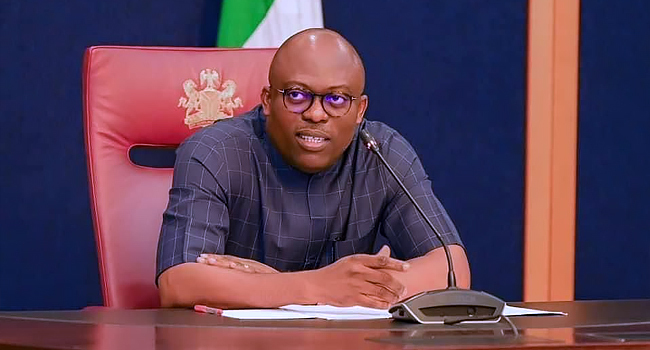
Rivers State Governor, Siminalayi Fubara, has said he is ready to work with members of the State House of Assembly, including newly elected lawmakers, as part of efforts to restore political stability and strengthen governance in the oil-rich state.
The governor made the pledge while congratulating winners of the recent bye-elections in Ahoada East and Khana constituencies, urging them to focus on development and service to the people.
The Independent National Electoral Commission conducted the polls on February 21 to fill vacant seats in the Rivers Assembly, with candidates of the All Progressives Congress emerging victorious in both constituencies.
According to Fubara, the outcome of the elections reflects the will of the people and the strength of democracy in the state.
“It is the beauty of democracy. When the people believe in your capacity, they will give you their votes,” the governor said.
He added that he looks forward to collaborating with the new lawmakers and their colleagues in the Assembly for the progress of Rivers State.
The governor also praised residents of the affected constituencies for maintaining peace before, during and after the elections, describing their conduct as a sign of political maturity.
The latest statement comes at a time when Rivers State is gradually emerging from a prolonged political crisis that drew national and international attention.
The crisis, which began shortly after Fubara assumed office in 2023, created deep divisions within the political leadership of the state and led to repeated clashes between the executive and legislative arms of government.
The conflict was widely linked to a power struggle between the governor and his predecessor, Nyesom Wike, who later became Minister of the Federal Capital Territory.
Political tension escalated as lawmakers loyal to the former governor moved to challenge Fubara’s authority, leading to impeachment threats and institutional breakdown.
The situation worsened in 2025 when President Bola Tinubu declared a state of emergency in Rivers State, suspending the governor, his deputy and the House of Assembly.
The decision followed months of political instability, pipeline vandalism and fears that the crisis could threaten national economic and security interests.
Rivers State is a major oil-producing region and a key contributor to Nigeria’s revenue, making political stability in the state a national priority.
Following the emergency rule, a retired naval chief, Vice Admiral Ibok Ekwe Ibas, was appointed as sole administrator to restore order and ensure governance continued.
The emergency rule was lifted in September 2025, allowing elected officials to return to office and resume their constitutional roles.
Since his reinstatement, Fubara has consistently called for dialogue and unity among political stakeholders.
Observers say his latest comments reflect a renewed effort to ease tensions and build working relationships with lawmakers across party lines.
The governor’s move is seen as strategic, especially as political alignments in Rivers continue to shift ahead of the 2027 elections.
Analysts also note that cooperation between the executive and legislative arms is critical for development, budget approval and implementation of key projects.
Fubara’s administration has been focusing on infrastructure, economic reforms and peace-building since returning to office.
One of the major projects initiated under his leadership is the Port Harcourt Ring Road, which is expected to improve traffic flow and support economic growth in the state.
Political watchers say the governor’s approach reflects a broader effort to stabilise governance and reassure investors.
The bye-elections themselves were viewed as a test of political control in the state and a measure of public confidence in democratic institutions.
The peaceful conduct of the elections has been welcomed by stakeholders, including civil society groups and election observers.
Many Nigerians believe that continued political stability in Rivers State is important not only for the region but also for the country’s economy.
Nigeria relies heavily on crude oil exports, and any disruption in oil-producing areas often affects national revenue, foreign exchange earnings and global energy markets.
The crisis in Rivers had earlier raised concerns among international partners and investors, especially given the importance of the Niger Delta in global oil supply.
Experts say political tension in the region could also affect security and community relations.
In recent years, pipeline attacks and oil theft have been linked to political and economic grievances in the Niger Delta.
For this reason, efforts to maintain peace and stability remain a key priority for both the state and federal governments.
Fubara’s message of cooperation also aligns with calls from national leaders and traditional rulers for unity in the state.
Since his return to office, he has been engaging stakeholders, including political leaders, community groups and security agencies.
The governor has also emphasised that development and governance must remain the focus, rather than political rivalry.
He urged newly elected lawmakers to represent their constituents with integrity and transparency.
According to him, the trust given to them by voters must be honoured through effective service and lawmaking.
The governor said the Assembly and the executive must work together to address key challenges facing the state.
These include unemployment, youth restiveness, environmental degradation and infrastructure gaps.
Observers say such cooperation could help accelerate development projects and improve the living conditions of residents.
The peaceful conduct of the elections and the governor’s conciliatory tone have raised hopes that Rivers State may finally move beyond its recent political crisis.
However, analysts caution that lasting peace will require sustained dialogue and commitment from all political actors.
The coming months are expected to test whether the fragile calm in the state can be maintained.
For many residents, the priority is stability, economic growth and improved welfare.
Fubara’s pledge to work with lawmakers is therefore seen as a positive step toward rebuilding trust in governance.
As Rivers State moves forward, the focus will remain on strengthening democratic institutions, promoting unity and ensuring that political competition does not undermine development.
For Nigeria, the success of peace efforts in Rivers State could serve as a model for resolving political conflicts in other regions.
The governor’s message also highlights the importance of collaboration, democratic maturity and respect for the will of the people in building a stronger and more stable country.

