
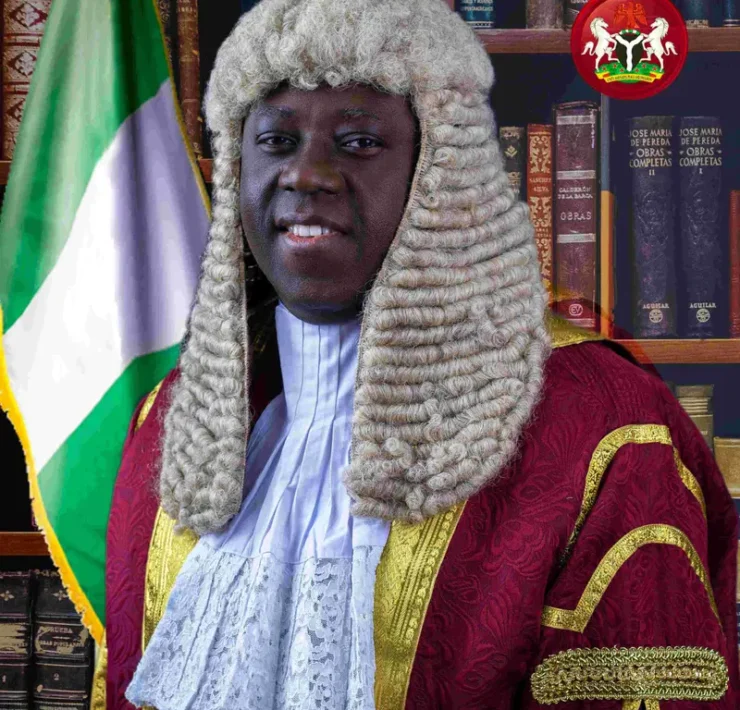
The Supreme Court of Nigeria has returned to its full constitutional strength following the swearing-in of Justice Joseph Olubunmi Kayode Oyewole by the Chief Justice of Nigeria, Justice Kudirat Kekere-Ekun, in Abuja on Wednesday.
The ceremony, held at the Supreme Court complex, restored the apex court to its full complement of 21 justices as provided by the 1999 Constitution, marking a major step in efforts to improve justice delivery and reduce the growing backlog of cases.
The development comes at a time when Nigeria’s judiciary is under pressure to speed up the handling of election disputes, commercial cases, and constitutional matters that have increased in recent years.
Strengthening the apex court
Speaking at the ceremony, the Chief Justice said the restoration of the full bench carried “added institutional importance” and would improve the court’s capacity to handle complex legal issues.
She noted that a full complement of justices would allow the court to sit in more panels and deal with pending cases more efficiently.
According to her, the Supreme Court plays a critical role in shaping the country’s legal system and democratic process.
The CJN stressed that the authority of the court rests on the quality of its reasoning, the integrity of its processes, and the professionalism of the judges.
She described the appointment of Justice Oyewole as a recognition of his experience, legal scholarship, and dedication to the rule of law.
She said his judicial record showed independence of thought, clarity in legal reasoning, and strong understanding of evolving social and legal realities.
She added that these qualities were necessary for the work of the Supreme Court, where decisions often have far-reaching consequences for the country.
Background of the new justice
Before his elevation, Justice Oyewole served as a Justice of the Court of Appeal and was the Presiding Justice of the Enugu Division.
He was recommended for the position by the National Judicial Council as part of a broader effort to strengthen the judiciary and fill vacancies created by the retirement of senior judges.
Legal analysts say his appointment reflects a continued focus on appointing experienced jurists to the country’s highest court.
They also believe the move will enhance the court’s ability to deliver fair and timely judgments.
Why the full bench matters
The Supreme Court is the final court of appeal in Nigeria.
Its decisions are binding on all other courts and institutions.
Experts say having the full number of justices is essential for the smooth functioning of the legal system.
When the number of judges drops due to retirement or delays in appointments, the court struggles to cope with the volume of cases.
This leads to delays in justice delivery.
Some cases, including election petitions and commercial disputes, can take years to conclude.
Legal practitioners have repeatedly raised concerns about case backlog and slow judicial processes.
They argue that timely appointment of justices is critical to improving efficiency.
The CJN also said numerical completeness enhances intellectual diversity and strengthens the stability of judicial decisions.
She emphasised that the Supreme Court’s pronouncements affect not only the parties involved but also future generations.
Judiciary under pressure
Nigeria’s judiciary has faced growing pressure in recent years due to increasing litigation in areas such as elections, corruption, and constitutional disputes.
The country’s political system has made the courts central to resolving electoral conflicts.
Following every general election, the judiciary handles hundreds of petitions.
Many of these cases eventually reach the Supreme Court.
The growing complexity of commercial and financial transactions has also increased the number of high-value cases.
Experts say this trend will continue as Nigeria’s economy expands and global investors demand stronger legal protections.
The judiciary is also playing a bigger role in governance as citizens increasingly turn to the courts to challenge government decisions.
This has further increased the workload of the apex court.
Calls for judicial reform
The appointment has revived discussions about broader reforms in Nigeria’s judicial system.
Lawyers and civil society groups have called for increased funding, better infrastructure, and improved working conditions for judges.
They also want the use of technology to speed up hearings and reduce delays.
Some experts have suggested the creation of additional appellate courts or specialised courts to ease pressure on the Supreme Court.
Others believe the solution lies in improving case management and alternative dispute resolution.
The CJN has repeatedly emphasised the need for innovation and efficiency in the justice system.
Observers say the restoration of the full bench is a positive step but must be supported by wider reforms.
Importance for democracy
Legal experts say a strong and independent judiciary is essential for democracy.
The Supreme Court often decides cases involving elections, constitutional interpretation, and disputes between government institutions.
Its rulings can shape the country’s political direction.
The court has delivered several landmark judgments in recent years that affected governance and public policy.
These include cases on electoral outcomes, legislative authority, and federal-state relations.
Observers say public confidence in the judiciary depends on transparency, fairness, and speed.
They argue that delays and perceived bias can weaken trust in democratic institutions.
Reactions from stakeholders
Many lawyers welcomed the swearing-in, saying it would improve the administration of justice.
They said the full complement of justices would help reduce delays and enhance the quality of decisions.
Some legal scholars also praised the judiciary for maintaining professionalism despite political and economic pressures.
However, they stressed the need for continued reforms.
Civil society groups urged the government to ensure adequate funding for the judiciary.
They also called for transparency in the appointment of judges.
The bigger picture
The restoration of the full bench comes at a critical time for Nigeria.
The country is undergoing major economic and political reforms.
These changes often lead to legal disputes that eventually reach the courts.
Experts say a strong judiciary will be essential for managing these challenges.
They believe the Supreme Court must continue to uphold the rule of law and protect constitutional governance.
For many Nigerians, the focus remains on timely justice and fairness.
Delays in court cases affect businesses, elections, and everyday life.
With Justice Oyewole now joining the bench, expectations are high that the Supreme Court will improve efficiency and strengthen confidence in the legal system.
As the country’s apex court regains full strength, legal observers say the task ahead is clear: delivering justice that is fair, transparent, and timely.
The coming months will show whether the renewed capacity of the court will translate into faster judgments and stronger protection of democratic values in Nigeria.

