
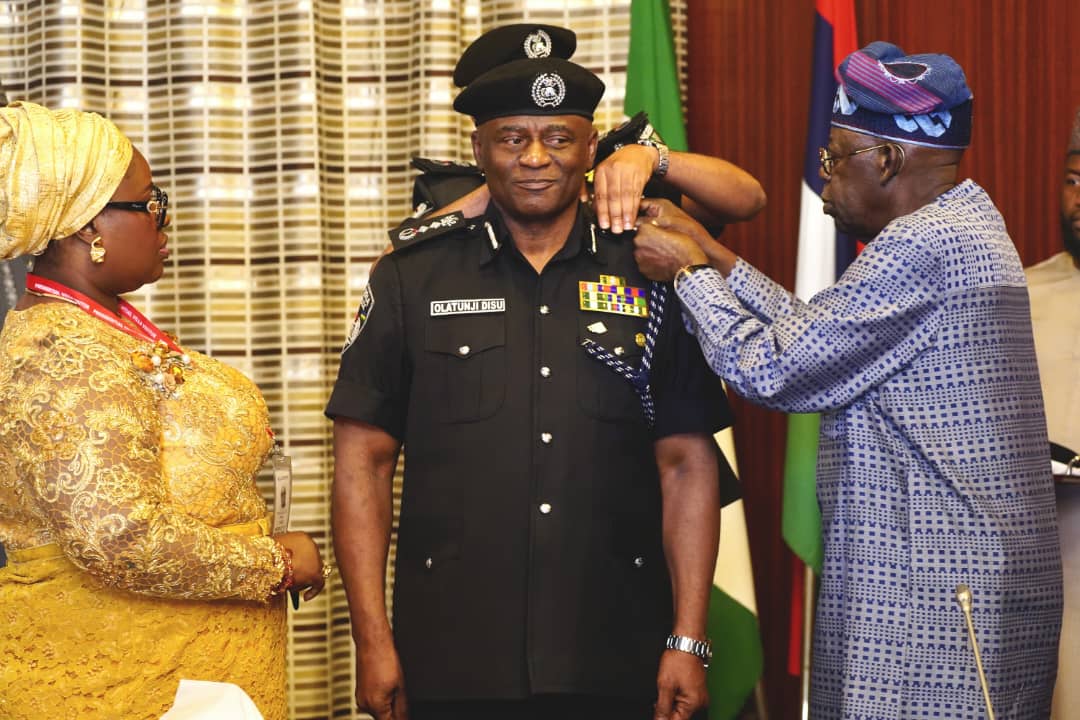
President Bola Tinubu on Wednesday decorated Assistant Inspector-General of Police, Tunji Disu, with his new rank as Acting Inspector-General of Police at the State House, Abuja, marking a major leadership change in the Nigeria Police Force amid rising security concerns across the country.
The ceremony, held at the Presidential Villa, formally ushered in Disu as the 23rd head of the police, following the resignation of former Inspector-General, Kayode Egbetokun.
The event was attended by top government officials, including the National Security Adviser, Nuhu Ribadu, Chief of Staff to the President, Femi Gbajabiamila, and Secretary to the Government of the Federation, George Akume, alongside senior police officers.
Disu’s decoration came barely 24 hours after the President accepted Egbetokun’s resignation, which the former police chief said was due to pressing family matters.
The leadership transition is seen as a significant development in Nigeria’s security architecture, especially at a time when the country continues to battle kidnapping, terrorism, armed robbery, and communal violence in several regions.
Presidential spokesman, Bayo Onanuga, confirmed that Disu’s appointment takes immediate effect but remains subject to confirmation by the Nigeria Police Council and the Senate.
The presidency also said the meeting of the Police Council would be convened soon to consider Disu’s nomination for a substantive appointment in line with the Police Act 2020.
According to the presidency, the appointment reflects the government’s commitment to strengthening internal security and improving professionalism in the police.
Disu, who is 59, was until his elevation the Assistant Inspector-General in charge of the Force Criminal Investigation Department Annex in Alagbon, Lagos.
He has also served as Commissioner of Police in Rivers State and later in the Federal Capital Territory, where he led major operations against criminal groups.
Before these roles, he headed the Intelligence Response Team and commanded the Rapid Response Squad in Lagos, where he gained national attention for introducing reforms and promoting better relations between officers and citizens.
Born on April 13, 1966, in Lagos Island, Disu joined the Nigeria Police in 1992 and has held various operational and administrative positions across the country.
He is also a member of the International Association of Chiefs of Police and holds academic qualifications in administration, criminology, and security studies.
His appointment comes just weeks before his scheduled retirement under the traditional age limit for police officers.
However, recent amendments to the Police Act introduced a fixed four-year tenure for Inspectors-General, regardless of age or years of service, meaning Disu could remain in office until 2030 if confirmed.
The development is expected to trigger major changes within the police hierarchy.
Traditionally, when a junior officer is appointed as IGP, several senior officers are required to retire or step down.
This may affect a number of Deputy Inspectors-General currently serving at the Force Headquarters.
Security experts say such transitions often reshape operational priorities and leadership direction in the force.
The resignation of Egbetokun has also generated public interest and political debate.
Although the former police chief cited family reasons, sources within government circles suggested that his exit followed consultations with the presidency.
Egbetokun was appointed in June 2023 and was expected to complete a four-year tenure under the amended Police Act.
During his time in office, he faced criticism over insecurity and controversies surrounding the interpretation of the tenure law.
However, the presidency commended him for his contributions to strengthening the country’s security system.
The Inspector-General of Police is the most senior officer in the Nigeria Police Force and is responsible for overseeing operations across the country’s 36 states and the Federal Capital Territory.
The position also plays a key role in coordinating national security with other agencies and advising the government on law enforcement matters.
Nigeria’s police system has faced challenges over the years, including underfunding, poor welfare, manpower shortages, and public trust issues.
These concerns became more prominent after the #EndSARS protests in 2020, which highlighted allegations of police brutality and demands for reform.
Since then, successive governments have promised reforms, including improved training, technology, and community policing.
Tinubu’s administration has repeatedly said security remains a top priority, linking economic recovery and investment to stability across the country.
Analysts believe the new police leadership will be judged on its ability to tackle banditry in the North-West, terrorism in the North-East, kidnapping along highways, and rising urban crime.
There are also expectations that Disu will deepen intelligence gathering and improve cooperation between federal and state security agencies.
In recent years, insecurity has affected agriculture, education, and business activities, forcing many communities to abandon their homes.
The appointment is also coming at a time when Nigeria is seeking to attract foreign investment and rebuild investor confidence.
Observers say strong security institutions are essential for economic growth and national development.
For many Nigerians, the leadership change in the police brings renewed hope but also caution.
Civil society groups have urged the new police chief to prioritise accountability, human rights, and professionalism.
They also want stronger action against corruption within the force.
Others have called for increased recruitment and better equipment to enable officers to respond effectively to modern security threats.
As Disu takes charge, attention will focus on his strategy, early reforms, and operational decisions.
The coming months are expected to test his leadership, especially as Nigeria prepares for major political and economic activities.
For now, the decoration ceremony at the State House signals a new phase in the leadership of the Nigeria Police Force and a fresh opportunity to address the country’s long-standing security challenges.

