
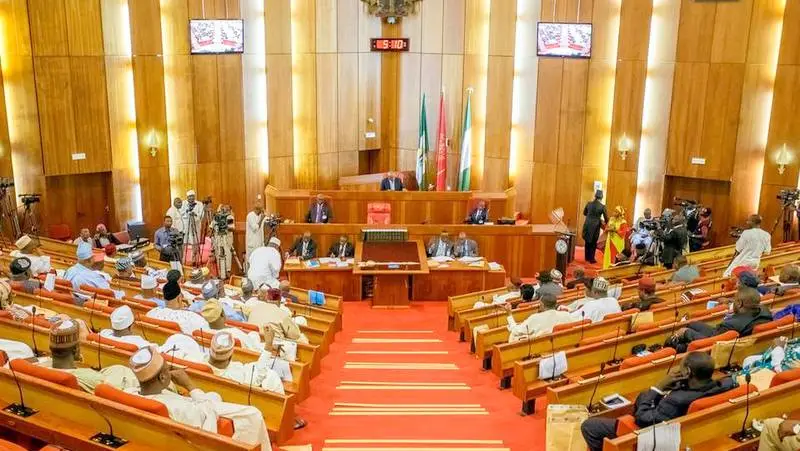
The Nigerian Senate has called on the Federal Government to return to the old payment system that allowed Ministries, Departments, and Agencies (MDAs) to pay contractors directly. The lawmakers said the current centralised system is flawed and has left many contractors unpaid for work already completed.
The call was made on Thursday by the Senate Committee on Finance during a meeting with the Federal Government’s Economic Management Team, led by the Minister of Finance and Coordinating Minister of the Economy, Mr Wale Edun. Other key officials present included the Minister of Budget and National Planning, Senator Atiku Bagudu; the Accountant-General of the Federation, Dr Shamseldeen Ogunjimi; and the Chairman of the Nigeria Revenue Service, Zacch Adedeji.
Chairman of the committee, Senator Sani Musa, said that submissions made by heads of MDAs during the ongoing budget defence sessions showed that government policies were not benefiting ordinary Nigerians.
Senator Musa criticised the current envelope budgeting system, saying it has failed to prioritise key projects and promotes routine expenditure growth instead of strategic planning. He recommended replacing it with a priority-based budget model.
“Specifically, based on submissions made by heads of various agencies during the ongoing budget defence sessions, the envelope system of budgeting has failed and needs to be replaced by a priority-based model,” Musa said.
He also questioned the incremental allocation approach, which spreads resources across MDAs in fixed percentages each year without focusing on the country’s most critical needs. According to him, this method encourages routine spending instead of growth-enhancing projects.
“Similarly, the centralised system of payment which has led to many contractors remaining unpaid for projects already executed should be replaced with the old system which allows the various MDAs to pay contractors they gave jobs to,” the senator added.
Senator Musa further called for a return to a strict annual budget cycle, stressing that fiscal discipline is necessary for effective governance. He warned that failing to end one fiscal year before starting another reflects a system in crisis.
“If, by December, we cannot assess ourselves realistically, then the system is failing. We must return to a disciplined budget cycle where one fiscal year ends before another begins,” he said.
The Senate’s position aligns with long-standing concerns in Nigeria that delayed budgets and disorganised payment systems negatively affect economic growth and public trust. In many cases, contractors and small businesses rely on timely government payments to continue operations. Delays often lead to project stagnation, job losses, and stalled public services.
In response, members of the Economic Management Team assured the Senate that the outlook for the proposed 2026 budget is positive. Minister Edun addressed concerns over Nigeria’s growing debt profile, explaining that the country’s N152 trillion debt was not entirely due to new borrowing.
“Currently, government debt in naira terms, is N152tn. About N30tn came from Ways and Means inherited by this government and N9tn incurred from exchange rate adjustment. So virtually half of that debt is made up of adjustments. It is not additional borrowing. Additional borrowing since 2023 is in the 20 trillion range,” Edun said.
The Minister said the government would prioritise growth-enhancing projects, starting with MDAs identifying key initiatives. The Economic Management Team would review these projects, and the President would decide on financing based on priorities, especially for capital projects.
“Going forward is what matters most. Prioritisation will start with the MDAs, bringing forward growth-enhancing projects. Then the economic management team will review those projects, and finally, Mr. President will decide financing based on priorities, particularly for capital projects,” he said.
Nigeria has faced recurring problems with delayed payments to contractors. The centralised payment system was introduced to regulate disbursement and reduce fraud, but in practice, it has slowed down payments and increased bureaucratic bottlenecks. Many contractors have struggled for months without receiving payment, causing project delays and financial strain.
The Senate’s call to return to the previous system reflects a broader push for efficiency and accountability in government spending. Lawmakers argue that allowing MDAs to pay contractors directly would ensure that completed projects are not left unpaid and that citizens see the impact of government policies more quickly.
Similarly, calls to move from envelope budgeting to a priority-based approach signal a desire for a more strategic allocation of resources. Nigeria faces competing needs in infrastructure, healthcare, education, and security. The current incremental system, critics argue, often spreads resources thinly without addressing the most urgent national priorities.
The Senate and the Economic Management Team agreed on the importance of dialogue and coordination to improve budget planning and execution. Both parties stressed that effective implementation of the 2026 budget would require focus on growth projects, disciplined spending, and timely payments to contractors.
The Finance Minister and his team assured lawmakers that the administration would continue to review systems to ensure that public funds are used efficiently and that projects critical to economic growth are prioritised.

