
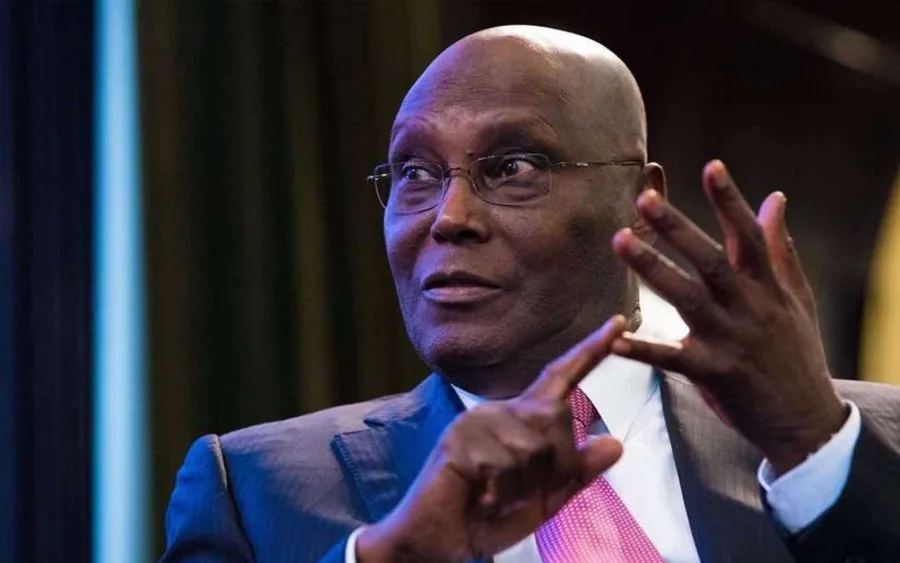
Former Vice President, Atiku Abubakar, has dismissed the recent wave of defections to the ruling All Progressives Congress (APC), declaring that the 2027 general election will be a direct contest between the party and the Nigerian people.
Atiku, who was the presidential candidate of the Peoples Democratic Party (PDP) in the 2023 election and is now a chieftain of the African Democratic Congress (ADC), made this known on Friday in a statement issued by his media office.
He was reacting to the defection of Adamawa State Governor, Ahmadu Fintiri, who earlier in the day announced his move from the PDP to the APC.
Governor Fintiri announced his defection in a 14-minute statewide broadcast from Yola, the Adamawa State capital. He said the decision was taken in the “developmental interest” of the state.
According to him, he moved to the APC with his entire cabinet, PDP officials and supporters across the 226 wards and 21 local government areas of the state. Shortly after his announcement, PDP flags were removed from Government House, signaling a formal shift in political alignment.
Fintiri was later registered as a member of the APC and issued membership card number 001 in Adamawa State.
His defection followed an earlier move by lawmakers in the state. On Wednesday, 15 of the 16 PDP members in the Adamawa State House of Assembly defected to the APC. The Speaker of the House, Bathiya Wesley, also joined the ruling party.
The developments effectively handed the APC control of both the executive and legislative arms of government in the state.
Political observers say Fintiri’s move is one of the most significant defections in recent times, especially as Adamawa has long been considered a PDP stronghold. The governor won elections in 2019 and 2023 under the PDP platform.
Reacting to the development, Atiku said political realignments are not new in Nigeria and that politicians are free to choose their political path.
“Every politician is free to choose a path,” the statement said. He added that even members of his own family are entitled to their own political choices.
However, Atiku insisted that defections by politicians should not be mistaken for genuine support from the people.
He said the 2027 election would not be about how many governors or lawmakers join the APC, but about the daily realities faced by ordinary Nigerians.
According to him, “Governors may defect for personal survival. Nigerians are defecting in their millions because they want survival.”
Atiku argued that many Nigerians are struggling with rising hunger, poverty, insecurity and unemployment. He blamed what he described as failed economic policies of the current administration for the hardship across the country.
In his statement, Atiku accused the administration of President Bola Ahmed Tinubu of using state institutions to intimidate opposition figures.
He claimed that the government was attempting to weaken opposition parties and move Nigeria toward a one-party state.
“This government fears accountability. It fears credible elections. It fears the people,” he said.
Atiku did not provide specific evidence for the allegation, but his comments reflect growing tension between the ruling APC and opposition parties ahead of the next election cycle.
Since the 2023 general election, there have been several defections from opposition parties to the APC at both federal and state levels. Analysts say some politicians may be seeking closer ties with the party at the centre in order to secure political protection or access to federal resources.
However, APC leaders have maintained that defections into the party are voluntary and reflect confidence in the leadership of President Tinubu.
Atiku is one of Nigeria’s most experienced politicians. He served as Vice President from 1999 to 2007 under former President Olusegun Obasanjo. Over the years, he has contested for the presidency multiple times under different political platforms.
In the 2023 presidential election, Atiku ran under the PDP but lost to Tinubu of the APC. He challenged the result in court but the Supreme Court upheld Tinubu’s victory.
His recent alignment with the ADC marks another chapter in his long political career. Political observers believe he remains interested in contesting the presidency again in 2027, although he has not formally declared his intention.
Although the next general election is still about two years away, political activities and alignments are already taking shape.
Atiku urged Nigerians not to be influenced by defections or short-term political moves. He called on citizens to protect their votes and resist vote-selling.
“Do not trade your future. Do not mortgage your children’s tomorrow,” he said. “In 2027, the people will have their say — and their will shall prevail.”
He also questioned what the APC would campaign on in 2027, asking whether the ruling party would present hunger, hardship and hopelessness as achievements.
The APC has repeatedly defended its policies, saying some of its economic reforms, including fuel subsidy removal and exchange rate adjustments, were necessary steps to stabilise the economy. Government officials argue that while the reforms have caused short-term pain, they are meant to bring long-term benefits.
The exchange between Atiku and the APC highlights the growing political tension in the country as parties reposition for 2027.
For now, the defection of Governor Fintiri has reshaped the political map of Adamawa State. But Atiku’s reaction shows that the wider battle for Nigeria’s political future is just beginning.
As politicians continue to change parties and build new alliances, many Nigerians are watching closely. With economic hardship and security concerns still major issues, voters are likely to focus more on performance and solutions than on party labels.

