
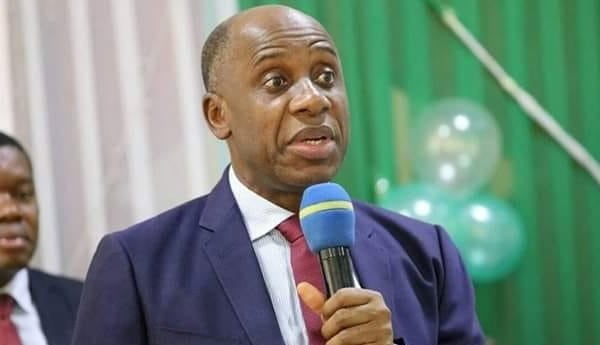
Former Rivers State governor and ex-minister of transportation, Rotimi Amaechi, has said that Nigeria’s major challenge is not President Bola Ahmed Tinubu but the weakness of opposition political parties.
Amaechi made the remarks on Thursday during a joint press conference organized by opposition political parties. His comments have since stirred discussion across political circles.
Speaking at the event, Amaechi said, “Tinubu is not our problem. The problem is the opposition. When the opposition is ready, Nigeria will change.”
He argued that for any real change to happen in the country, opposition parties must first put their own house in order. According to him, they must clearly separate themselves from the government in power and present a strong alternative to Nigerians.
Nigeria operates a multi-party system, with the ruling All Progressives Congress (APC) currently in power at the federal level. President Tinubu, who was elected in 2023, is a member of the APC.
The main opposition party is the People’s Democratic Party (PDP), alongside other parties such as the Labour Party and the New Nigeria Peoples Party (NNPP).
Amaechi’s comments appear to reflect concerns among some politicians that opposition parties have not been united or strong enough to challenge the ruling party effectively.
“The first thing we need to do is to separate ourselves from the government in power,” Amaechi said. He suggested that some opposition figures may be too close to the ruling party, making it difficult to present a clear alternative.
Since the return to democratic rule in 1999, power at the federal level has mainly rotated between the PDP and the APC. The APC came to power in 2015 after defeating the PDP, which had ruled for 16 years.
Amaechi himself was once a leading member of the APC and served as minister of transportation under former President Muhammadu Buhari. His recent comments show growing debate within political circles ahead of future elections.
During the press conference, Amaechi also criticized what he described as President Tinubu’s style of governance.
“Tinubu’s pattern is simple,” he said. “He tries something today, and you’re weak. He puts something bigger, and you’re weaker.”
Though he did not go into details, his remarks appear to refer to recent economic and policy decisions taken by the current administration.
Since assuming office in May 2023, President Tinubu has introduced major reforms. One of his first decisions was the removal of fuel subsidy, which led to a sharp increase in petrol prices. The government has said the move was necessary to save public funds and redirect them to development projects.
The administration also unified the exchange rate system, a step officials say is aimed at attracting foreign investment and stabilising the economy. However, these policies have led to rising living costs, and many Nigerians have complained about hardship.
Civil society groups and labour unions have staged protests in the past over the high cost of living. Wages have struggled to keep up with inflation, and many households are finding it difficult to cope.
Amaechi’s statement suggests that he believes the opposition has not responded strongly enough to these challenges.
The former minister also questioned the timing of a recent trip by President Tinubu to France.
“Which president goes to France when you’re shouting that the man is stealing our money?” Amaechi asked.
Though he did not provide further explanation, his comment appears to reflect concerns raised by some critics about government spending and accountability.
Presidential foreign trips are common and often aimed at attracting investment, strengthening diplomatic ties, or attending international meetings. However, such trips sometimes draw criticism from opposition figures who argue that leaders should focus more on domestic issues.
The Tinubu administration has defended its foreign engagements, saying they are necessary to improve Nigeria’s global standing and attract economic opportunities.
Political tension has remained high in Nigeria since the 2023 general elections. The presidential election was closely contested, and opposition parties challenged the results in court. However, the Supreme Court later upheld Tinubu’s victory.
Since then, opposition parties have been reviewing their strategies and discussing possible alliances. Talks of coalitions have emerged in recent months, as some politicians believe that unity is the only way to challenge the ruling party in future elections.
Amaechi’s remarks may be seen as part of this wider conversation about the future of opposition politics in Nigeria.
Amaechi’s comments have generated mixed reactions. Some supporters agree with him, saying that opposition parties need to reorganize and present a clear vision for the country.
Others argue that the ruling government must also take responsibility for the current economic challenges facing Nigerians.
As Nigeria continues to face economic and social challenges, many citizens are watching closely to see how political leaders respond.
For now, Amaechi’s message is clear: in his view, meaningful change in Nigeria will only happen when the opposition becomes stronger, more united and clearly independent from the ruling party.

