
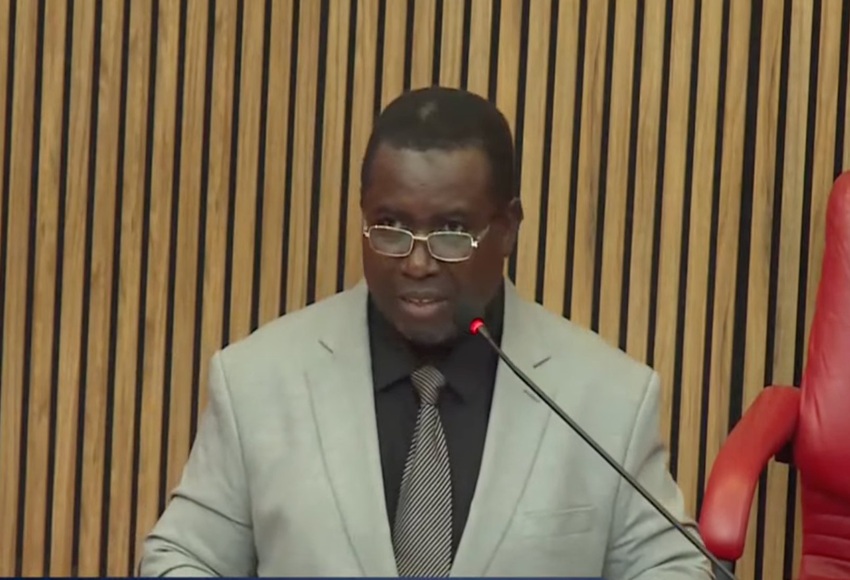
The Chairman of the Independent National Electoral Commission (INEC), Prof. Joash Amupitan, has assured Nigerians that the commission has the capacity to electronically transmit election results in 2027. However, he warned that the country may not experience a “100 per cent perfect election.”
Amupitan gave the assurance on Sunday during the Citizens’ Town Hall programme aired live on major television networks. The event, tagged “Electoral Act 2026: What it means for your votes and the 2027 elections,” focused on the changes introduced by the new law and what Nigerians should expect in the next general election.
The live debate was anchored by Seun Okinbaloye and the Executive Director of Yiaga Africa, Samson Itodo. Among those present were the National Chairman of the All Progressives Congress, Nentawe Yilwatda; the Interim National Chairman of the Labour Party, Nenadi Usman; former Minister of Education, Oby Ezekwesili; and Senator Ireti Kingibe.
Speaking during the programme, Amupitan appealed to Nigerians to manage their expectations. According to him, while INEC will work hard to deliver credible elections, it cannot promise perfection.
“I have noticed that what Nigerians desire is a perfect election. INEC will strive as much as possible to give this country the best election. However, we may not be able to achieve a 100 per cent perfect election for now,” he said.
He stressed that INEC has the capacity to transmit results electronically. He recalled that he had earlier told stakeholders in the Federal Capital Territory that results would be transmitted. The main concern, he explained, was defining what qualifies as “real-time” transmission.
The issue of electronic transmission became a major topic after the 2023 general elections, when some political parties and civil society groups raised concerns about delays and technical problems. The debate continued during discussions that led to the passage of the Electoral Act 2026.
Amupitan revealed that INEC played an active role in shaping the new law. According to him, the process started about three years ago through a joint committee made up of members of the National Assembly, civil society organisations and the commission.
“By the time I took over, the work was almost concluded. But we still made some important provisions and recommendations,” he said.
He disclosed that INEC pushed for electronic transmission of results to be made mandatory during discussions with lawmakers. However, the challenge, he noted, was agreeing on how to define real-time transmission.
To explain the challenges, Amupitan cited the recent FCT Area Council elections. He said results from five of the six area councils were received on time. However, in Kuje Area Council, results from Kabi ward were delayed until the following day.
According to him, Kabi ward is about three-and-a-half hours’ drive from Kuje town, and the road is difficult. When officials and security personnel were deployed there, communication became impossible because phone signals were weak. INEC later had to send another team to confirm their safety before the results were eventually brought to Kuje town for collation.
He insisted that transmission itself is not the main problem but rather network coverage and logistics.
“In a place like the FCT, you expect to transmit results without any problem. But we had a situation where real-time transmission was impossible from one ward,” he said.
The INEC chairman linked election credibility to logistics, noting that operational failures can affect public trust.
“Your election can only be as good as your logistics. Where there is a logistics failure, you are beginning to fail,” he stated.
He admitted that the FCT poll experienced some logistical issues, including human errors, but said the commission was already working to address them.
Despite the challenges, Amupitan expressed optimism that the 2027 general elections would be an improvement on previous polls. He said voter awareness has increased and Nigerians now demand more accountability from leaders.
“By the time you have a transparent election and people begin to trust INEC and trust their leaders, then the country will move forward,” he said.
In a related development, INEC has started a comprehensive review of its regulations and guidelines for political parties ahead of the 2027 elections.
According to a statement issued by the Chief Press Secretary to the INEC chairman, Adedayo Oketola, the review is taking place in Abuja under Amupitan’s leadership. The exercise is aimed at strengthening political party oversight, improving compliance, reducing pre-election disputes and boosting public confidence.
The statement said the review will involve national commissioners, directors, legal experts and election administrators. They are expected to conduct a clause-by-clause review of the 2022 regulations governing political parties.
INEC explained that the Electoral Act 2026 introduced major changes affecting party administration, candidate nomination, compliance requirements and dispute resolution. As a result, the commission is updating its regulations to align with the new law.
The commission also noted that past elections revealed persistent problems such as opaque party primaries, membership disputes, weak financial reporting and exclusion of women, youth and persons with disabilities. These issues, it said, have often led to court cases and uncertainty before elections.
To support reforms, INEC is using findings from the Political Party Performance Index, a tool designed to identify weaknesses in party governance nationwide. The commission said it wants to move from reacting to problems after they happen to preventing them before they arise.
Technical support for the review is being provided by the Westminster Foundation for Democracy, alongside Nigerian legal and electoral experts.
Meanwhile, political parties have begun adjusting to the new requirements under the Electoral Act 2026. The Peoples Democratic Party and the African Democratic Congress have launched nationwide digital membership registration exercises.
The PDP, led by its National Working Committee under Tanimu Turaki, announced that it would commence electronic membership registration nationwide. Similarly, the ADC said it had begun free online membership registration and asked existing members to update their details in line with the new law and INEC guidelines.
Earlier this year, INEC fixed dates for the 2027 general elections. The Presidential and National Assembly elections were initially scheduled for February 20, 2027, while the Governorship and State Houses of Assembly elections were set for March 6, 2027.
However, some Muslim stakeholders raised concerns that the dates coincided with the Ramadan period. Following amendments by the Senate, INEC released a revised timetable.
Under the new schedule, the Presidential and National Assembly elections will now hold on January 16, 2027, while the Governorship and State Houses of Assembly elections will take place on February 6, 2027.
Political parties are required to submit a comprehensive digital membership register by April 2, 2026. While INEC says this will improve transparency, some stakeholders argue that the deadline could pose challenges for opposition parties.

