
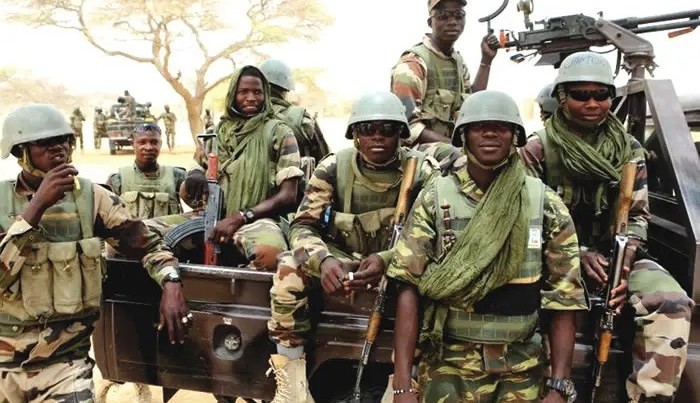
Troops of the Joint Task Force (North East) Operation Hadin Kai successfully repelled coordinated attacks by suspected ISWAP fighters on Forward Operating Bases (FOBs) in Mayanti, Gajigana, and Gajiram in Borno State between February 28 and March 1, 2026.
In a statement signed by the Media Information Officer, Lt Col Sani Uba, the military confirmed that all attacks were foiled and troops retained full control of their positions. The operation resulted in the deaths of ten suspected terrorists and one army major.
According to Lt Col Uba, the first attack occurred at FOB Mayanti on February 28. Troops faced heavy fire but held their ground, later recovering five bodies of the attackers. Significant combat equipment was also seized, including three PKT automatic anti-aircraft guns, two RPG-7 tubes, four AK-47 rifles, two FN rifles, three RPG bombs, and large quantities of 7.62mm ammunition.
“Troops of the Joint Task Force (North East) Operation Hadin Kai have once again demonstrated resilience and battlefield dominance by decisively foiling coordinated ISWAP attacks on FOBs Mayanti, Gajigana, and Gajiram, while intensifying offensive operations across Sector 2,” Uba said.
He noted that five terrorists were killed in Mayanti, three at Gajiram, and two at Gajigana. The failed assaults, he explained, show the growing desperation of the terrorists as the military maintains sustained pressure on their enclaves, logistics corridors, and leadership structures.
At Gajiram, the assault occurred in the early hours of March 1. The terrorists used PKT guns, RPGs, and armed drones, but the attacks were repelled with the support of air assets. Three terrorist bodies were recovered along the withdrawal route, along with weapons including four AK-47 rifles, five anti-tank bombs, three locally fabricated mortar bombs, one armed drone, six fully loaded 7.62mm NATO magazines, barbed wire cutters, poisoned arrows, and other abandoned equipment. One wounded soldier was airlifted by a Nigerian Army Aviation helicopter for advanced medical care.
The attack on Gajigana was also foiled, with troops maintaining full control of the base.
In a related operation in Kayawa Village, soldiers engaged suspected terrorists who were forced to flee. They abandoned a tricycle, three motorcycles, and five bicycles. Military personnel also destroyed life-support structures and arrested two confessed ISWAP logistics suppliers. Recovered items included drugs and medical consumables used to treat wounded terrorists.
During another ambush around Bulturam Corner and Dadingel in Gujba Local Government Area, troops neutralized two terrorists and recovered two AK-47 rifles, four magazines, a bicycle, and other sundry items.
“The scale of recoveries and confirmed enemy losses further underscores the degrading combat capacity of ISWAP elements,” the statement added.
This series of attacks highlights the continued threat posed by ISWAP, an offshoot of Boko Haram, which operates mainly in northeastern Nigeria. The group has carried out multiple attacks against civilians and security forces over the years, often targeting military installations, towns, and humanitarian convoys.
The Nigerian military has been conducting Operation Hadin Kai since 2016, with the primary aim of degrading Boko Haram and ISWAP’s capabilities, securing communities, and restoring state authority in the northeast. The operation has involved a combination of ground assaults, air support, intelligence operations, and collaboration with regional partners.
The death of an army major during the Mayanti attack underscores the risks faced by Nigerian troops in combating insurgents. Officers and soldiers routinely face ambushes, improvised explosive devices (IEDs), and drone-assisted attacks, making frontline operations extremely dangerous.
Recovery of weapons and combat equipment from ISWAP fighters is also significant. The seizure of anti-aircraft guns, RPGs, AK-47 rifles, drones, and ammunition not only reduces the terrorists’ operational capability but also prevents these arms from being used against civilians or other military units.
Lt Col Uba explained that the attacks occurred at night, with terrorists attempting to exploit darkness to gain an advantage. Despite this, troops remained vigilant and relied on intelligence, reinforcements, and air support to maintain control of their positions.
The military’s success in repelling the attacks and dismantling ISWAP logistics in Borno is expected to boost morale among troops and reassure civilians in the affected areas. Security in the northeast has remained fragile, with many communities experiencing periodic attacks that disrupt daily life and economic activities.
Officials say that sustaining pressure on ISWAP is essential to preventing the group from regrouping and launching further attacks. Offensive operations in Sector 2, including Kayawa Village and surrounding areas, demonstrate the military’s proactive approach in denying terrorists freedom of movement.
Civilian populations in Borno State and neighbouring areas have been advised to remain vigilant and cooperate with security agencies. Community support, timely intelligence, and reporting of suspicious activities are critical to ensuring the success of ongoing military operations.
The Nigerian Army and Joint Task Force also continue to emphasise the importance of coordinated air and ground operations. Air assets, including helicopters and surveillance drones, have played a key role in supporting troops, disrupting enemy attacks, and facilitating medical evacuation for injured soldiers.
The recent attacks and successful repulsion by the military further illustrate the ongoing struggle between Nigerian security forces and insurgent groups in the northeast. While insurgents continue to attempt assaults and raids, the military’s ability to maintain control of strategic bases and recover weapons highlights their operational effectiveness.
The military has reassured Nigerians that all Forward Operating Bases remain secure and under government control. The statement concluded by reaffirming the commitment of the Joint Task Force to degrade terrorist capabilities, protect civilians, and restore peace in Borno State and the wider northeast region.

