
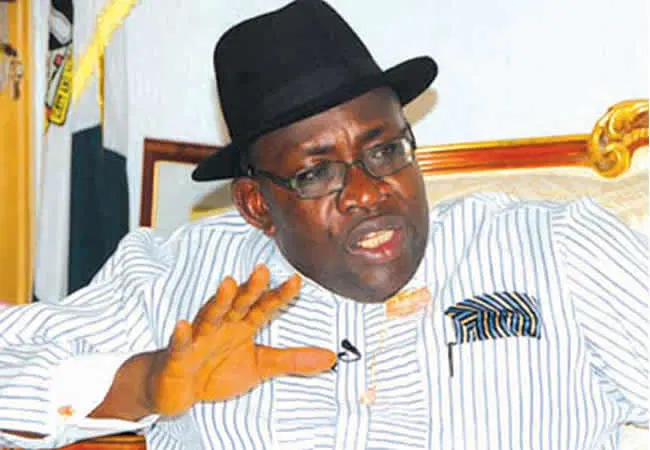
The senator representing Bayelsa West Senatorial District, Seriake Dickson, has said he has no immediate plan to contest the presidency against Bola Tinubu in the 2027 general election.
Dickson made this known while speaking to journalists on the sidelines of a press conference held at his residence in Abuja. The briefing came shortly after he announced his resignation from the Peoples Democratic Party and his decision to join the newly registered Nigeria Democratic Congress.
The former governor of Bayelsa State said his main focus at the moment is not the presidential race but the building of a strong political platform that can attract Nigerians from different regions and political backgrounds.
According to him, he and other political leaders involved in the party are working to develop the Nigeria Democratic Congress, also known as NDC, into a credible national platform that can compete in future elections.
“We are actually aiming to take over power at the centre. And it is possible. It’s human beings that make up a party. It’s not the name,” Dickson said.
He explained that the party’s strategy is to first build strong structures across the country before discussing who will run for the presidency in 2027.
Dickson said the growing dissatisfaction among Nigerians over economic hardship and political issues could make room for a new political movement if it is properly organised.
“But if you look at the dynamics that played out in 2023, you will know that this anger and hunger in Nigeria, the disenchantment, and with the credibility of the platform that we offer, anything is possible,” he added.
The senator was asked by journalists whether his move to the NDC was part of a larger plan to challenge President Tinubu in the next presidential election.
However, Dickson dismissed the suggestion, saying discussions about the presidency are not the party’s immediate concern.
“You also talked about the presidential race. Let me tell you right away. That’s not our focus. My colleagues and I are working to build a credible platform to offer to Nigeria and attract as many people as possible,” he said.
Nigeria’s next presidential election is scheduled for 2027, when President Tinubu, who was elected in the 2023 election, is expected to complete his first term in office.
Tinubu contested and won the 2023 presidential election under the platform of the ruling All Progressives Congress, defeating candidates of several opposition parties.
The election was one of the most competitive in Nigeria’s recent political history, with three major candidates receiving strong support from different regions of the country.
Since then, discussions about political alliances and preparations for the 2027 election have started within different political circles.
Dickson, however, said that focusing on personal ambition too early could weaken political parties.
He said many parties in Nigeria often make the mistake of concentrating on who will run for office rather than strengthening their institutions.
“Politics is much more than talking about who will run or which region should produce the president,” he said.
“Let us first build a party. When the time comes, the issue of candidates will sort itself out.”
The senator also addressed the ongoing debate about zoning, which is the informal practice of rotating political offices among different regions of the country.
The zoning debate has been a major topic in Nigerian politics for many years, especially when presidential elections approach.
Some political leaders believe that the presidency should rotate among the North, South, East and West in order to promote fairness and national unity.
Dickson said that while zoning is an important issue, it should not overshadow the need to build strong political parties and democratic institutions.
He noted that discussions about which region should produce the next president should come later.
“But I am not, for now, looking at that presidency, even though I am eminently qualified, as you can see,” he said with a smile.
Dickson used the opportunity to invite politicians across the country to join the Nigeria Democratic Congress.
According to him, the party plans to welcome people with different political ambitions, including those seeking positions such as president, governor, senator, member of the House of Representatives, and local government offices.
“We want to build a party. So we want to invite everyone. All those who have presidential, governorship, senatorial, House of Representatives, state House of Assembly, chairmanship and councillorship interests—come to the Nigeria Democratic Congress,” he said.
“With NDC, the game has changed.”
He also responded to concerns that members of the ruling party might secretly join the new party to weaken it from within.
Dickson said the party would remain open to all Nigerians but assured that it would manage any internal challenges if they arise.
“We are open to everyone. If any situation arises, we will know how to handle it. That is not the least of our worries,” he said.
He expressed confidence that the party would attract credible leaders from across the country.
“I assure you that with the calibre of people from all over Nigeria that are coming to us, the NDC will spring surprises. We will win elections in many places,” he said.
Dickson also clarified that the newly formed Nigeria Democratic Congress should not be confused with the former Niger Delta Congress, which existed many years ago.
According to him, the earlier political group was formed under different historical conditions when most parties in Nigeria were regional.
“Our own NDC is different from that one. That one was a product of the historical circumstances at that time when parties were largely regional,” he explained.
“But today Nigeria has moved beyond regional parties.”
Earlier in the week, Dickson formally announced his resignation from the Peoples Democratic Party.
The former governor said his decision was influenced by the internal crisis currently affecting the party.
The PDP, which ruled Nigeria from 1999 to 2015, has faced several internal conflicts in recent years, including leadership disputes and disagreements among party leaders.
Dickson said the party had deteriorated because of poor leadership and unresolved conflicts among its key members.
“The governors and other leaders must take responsibility for the avoidable, self-inflicted destruction of the PDP,” he said.
Despite his criticism, the senator said he still has emotional attachment to the party because of the role it played in Nigeria’s democratic development.
The PDP played a central role in Nigeria’s return to democratic rule in 1999 after many years of military government.
However, the party lost power at the national level in 2015 to the All Progressives Congress.
Since then, it has struggled to regain its position as the dominant political force in the country.
Dickson also warned against the idea of Nigeria becoming a one-party state.
According to him, the country’s diverse population and political culture make such a system unrealistic.
“Nigeria cannot be a one-party state,” he said.
“Anyone promoting one-party rule in Nigeria is pursuing a mirage.”
He urged Nigerians who want a stronger democracy to support new political platforms that can provide healthy competition in the country’s political system.
Dickson said the success of democracy depends on the presence of strong and credible opposition parties that can hold the government accountable.
As political activities slowly begin ahead of the 2027 elections, analysts believe that movements such as Dickson’s shift to the NDC could reshape alliances within Nigeria’s opposition politics.

