
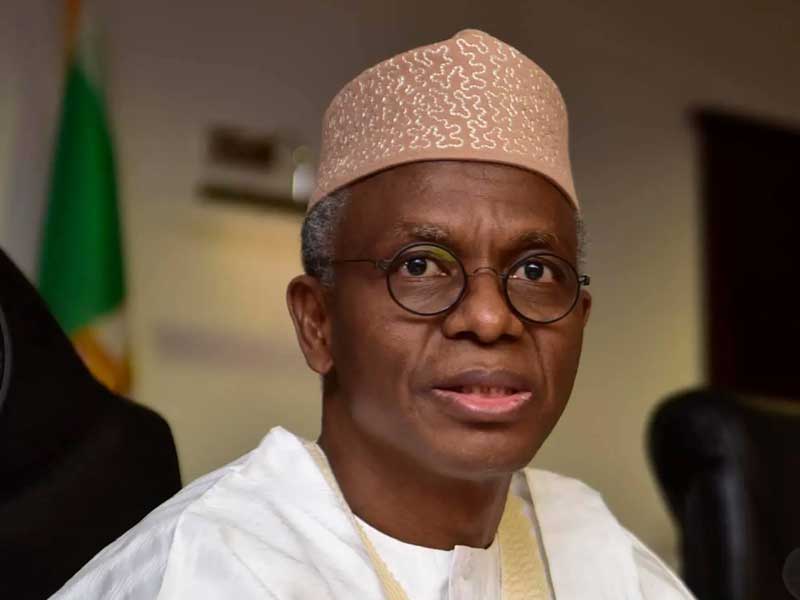
Former Kaduna State Governor, Nasir El-Rufai, is set to be formally arraigned in court on Tuesday after spending over one month in the custody of the Independent Corrupt Practices and Other Related Offences Commission (ICPC).
The arraignment marks a major development in a growing legal battle involving the former governor, who is facing a range of allegations including money laundering, abuse of office, fraud, and unlawful handling of public property.
El-Rufai has been in detention since February 18, 2026, shortly after he was released by the Economic and Financial Crimes Commission (EFCC), another key anti-corruption agency in Nigeria.
Following his arrest, the ICPC obtained a court order from a magistrate court in Bwari to detain him for two weeks to allow for investigation. That order was later extended on March 5 for an additional two weeks, keeping the former governor in custody as investigations continued.
Before the expiration of the extended remand order, the commission moved to formally charge him. On March 18, 2026, the ICPC filed charges in both the Federal High Court and the Kaduna State High Court, paving the way for his arraignment on March 24.
According to the Head of Media and Public Communications of the ICPC, John Odey, El-Rufai will be arraigned alongside one Joel Adoga in a case before the Federal High Court in Kaduna. The case, listed as FHC/KD/73/2026, includes charges related to conversion and possession of public property as well as money laundering.
In a separate case before the Kaduna State High Court, El-Rufai will be tried alongside Ahmadu Sule, also known as LEDA. This case involves allegations such as abuse of office, fraud, intent to commit fraud, and conferring undue advantage.
The ICPC confirmed that both cases were filed on March 18 and that the former governor has been formally served with the charges. The commission also stressed its commitment to due process and the rule of law.
As part of its investigation, the ICPC has taken steps to gather and analyse evidence linked to the case. Recently, a Federal High Court in Abuja granted the commission permission to examine electronic devices recovered from El-Rufai’s residence.
The approval was given by Joyce Abdulmalik, who ruled on an application filed by the ICPC’s lawyer, Osuobeni Akponimisingha.
The court allowed the commission to carry out forensic examination and extraction of data from the devices. This includes reviewing documents, WhatsApp messages, text messages, call logs, and other digital records that may be relevant to the investigation.
Items recovered from the former governor’s Abuja residence include mobile phones, laptops, storage devices, flash drives, and other electronic equipment. The ICPC had earlier conducted a search at the residence under a valid court order, reportedly in the presence of El-Rufai’s family members.
Investigators say the analysis of these devices is crucial in building their case, especially in tracing financial transactions and communication records linked to the allegations.
In addition to the ICPC charges, El-Rufai is also facing a separate legal challenge involving the Department of State Services (DSS).
The DSS has already filed charges against the former governor over allegations that he illegally monitored or wiretapped the phone lines of the National Security Adviser, Nuhu Ribadu.
However, his arraignment in that case has been delayed due to his ongoing detention and investigation by the ICPC. Legal observers say the multiple cases could further complicate his legal situation in the coming weeks.
El-Rufai, a senior member of the African Democratic Congress (ADC), has continued to deny all allegations against him. He has repeatedly described the charges as politically motivated, suggesting that they are part of a broader effort to target him.
Some political figures and civil society groups have also raised concerns about the length of his detention before formal charges were filed. They argue that prolonged detention without trial could raise questions about fairness and respect for human rights.
On the other hand, supporters of the anti-corruption agencies insist that thorough investigations are necessary, especially in cases involving public funds and high-ranking officials.
El-Rufai served as governor of Kaduna State from 2015 to 2023 and remains a prominent figure in Nigerian politics. During his tenure, he was known for introducing reforms in public service, education, and infrastructure development.
However, his administration also faced criticism over governance decisions and the management of state resources. The current charges appear to be linked to actions taken during his time in office.
The ICPC and EFCC are Nigeria’s main anti-corruption agencies, tasked with investigating and prosecuting financial crimes and abuse of office. In recent years, both agencies have stepped up efforts to hold former public officials accountable.
At the arraignment, the court is expected to read out the charges against El-Rufai, after which he will enter his plea. Depending on the outcome, the court may decide on bail and set dates for further hearings.
For now, attention is focused on Kaduna, where the proceedings are set to begin. Many Nigerians are watching closely, as the outcome could have significant political and legal consequences.
The case also highlights ongoing concerns about corruption and accountability in public office, issues that continue to shape public debate across the country.