
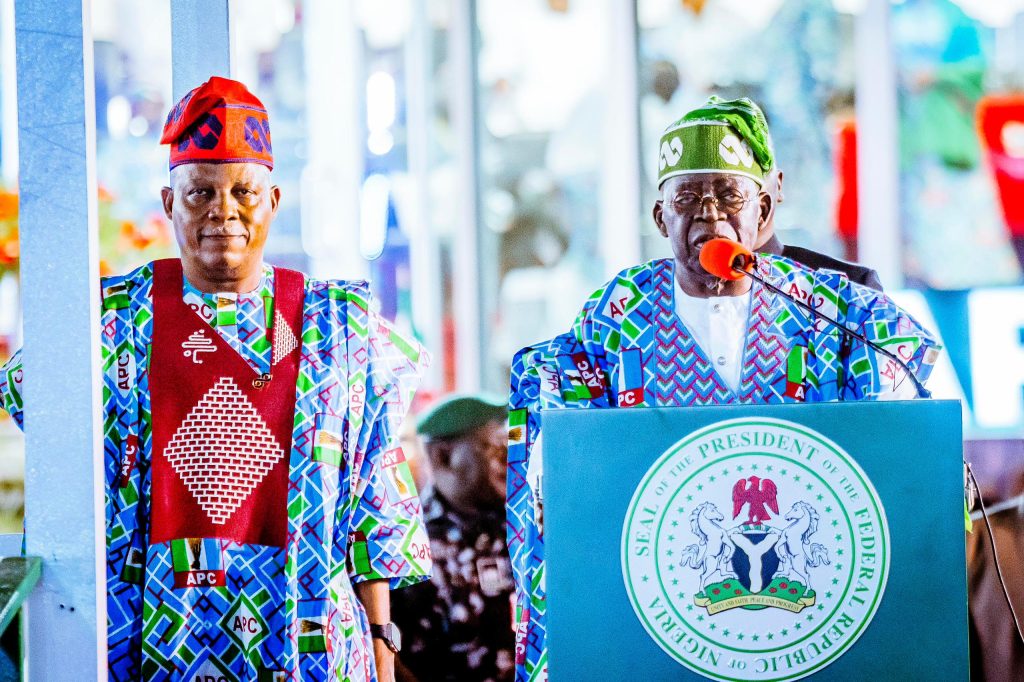
President Bola Tinubu on Friday criticized opposition parties for what he described as deliberate misrepresentation of Nigeria’s Electoral Act, insisting that such actions could harm the country’s democratic progress.
The President spoke at the 4th Elective National Convention of the All Progressives Congress (APC), held at Eagle Square in Abuja. The event brought together party leaders, government officials, and delegates from across the country.
Tinubu used the occasion to defend the Electoral Act 2026, which has come under criticism from opposition groups. According to him, the law was not imposed on Nigerians but was the result of a detailed legislative process that included public participation.
He said the National Assembly, which passed the law, was made up of elected representatives of the people. He added that the process included public hearings and careful review before the law was approved.
The President argued that portraying the Electoral Act as unfair or anti-democratic ignores the work that went into its development. He warned that such claims could weaken public trust in the electoral system.
“While we welcome criticism, constant attacks on the Electoral Act are a disservice to Nigerians,” he said.
The Electoral Act is a key law that guides how elections are conducted in Nigeria. It covers areas such as voter registration, voting procedures, and the announcement of results. Changes to the law are often debated because they can affect how elections are run.
In recent months, some opposition parties have raised concerns about the Act, claiming it could give an advantage to the ruling party. They have also pointed to political developments, including the movement of politicians from opposition parties to the APC, as signs of growing imbalance in the political system.
However, President Tinubu rejected these claims. He said the Act reflects a national effort to strengthen democracy and should not be used as a tool for political arguments.
He also addressed concerns that Nigeria may be moving toward a one-party system due to the increasing number of defections to the APC. The ruling party currently controls the presidency, has a majority in the National Assembly, and governs most states.
Tinubu made it clear that his administration does not support a one-party system. Instead, he said democracy works best when there is healthy competition among political parties.
“We do not seek a one-party state,” he said, adding that a strong opposition is important for good governance.
According to him, opposition parties play a key role in questioning government actions and helping to improve policies. He said constructive criticism should be encouraged, but warned against what he called distortion of facts.
While critics see this trend as a threat to democracy, supporters of the APC say it shows growing confidence in the party’s leadership and direction.
President Tinubu also used his speech to caution members of his own party. He warned that political parties often fail not because they lose elections, but because of internal problems such as lack of discipline and personal interests.
He urged party members to remain united and focused on shared goals. According to him, unity is more important than numbers when it comes to building a strong political party.
“Let no contest divide us. Let no outcome embitter us,” he told delegates.
The APC convention is an important event where party leaders are elected and key decisions are made. It also serves as a platform for discussing the party’s direction and preparing for future elections.
During the event, several party leaders and government officials spoke in support of the President and his policies.
Former Katsina State Governor, Aminu Masari, who chaired the convention coordinating committee, described the gathering as a historic moment for the party. He said it was an opportunity to renew commitment to the party’s values and plan for the future.
Masari noted that the APC was built on the ideas of progress, unity, and justice. He urged delegates to take their responsibilities seriously, saying their decisions would affect both the party and the country.
The Minister of Finance and Coordinating Minister of the Economy, Wale Edun, also spoke at the event. He defended the government’s economic policies, saying they were beginning to produce positive results.
According to him, the administration’s reforms are helping to stabilise the economy and reduce poverty. He explained that past policies had created challenges, including a weak currency and lack of investment.
Edun said the government had taken bold steps to address these issues, including changes in fuel subsidy and foreign exchange management. While acknowledging that the reforms were difficult, he said they were necessary to move the country forward.
President Tinubu also spoke about the economic situation, admitting that the reforms have been tough on Nigerians. However, he insisted that they are important for long-term growth.
“We knew the road to reform would be tough,” he said.
He pointed to what he described as improvements in key economic indicators. According to him, inflation is beginning to decline, investor confidence is improving, and the country is moving toward stability.
He also mentioned growth in the stock market and increased trade activity as signs that the economy is recovering. In addition, he said Nigeria’s exit from the Financial Action Task Force grey list has improved its international image.
Governor of Imo State, Hope Uzodinma, who spoke on behalf of APC governors, said the party remains committed to supporting the President’s agenda. He described the administration’s direction as clear and focused on long-term development.
Uzodinma said the governors would continue to work with the Federal Government to improve infrastructure, create jobs, and support businesses. He added that efforts would also be made to empower young people and women.
The APC convention comes at a time when Nigeria is facing several challenges, including economic pressure, security concerns, and political competition. The decisions made at the convention are expected to shape the party’s strategy in the coming years.
As the country moves closer to future elections, issues such as electoral laws, party strength, and economic performance will remain central to political discussions.
For now, President Tinubu’s message is clear: defend the electoral system, maintain party unity, and stay focused on reforms aimed at improving the country’s future.
The coming months will show how these positions are received by both supporters and critics, as Nigeria continues its democratic journey.