
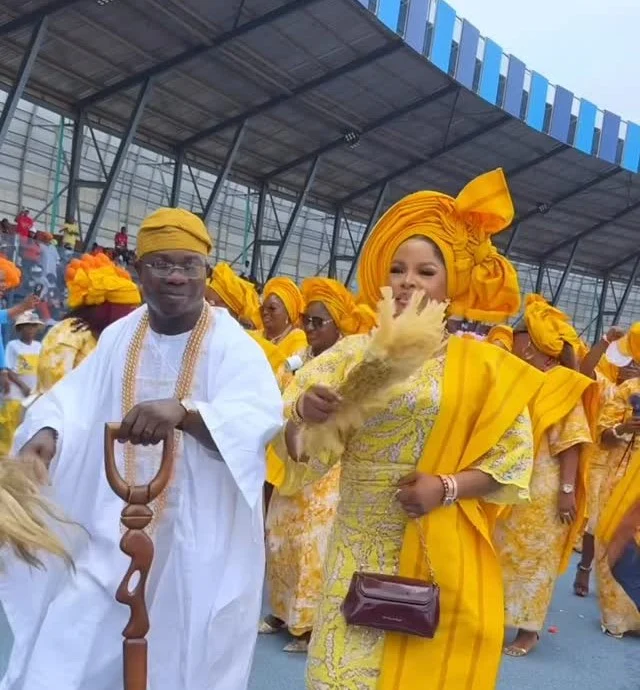
What began as a routine inter-house sports competition at Sunshine Schools in Ibadan, Oyo State, turned into a lively and colourful event as parents showed up in coordinated aso ebi, adding a new dimension to the traditional school activity.
The event, tagged “Sunshine Schools Olympics 2026,” featured the usual races and games for pupils. However, it was the parents’ appearance and participation that drew the most attention, both at the venue and on social media.
Videos from the event, which have since gone viral, showed groups of parents dressed in matching fabrics in bright colours such as yellow, blue, and white. Many of them danced, marched, and cheered in organised formations, creating an atmosphere similar to a cultural festival rather than a typical school sports day.
Inter-house sports competitions are a long-standing tradition in Nigerian schools. These events usually bring together students to compete in activities such as sprint races, relays, long jump, and march past displays. Each student is assigned to a “house,” often represented by a colour, and they compete for points and trophies.
Parents, on the other hand, typically attend as spectators. They come to support their children, take photos, and cheer from the stands, usually dressed in casual or everyday clothing.
However, the situation at Sunshine Schools showed a clear shift from this norm. Instead of remaining in the background, parents became active participants in the celebration, using coordinated clothing and group displays to show support for their children’s houses.
The development quickly sparked reactions online, with many Nigerians sharing their views on the trend.
Some social media users found the display amusing and praised the parents for bringing life to the event.
One user wrote, “This is no longer inter-house sports, this is parents’ Olympics. But I love the vibe!”
Another commented, “Nigerian parents will not carry last. Give them small opportunity, they will turn it into a full party.”
Others joked about the level of planning that must have gone into the coordinated outfits.
“Aso ebi for school sports? That means there was a WhatsApp group, contributions, and probably a committee,” a user posted.
However, not everyone was impressed. Some critics argued that the focus of the event should remain on the children.
One comment read, “The children are supposed to be the stars of the day. Parents should not overshadow them.”
Another user added, “It’s fun, but let’s not turn everything into a competition among adults.”
The use of aso ebi, a popular practice in Nigeria where groups wear matching outfits to events, is deeply rooted in the country’s social culture. It is commonly seen at weddings, parties, and other celebrations, where it serves as a symbol of unity and identity.
In recent years, aso ebi has expanded beyond traditional ceremonies to include birthdays, funerals, and even casual gatherings. The appearance of aso ebi at a school event like inter-house sports reflects how the culture continues to evolve.
For many parents, dressing in matching outfits may have been a way to show solidarity, pride, and support for their children. It also created an opportunity for social interaction among parents, strengthening relationships within the school community.
While it is not yet clear whether this trend will spread to other schools, the attention generated by the Ibadan event suggests that it could influence how future inter-house sports are organised.
The Sunshine Schools event highlights the changing nature of social activities in Nigerian schools. What was once a simple sporting event is now becoming a broader social gathering that includes parents, teachers, and the wider community.
For the students, the presence of enthusiastic parents may have added to the excitement of the day. Seeing their families actively support them could boost their confidence and sense of belonging.
At the same time, the reactions online show that Nigerians are divided on how far such involvement should go.
As schools continue to organise events that bring together students and families, the role of parents may continue to evolve. Whether through fashion, music, or dance, their participation is becoming more visible.
For now, the “Sunshine Schools Olympics 2026” will be remembered not just for the races won by students, but for the colourful display by parents that captured national attention.
The event has opened up a conversation about how traditions can change over time and how communities can find new ways to celebrate together.
Whether seen as a fun innovation or a distraction, one thing is clear: inter-house sports in Nigeria may never look quite the same again.