
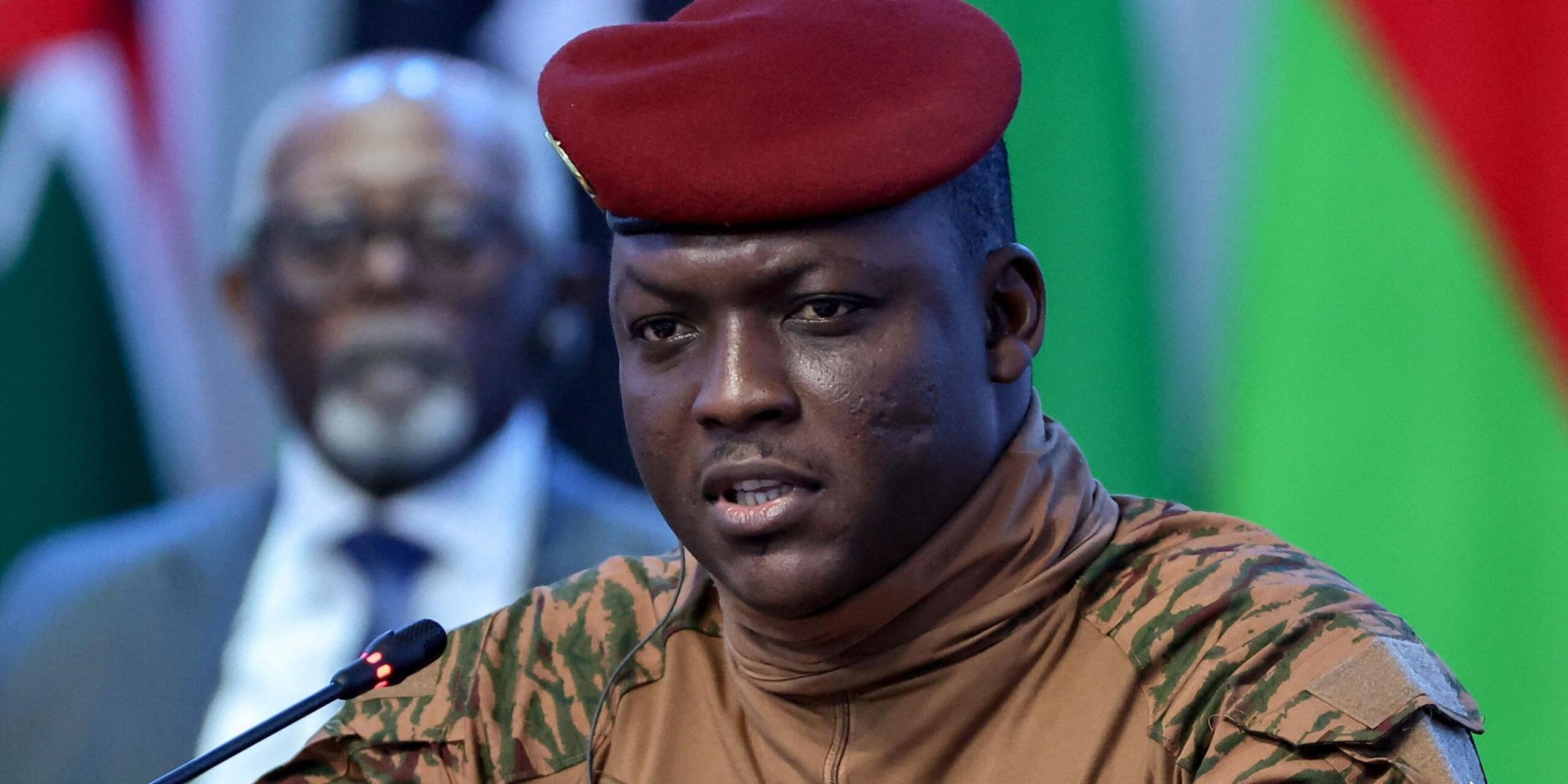
Burkina Faso is once again in political upheaval after its military leader, Captain Ibrahim Traore, dismissed the country’s Prime Minister and dissolved the government on Friday.
The decree, signed by the ruling military junta, announced that Apollinaire Joachim Kyelem de Tambela, who had served as Prime Minister since October 2022, was no longer in office.
The decree offered no explanation for the dismissal, fueling speculation and uncertainty over the country’s future.
Tambela, who had survived multiple government reshuffles since coming to power following a military coup, was abruptly removed from his position.
“The Prime Minister’s official functions are terminated,” the decree stated. It also noted that members of the now-dissolved government would remain in their posts until a new cabinet is formed.
Tambela had only served for about two years under the regime of Captain Traore, who came to power in a military coup that ousted Lieutenant-Colonel Paul-Henri Sandaogo Damiba.
Damiba himself had overthrown the previous government in January 2022, toppling elected president Roch Marc Christian Kabore, but he was ousted in another coup less than a year later.
Traore, at just 36 years old, now leads the junta government in a country that has seen instability following a series of military takeovers.
The reasons behind the prime minister’s removal remain unclear, but the decision has sparked debate over the state of Burkina Faso’s political future.
In the face of growing challenges, including armed insurgencies, Traore’s government has found itself increasingly isolated on the global stage.
Burkina Faso has moved away from its former colonial power, France, and sought new alliances with other military-led governments in the region.
Along with Mali and Niger, which have also undergone military coups, Burkina Faso formed the Alliance of Sahel States (AES) in September. This coalition has sought to break away from Western influence, particularly from France.
In a statement issued last month, Burkina Faso’s Foreign Minister, Karamoko Jean-Marie Traore, emphasized that the country’s relationship with Russia better suited its interests than its historic ties to France.
“We no longer want to be manipulated by France or the Economic Community of West African States (ECOWAS),” he declared, highlighting the shift in Burkina Faso’s foreign policy.
The alliance with Mali and Niger has stirred tensions with the broader West African community, especially ECOWAS, which has been at odds with the military juntas in the region.
ECOWAS has condemned the coups in Burkina Faso, Mali, and Niger, calling for a return to democratic rule. However, the military governments in these countries have largely ignored these calls, instead opting to strengthen their ties with Russia.
Burkina Faso’s pivot toward Moscow and away from the West represents a dramatic shift for the country, which had once been a close ally of France.
The removal of the prime minister and the dissolution of the government come at a time of heightened instability in the Sahel region.
In addition to the political crises, Burkina Faso is grappling with ongoing security threats from armed groups that have caused widespread displacement and humanitarian issues.
Captain Traore’s government has faced criticism for its inability to effectively combat these insurgencies, which have destabilized the country and the broader region.
Despite the challenges, Traore has maintained his position as the leader of the country, and the military government continues to hold power, with no immediate end in sight.
While the reason for the prime minister’s dismissal remains a mystery, it reflects the broader political instability that has come to define Burkina Faso since the 2022 coup.
The military junta’s decision to dissolve the government is likely to further exacerbate the country’s volatile political situation, as questions about leadership and governance remain unresolved.
As Burkina Faso navigates this new chapter in its turbulent history, many are left wondering how long the current regime can maintain its grip on power and whether the country will ever return to democratic rule.