
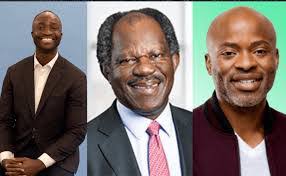
Forbes has released its 2024 ForbesBLK 50 list, celebrating the achievements of the wealthiest and most influential Black Americans.
The prestigious list honours individuals who have demonstrated remarkable financial success, societal impact, and leadership.
Among the honourees are three Nigerians—Adebayo Ogunlesi, Tope Awotona, and Wemimo Abbey.
Their inclusion is a testament to their entrepreneurial spirit and groundbreaking contributions across diverse industries.
The ForbesBLK 50 list, an evolution of the 2009 Wealthiest Black Americans compilation, recognises individuals who are shaping the future through innovation and influence.
Ogunlesi: The Infrastructure Visionary
Adebayo Ogunlesi, with a net worth of $1.7 billion, is a towering figure in global infrastructure investment.
As chairman and cofounder of Global Infrastructure Partners (GIP), Ogunlesi has reshaped the industry with bold acquisitions and strategic investments.
In 2024, GIP underwent a transformative $12.5 billion acquisition by BlackRock, further cementing Ogunlesi’s legacy.
Educated at Harvard as a lawyer and banker, Ogunlesi spent over two decades at Credit Suisse before founding GIP in 2006.
His work extends beyond boardrooms, as he champions global infrastructure development and economic progress.
Forbes praised Ogunlesi’s ability to “turn challenges into opportunities” in a competitive and capital-intensive field.
Awotona: Scheduling Genius Behind Calendly
Tope Awotona, the founder and CEO of Calendly, redefined efficiency in the world of scheduling.
With a net worth of $1.4 billion, Awotona’s journey from Lagos to global success is one of resilience and determination.
Born in Lagos, Nigeria, he moved to Atlanta as a teenager and pursued studies in business and management information systems at the University of Georgia.
Awotona’s early ventures were met with failures, but his frustration with scheduling inefficiencies inspired him to launch Calendly in 2013.
The platform, now valued at $3 billion, raised $350 million in 2021 and serves millions of users worldwide.
Forbes commended Awotona for “turning a simple idea into a global phenomenon” and proving that innovation in everyday challenges can lead to extraordinary success.
Abbey: The Young Fintech Trailblazer
At just 32 years old, Wemimo Abbey is the youngest Nigerian on the list.
Abbey, the cofounder of Esusu, has dedicated his career to tackling financial inclusion through technology.
Esusu, an African fintech company, enables renters to build credit by reporting rent payments to credit bureaus.
The platform has partnered with over 20,000 properties in the United States and benefits 1.8 million Americans.
In 2022, Esusu achieved a $1 billion valuation after raising $130 million in a funding round.
Abbey’s Lagos upbringing and background in mergers and acquisitions consulting influenced his mission to use technology for social impact.
“Esusu is not just a company; it’s a movement to create opportunities for those overlooked by traditional systems,” Abbey said in a recent interview.
The Nigerian Spirit on a Global Stage
The inclusion of these three Nigerians highlights the global impact of the Nigerian entrepreneurial spirit.
Despite operating in different industries, Ogunlesi, Awotona, and Abbey share a commitment to innovation and excellence.
Their success stories resonate with young Nigerians striving to make a mark in the world.
Their achievements also underline the importance of education, determination, and a clear vision.
Historical Context: The Evolution of ForbesBLK 50
The ForbesBLK 50 list is a reimagined version of Forbes’ 2009 Wealthiest Black Americans compilation.
The earlier list featured icons like Oprah Winfrey, Michael Jordan, and Magic Johnson, emphasising wealth accumulation.
The 2024 version goes beyond net worth, spotlighting societal impact, innovation, and leadership.
By recognising individuals like Ogunlesi, Awotona, and Abbey, Forbes underscores the evolving definition of success in the Black community.
A Symbol of Hope and Hard Work
The recognition of these Nigerians serves as a reminder that success does not require cutting corners or engaging in unethical practices.
Their achievements are built on hard work, innovation, and integrity.
As one commentator noted, “This shows that you do not need to do anything illegal to be recognised.”