
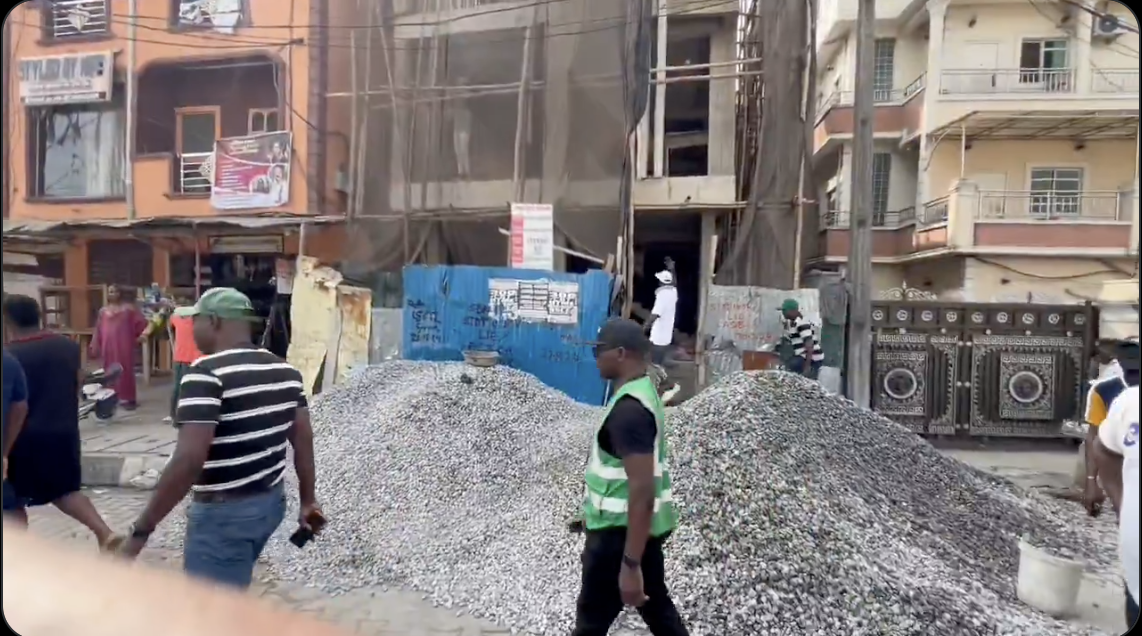
The Lagos State Government has intensified its crackdown on environmental violations by sealing multiple construction sites on Lagos Island for obstructing public roads with building materials. This decisive action highlights the state’s commitment to enforcing environmental regulations and maintaining urban order.
The properties in question are located at 65, 68, and 124 Adeniji Adele Road. They were sealed following an inspection led by the Lagos State Commissioner for Environment and Water Resources, Tokunbo Wahab, who described the situation as an “environmental nuisance.”
During the inspection, Wahab, accompanied by senior officials from the Ministry of Environment and Water Resources, identified several construction sites encroaching on public spaces. “While on an inspection tour of Lagos Island earlier today with the management staff of @LasgMOE, properties on 65, 68, and 124 Adeniji Adele road were ordered sealed for dropping building materials on the road and constituting environmental nuisance,” Wahab posted on his official X account, formerly known as Twitter.
A video shared along with Wahab’s announcement showed one of the sealed buildings, which was cordoned off with aluminum sheets. Piles of construction sand occupied a significant portion of the street, while the gutters were blocked, hampering proper drainage.
Another site displayed bags of cement and gravel stacked along the roadside, leaving little room for vehicles and pedestrians to maneuver. The encroachment disrupted the flow of traffic and raised concerns about public safety.
These activities not only created inconvenience for road users but also contributed to potential flooding risks by obstructing drainage channels—a recurring issue during Lagos’s rainy season.
The improper use of public spaces for private construction purposes is a long-standing problem in Lagos, a city grappling with rapid urbanization and infrastructure strain. Builders often use roadsides to store materials such as sand, cement, and gravel, a practice that, while convenient for them, has far-reaching negative implications.
Residents and commuters regularly face congestion caused by these obstructions, which reduce the already limited space available for vehicles and pedestrians. Beyond inconvenience, these activities compromise public safety and environmental health.
Moreover, the blockage of drainage systems exacerbates flooding, a frequent occurrence in Lagos due to its low-lying geography. Experts have warned that such practices could worsen the city’s vulnerability to climate change and urban flooding if not checked.
The sealing of these properties underscores the Lagos State Government’s determination to enforce compliance with environmental laws. Wahab emphasized that the government is committed to fostering a cleaner and more organized urban environment.
“These measures are necessary to protect public spaces and ensure compliance with environmental regulations,” Wahab said. “We must collectively work to maintain order and safeguard our urban infrastructure.”
The Lagos State Environmental Management and Protection Law, enacted to address such issues, empowers authorities to penalize individuals and organizations that misuse public spaces or violate environmental standards.
While the government continues to clamp down on offenders, it is also advocating for a shift in mindset among builders and developers. Urban planners and environmentalists have repeatedly stressed the need for construction professionals to adopt best practices that prioritize environmental sustainability and community well-being.
“This is not just about enforcement; it’s about changing attitudes,” said an environmental expert who spoke to our reporter. “If builders plan properly and make arrangements for on-site storage, these violations can be avoided. Compliance benefits everyone in the long run.”