
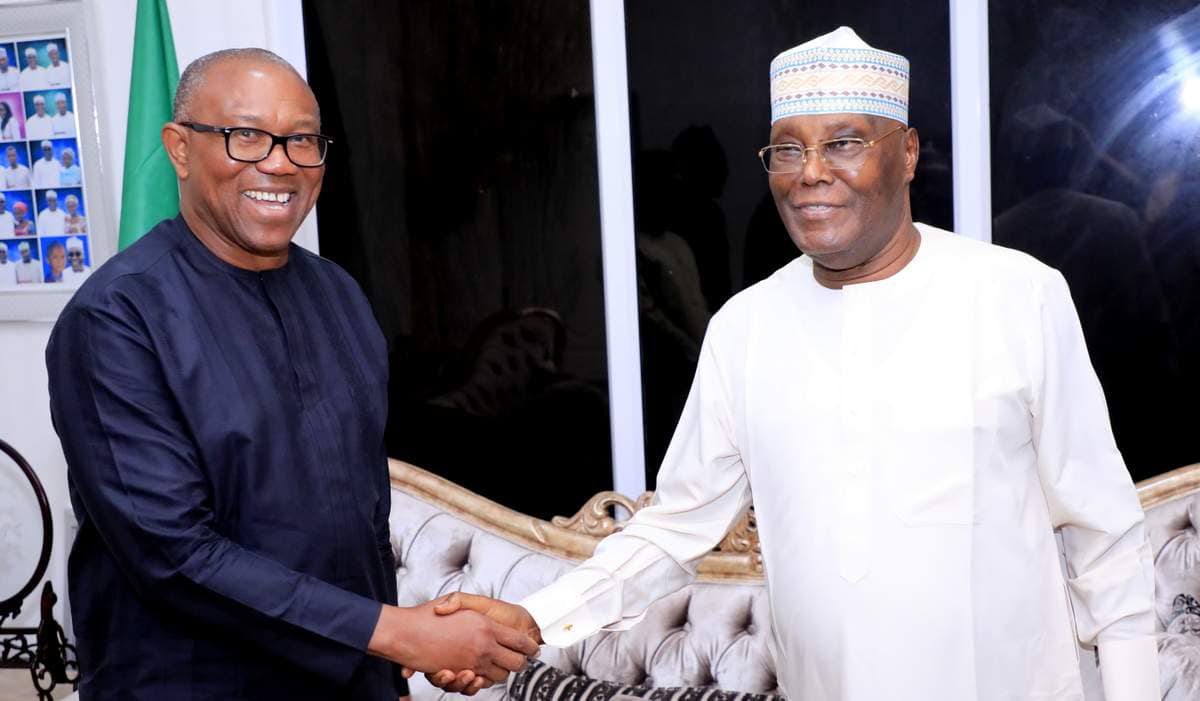
The political landscape in Nigeria has been shaken by a public disagreement between two prominent opposition figures, former Vice President Atiku Abubakar and Labour Party (LP) presidential candidate Peter Obi, over the future of the country’s opposition coalition against President Bola Tinubu.
The disagreement came to light during the ‘Democracy Conference’ held in Abuja, where Atiku, Obi, and other key political figures discussed the future of Nigeria’s democracy. The event, which attracted a diverse group of political leaders, academics, civil society members, and diplomats, focused on the theme “Strengthening Nigerian Democracy: Partway to Good Governance and Political Integrity.”
While Atiku strongly advocated for the formation of a robust opposition coalition to unseat Tinubu’s All Progressives Congress (APC) in the 2027 general election, Obi expressed his disapproval, saying he would not endorse any coalition focused solely on “power grabbing.” This marks the second time the two leaders have publicly differed on their approach to defeating the incumbent government.
Atiku Calls for Coalition Building to Unseat Tinubu
In his address at the conference, Atiku emphasized that opposition parties must unite in their pursuit of power, particularly as the 2027 elections approach. “It is extremely difficult to dislodge a governing party, however unpopular it may be, without a united opposition,” he said. Atiku, who ran for president under the People’s Democratic Party (PDP) in the 2023 elections, made the case for coalitions, highlighting their critical role in challenging entrenched political power. Drawing lessons from both Nigeria’s past and successful opposition movements in other countries, Atiku argued that only through strategic alliances could the opposition overcome the APC’s dominance.
“Coalition-building and outright mergers are essential for the opposition to build the necessary capacity to challenge a ruling party effectively,” Atiku explained.
The former vice president also criticized the current state of opposition parties in Nigeria, which he described as fragmented and lacking the cohesion necessary to present a credible challenge. “Our own history and examples from other countries prove that coalition-building is not just an option; it’s a necessity,” he added.
Obi’s Dissent: A Call for Nation-Building Over Power Struggles
Peter Obi, however, voiced a starkly different perspective. In his response, the LP leader distanced himself from any political arrangement that appeared to prioritize power at the expense of national development. “I’m not interested in coalition for the purpose of power grabbing,” Obi declared. He explained that many previous coalition efforts had been driven by the goal of seizing power, without addressing the deeper issues facing Nigeria.
For Obi, the future of the country hinges on leadership that places the nation’s welfare above political calculations. “We must talk about the future of Nigeria,” he insisted. “It is about securing the country, ensuring the education of our children, and caring for the common people. That’s what matters most now, not just winning elections for the sake of power.”
Obi’s stance comes from his frustration with what he sees as a prevailing culture of political maneuvering that sacrifices long-term national development for short-term power gains. He called on Nigerians to focus on strengthening democracy by addressing the issues that directly affect citizens’ lives, such as security, education, and economic stability.
“We need to stop the monetization of politics, because it encourages the theft of public funds,” Obi said, referring to the practice of using illicitly obtained money to fund electoral campaigns. “When stolen money is used to win elections, those in power are not held accountable.”
The Opposition Divide: A Show of Political Friction
The disagreement between Atiku and Obi over the future of the opposition comes at a critical juncture for Nigerian politics. While Atiku advocates for a coalition of opposition parties united by shared political goals, Obi has made it clear that he sees such alliances as fraught with corruption and a lack of genuine commitment to national progress.
Their public clash reflects broader tensions within the opposition, with other political figures, such as Senator Rabiu Kwankwaso of the New Nigeria Peoples Party (NNPP), also expressing skepticism about any coalition efforts. Kwankwaso, who is still influential in northern Nigeria, has accused the proposed coalition leaders of hypocrisy and opportunism.
The divisions within the opposition are particularly troubling as the 2027 election approaches. While some, like Atiku, believe that unity is crucial to challenge the APC, others, like Obi, fear that such a coalition could undermine the country’s democratic values and lead to further political instability.
Atiku’s Vision for Strengthening Democracy
During the conference, Atiku also outlined several critical reforms needed to strengthen Nigeria’s democracy. He emphasized the importance of party institutionalization, where parties are driven by ideas and not by individuals. “Political parties must be democratic enough to perform their roles effectively,” Atiku noted, suggesting that the ownership of political parties should not be concentrated in the hands of a few wealthy individuals or state governors.
The PDP stalwart also addressed concerns regarding the funding of political parties, advocating for more democratic funding mechanisms. “Funding should come from the masses, not just from governors or a few billionaires,” he said. “This way, party members will be more invested and engaged in the democratic process.”
Atiku also touched on the need for judicial reforms to ensure that political processes remain fair and transparent. “Judicial recklessness must be curbed,” he remarked, signaling that reforms in the judiciary are critical to the long-term stability of Nigeria’s democracy.
The Road Ahead for Nigeria’s Opposition
As the opposition navigates this tumultuous period, it remains uncertain whether Atiku and Obi’s differing views on coalitions will impact their future political strategies. While Atiku’s call for unity may find traction among those who believe a coalition is the only way to unseat the ruling party, Obi’s emphasis on integrity and national development may resonate with Nigerians disillusioned by the politics of power games.
With the 2027 elections in sight, the fate of Nigeria’s democracy will depend on whether opposition leaders can find common ground or whether their differences will further fragment the political landscape. For now, the debate between Atiku and Obi is a vivid reminder that the road to a stronger, more inclusive democracy in Nigeria will require more than just political alliances—it will demand leadership that prioritizes the nation’s future over the pursuit of power.
As the 2027 election approaches, the battle for Nigeria’s democratic soul is just beginning, with no clear victor in sight.