
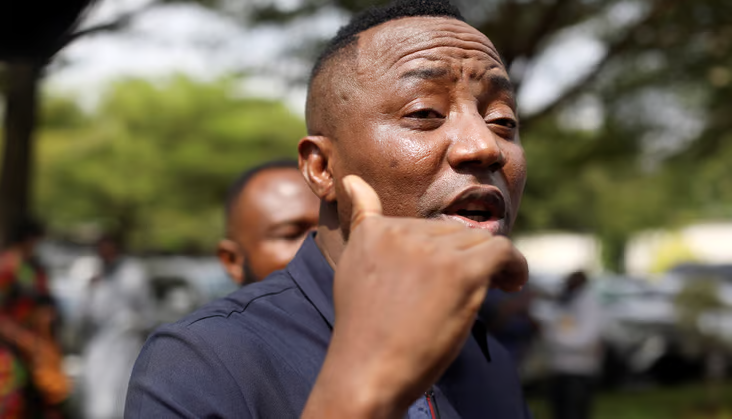
Omoyele Sowore, former presidential candidate and fierce rights activist, is set to appear before Justice Abdullah Liman at the Federal High Court in Abuja on Wednesday, January 29, 2025, over allegations of defamation and cyberstalking. The charges stem from his controversial social media posts in which he referred to Kayode Egbetokun, the current Inspector General of Police (IGP), as an “illegal IG.”
The high-profile case is expected to draw widespread attention, as Sowore is a well-known critic of the government and its leadership, often using his platform to challenge political figures and institutions. On the other side, the IGP’s office has taken a strong stand against the accusation, accusing Sowore of intentionally trying to incite unrest.
Sowore’s lawyer, Marshall Abubakar, confirmed the court date to reporters, stating, “The police have procured charges to arraign Omoyele Sowore before Justice Liman tomorrow. We are prepared to address the issues raised in the charge.”
According to court documents, Sowore faces multiple charges under the Cybercrime (Prohibition, Prevention, Etc.) Act, 2015, as amended in 2024. The charges are linked to messages Sowore allegedly sent through his verified Twitter handle, “Omoyele Sowore,” in December 2024. These posts included inflammatory statements about IGP Egbetokun, accusing him of being an illegitimate appointee and warning of a potential resurgence of protests similar to the #EndSARS movement.
In one of the tweets, Sowore wrote, “The illegal IG of Nigeria Police Force, Kayode Egbetokun, will make the next #ENDSARS inevitable! He is working tirelessly towards it. Just a matter of time. #EgbetekunMustGo #Revolution.” This message, along with others posted on his account, is central to the charges against him.
The specific charges listed in the court documents read:
- Count One: “That you, Omoyele Sowore, on December 13, 2024, knowingly sent messages through your verified Twitter account, calling the Inspector General of Police ‘illegal IGP Kayode Egbetokun,’ an accusation you knew to be false, with the intention to disrupt public order.”
- Count Two: “That you, on the same day, intentionally published another message that sought to incite Nigerians against the police force, thereby jeopardizing the reputation of the Inspector General and the Nigeria Police Force.”
- Count Three: “On December 20, 2024, you sent another publication that falsely labeled the IGP as ‘illegal’ and suggested a future #ENDSARS protest, an act which was aimed at creating unrest.”
These charges, according to legal experts, carry significant penalties under the Cybercrime Act, potentially leading to imprisonment if found guilty. The government, through the police, has made it clear that such public remarks, if left unchecked, could undermine the authority of law enforcement and provoke nationwide disorder.
While the case continues to attract media coverage, Sowore’s supporters argue that the charges against him are politically motivated and designed to silence dissent. A prominent figure in the #RevolutionNow movement, Sowore has been outspoken about what he perceives as corruption and authoritarianism within the Nigerian government.
However, Egbetokun’s office maintains that the defamation charges are valid. A police source close to the investigation stated, “The act of publicly labeling the IGP as ‘illegal’ is a direct attack on the integrity of the police force and the government. These kinds of statements do not just harm individual reputations, but they also disrupt the public peace. The law is clear in this regard, and justice must take its course.”
This legal drama has unfolded against the backdrop of simmering tensions between the Nigerian government and activists critical of its policies. In recent years, there has been increasing concern over the treatment of critics and the suppression of free speech, with many pointing to the use of legal frameworks to target opposition voices.
The conflict between Sowore and Egbetokun is more than just a legal dispute; it represents a larger struggle over the space for political expression in Nigeria. Sowore’s social media account has long been a platform for his anti-government views, with frequent criticisms of the police, the judiciary, and political leaders. His legal battle could set a significant precedent for how similar cases are handled in the future.
Sowore, whose activism gained significant attention during the #EndSARS protests in 2020, has repeatedly clashed with authorities. He was arrested multiple times during the protests, which sought an end to police brutality in the country. His criticisms of the police and government have made him a controversial figure, beloved by many for his defiance but equally despised by others who view his actions as destabilizing.
Speaking in an earlier interview, Sowore defended his statements, claiming that his posts were an exercise of his right to free speech. “I will not be silenced. The IGP may try to intimidate me, but I will continue to speak the truth,” he asserted. “The Nigerian police have failed the people, and I will hold them accountable, just as I have always done.”