
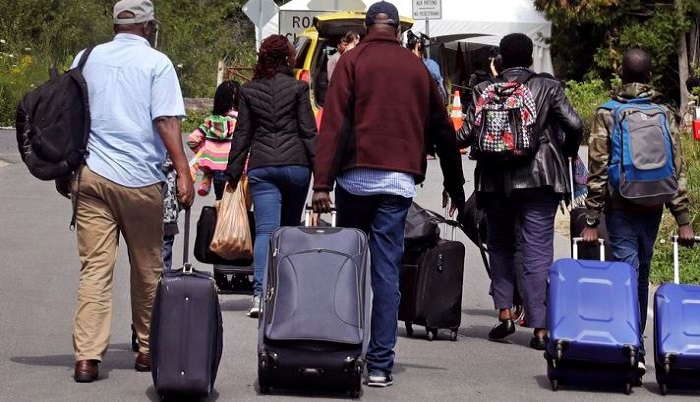
A group of 180 Nigerian migrants, who had been stranded in Libya, were repatriated back to Nigeria on Wednesday. This was made possible through a chartered flight arranged by the Nigerian government, marking another step in the country’s ongoing efforts to assist its citizens who have been affected by illegal migration and human trafficking.
The flight, which carried 76 men, 92 women, 8 children, and 4 infants, landed safely in Nigeria with the full backing of various governmental bodies, including the National Commission for Refugees, Migrants and Internally Displaced Persons (NCFRMI), as well as international partners like the International Organisation for Migration (IOM).
According to a statement released by Alexander Oturu, the Southwest Zonal Coordinator of NCFRMI, the repatriation was the result of a “coordinated, all-of-government approach” that was executed with the help of Nigeria’s mission in Tripoli, Libya.
“The federal government facilitated the reception of 180 Nigerian migrants who were stranded in Libya. Their humanitarian return was facilitated by the Nigerian mission in Tripoli and the International Organisation for Migration (IOM),” Oturu said in the statement, which was issued on Thursday.
The migrants’ return is a part of the Nigerian government’s broader strategy to help its citizens who find themselves in distressing situations abroad, particularly in countries like Libya, where many Nigerians have been stranded after attempting to cross into Europe. Libya has become a notorious hub for migrants from across Africa, many of whom are trying to make their way to Europe but find themselves trapped in difficult, often dangerous, conditions.
Many Nigerians leave their homes seeking better economic opportunities abroad. However, in the case of those who find themselves in Libya, the reality is often much harsher. Libya’s political instability, compounded by the exploitation of migrants, has turned it into a hotspot for illegal migration.
“Many Nigerians set out for better opportunities but end up being caught in a cycle of poverty, exploitation, and abuse,” said one of the returnees who spoke on condition of anonymity. “Libya is a difficult place to survive, especially if you don’t have the right connections or resources.”
The plight of Nigerian migrants has drawn increasing attention from the Nigerian government and international organisations, which have ramped up efforts to ensure safe returns.
The Nigerian government, under President Bola Tinubu’s leadership, has made it a priority to provide support for returnees, offering them a pathway to reintegrate into society and rebuild their lives.
In line with President Tinubu’s Renewed Hope Agenda, the federal government intends to integrate the returnees into various government programmes designed to support vulnerable populations. According to Oturu, these programmes will include both government-run initiatives and those facilitated by the UN Migration Agency (IOM).
“These returnees will be reintegrated into society through various government and IOM programs that are tailored to help them rebuild their lives,” Oturu explained. “This is a part of the federal government’s comprehensive approach to ensuring that our citizens have the opportunity to thrive once they return home.”
Upon their arrival in Lagos, the returnees were taken to a temporary shelter operated by the Lagos State Emergency Management Agency (LASEMA), as part of an agreement between the NCFRMI and IOM. The shelter provides basic amenities, safety, and support as the returnees begin the process of reintegration into Nigerian society.
In addition to temporary shelter, the returnees are also set to receive onward transportation allowance, which will help them travel to their homes in different parts of Nigeria. The allowance is intended to ease the financial burden of travel and help the returnees reintegrate into their communities.
The International Organisation for Migration (IOM) has played a key role in facilitating the repatriation process. The organisation’s assistance has been crucial in managing the logistics of bringing stranded migrants back home safely.
The issue of irregular migration has been a growing challenge for Nigeria and many other African countries. Every year, thousands of Nigerians embark on dangerous journeys, attempting to travel through Libya to reach Europe. Many of them fall prey to human traffickers, who exploit their hopes for a better life.