
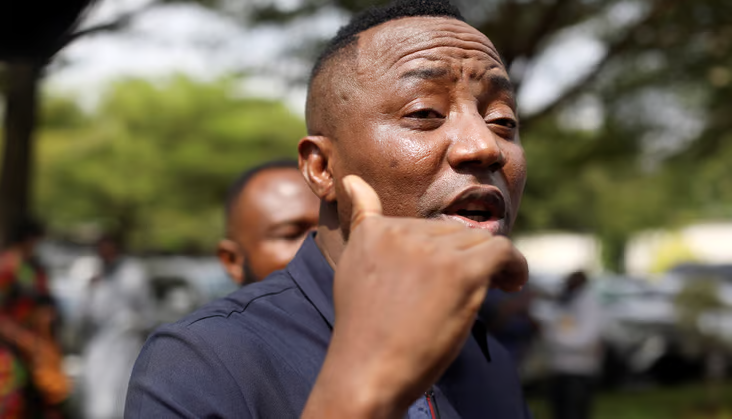
Omoyele Sowore, the convener of the #RevolutionNow movement, has called former Nigerian military leader, General Ibrahim Babangida, a “villain” and condemned him for his role in the annulment of the 1993 June 12 presidential election. Sowore expressed outrage that Babangida, who annulled the election widely believed to have been won by businessman Moshood Kashimawo Olawale (MKO) Abiola, continues to live freely and even enjoys public honours, despite the deep political consequences of his actions.
Sowore’s remarks, made in an interview with Nigerian Info FM, have sparked significant conversation about the painful legacy of June 12, 1993, and the lasting damage caused to Nigeria’s democratic journey. Babangida, who served as the country’s leader from 1985 to 1993, remains one of the most controversial figures in Nigeria’s history. His annulment of the election is often cited as a key moment that delayed the country’s transition to civilian rule and led to years of political instability and unrest.
The June 12 election was seen as Nigeria’s freest and fairest election up to that point, with Abiola, a wealthy businessman and philanthropist, defeating his opponent, Bashir Tofa, in a race that transcended ethnic and regional divides. However, after the election, Babangida’s government, citing what they referred to as “impending doom” and other unfounded claims, annulled the results, sparking widespread protests and leading to political turmoil.
Abiola’s eventual imprisonment, the mysterious death of his wife, Kudirat Abiola, and his own subsequent death while in custody, remain unresolved and tragic chapters of Nigeria’s political history. Many Nigerians still view the annulment as a deliberate attempt to deny the will of the people and derail the democratic process.
In a recent public event, Babangida, during the launch of his book “The Journey in Service” and a fundraising event for his presidential library, acknowledged that Abiola had won the election but attempted to justify his annulment by suggesting it was done to prevent further chaos in the country. His attempt to explain his actions did not sit well with Sowore, who described Babangida’s defence as “foolish talks.”
Sowore, a prominent human rights activist and advocate for good governance, was visibly disheartened by the fact that Babangida, who is widely blamed for undermining democracy, continues to receive respect and even praises from some quarters of Nigerian society. He argued that the former military leader, instead of being hailed for his “evil genius,” should have been put on trial for his actions.
During the interview, Sowore said, “I’m convinced and I have expressed even before the book was launched a few days ago that it was going to be a pack of lies.” He condemned the fact that Babangida, 32 years after the annulment, was still able to host a book launch and raise over N17 billion in three hours, a stark contrast to the suffering caused by the actions he took in 1993.
Sowore added, “Nigeria never worked and we must make sure that this country works so that people who engage in impunity and criminal activities just don’t get away with it in such a way that they were even rewarded years later.”
According to Sowore, Babangida’s actions disrupted the trajectory of Nigeria’s progress. He firmly believes that had Abiola been allowed to take office as president, Nigeria would have made significant strides towards democracy and economic stability.
One of the most contentious aspects of Babangida’s recent statements is his denial of personal responsibility for the annulment of the June 12 election. While acknowledging that Abiola won the election, Babangida sought to shift blame, implying that the decision to annul the election was made to prevent chaos, even mentioning the late General Sani Abacha, his successor, as a central figure in the decision-making process.
Sowore sharply rejected these claims, describing Babangida as someone who has never told the truth and accused him of continuing to engage in falsehood. Sowore argued that Babangida never wanted to relinquish power and only did so after being forced out in August 1993, following mounting political pressure.
Sowore remarked, “IBB has never told the truth in his life, and I’m not surprised that he has continued to engage in falsehood… IBB never wanted to hand over power. We forced him out of power in August 1993.”
One of the central themes of Sowore’s criticism is the failure of Nigeria’s political and legal systems to hold leaders accountable for their actions. He expressed frustration with the fact that Babangida has never faced legal consequences for his role in the annulment of the election, nor for the many other controversial events during his eight-year rule, including the bombing of journalist Dele Giwa and the mysterious disappearance of millions of dollars following the Gulf War windfall.
Sowore lamented the state of Nigerian democracy, explaining that it is a nation where impunity prevails because of a lack of accountability. He pointed out that the failure to prosecute those responsible for undermining democracy in the past has contributed to Nigeria’s ongoing political problems.
“The country would have made considerable progress traveling down the lane of democratic progress and economic progress… but that was suspended and disrupted by Babangida and his gangs,” he said.
He also criticised the Nigerian public for forgetting or not understanding the full extent of the damage caused by Babangida’s annulment, particularly among the younger generation, many of whom were born after 1993 and have not been properly taught about the country’s political history.
Sowore dismissed Babangida’s recent attempts to take responsibility for the annulment, saying that what was needed was not an apology, but rather a legal punishment for his crimes. He cited examples from history where individuals involved in crimes against humanity were tried well into old age, highlighting the importance of justice, no matter how long it takes.
He stated, “Apology is not what is needed because people ought to be deterred from doing this in the future. Anybody who wants to annul an election, or rig an election, will derive his inspiration from Babangida who did it.”
Sowore also outlined the punishment he believes Babangida and his collaborators deserve: an immediate round-up, arrest, and trial to expose all those involved in the election annulment and other crimes from that era. He called for full disclosure of the truth behind the death of Dele Giwa, the phantom coup that led to the deaths of military officers, and the missing $12 billion from Nigeria’s coffers during Babangida’s time in power.
While Sowore acknowledged that the current political leadership in Nigeria may not be willing to bring Babangida to justice, he expressed hope that future leaders would hold those responsible for Nigeria’s past mistakes accountable.
Sowore reiterated that Babangida’s legacy should not be one of admiration but of accountability. “Babangida is a villain and he should be consigned to the dustbin of history,” he said.