
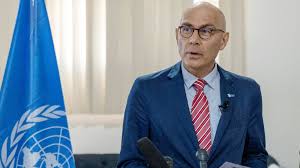
The United Nations High Commissioner for Human Rights, Volker Türk, has called on the United States government to immediately withdraw sanctions it imposed on four judges of the International Criminal Court (ICC). The move comes amid growing global criticism of what many see as an attack on judicial independence and international justice.
The US sanctions were announced on Thursday by Secretary of State Marco Rubio. According to the US government, the measures are in response to the ICC’s recent actions, including issuing arrest warrants for senior Israeli officials—most notably Prime Minister Benjamin Netanyahu—and opening investigations into alleged war crimes committed by US forces in Afghanistan.
Speaking in a statement on Friday, UN rights chief Volker Türk expressed deep concern, saying: “I am profoundly disturbed by these sanctions. Attacks against judges go against the very principles of the rule of law and equal protection of the law—values the United States has historically championed.”
The sanctions target four female judges from different parts of the world: Solomy Balungi Bossa of Uganda, Luz del Carmen Ibáñez Carranza of Peru, Reine Adelaide Sophie Alapini Gansou of Benin, and Beti Hohler of Slovenia. The sanctions freeze any property or financial interests they may hold in the US and require American individuals or institutions to report any such holdings to the Treasury Department.
The ICC condemned the move in strong terms, stating the sanctions were a “clear attempt to undermine” the court’s independence. In a statement, the court said, “Targeting those working for accountability does nothing to help civilians trapped in conflict. These sanctions affect not only the named individuals but also everyone supporting the Court’s mission to uphold international justice.”
The ICC, based in The Hague, is the world’s permanent court for prosecuting individuals for genocide, war crimes, and crimes against humanity. Its recent decisions to investigate alleged crimes committed by both the Israeli government and US military forces have sparked backlash, particularly from the governments involved.
The Israeli government welcomed the US sanctions. Prime Minister Netanyahu personally thanked Secretary Rubio and former US President Donald Trump, saying they had “stood up for the right of Israel to defend itself.” Netanyahu has consistently rejected the ICC’s authority, calling its actions “outrageous.”
Rubio, in his statement, accused the court of being “politicised” and claimed it was acting “illegitimately and without jurisdiction” over the US and its allies. “This dangerous abuse of power infringes on the sovereignty and national security of the United States and Israel,” he said.
The four judges sanctioned were involved in critical rulings: Judges Bossa and Ibáñez Carranza authorised the ICC’s investigation into alleged war crimes by US personnel in Afghanistan, while Judges Alapini Gansou and Hohler issued arrest warrants for Netanyahu and Israel’s former Defence Minister, Yoav Gallant, over alleged war crimes in Gaza.
Last year, the ICC found “reasonable grounds” to believe that Netanyahu, Gallant, and Hamas military leader Mohammed Deif bore “criminal responsibility” for war crimes and crimes against humanity during the Israel-Hamas conflict. While the ICC also issued an arrest warrant for Deif, Hamas later confirmed he was killed in an Israeli airstrike. Both the Israeli government and Hamas have rejected the allegations.
The controversy over the ICC’s authority is not new. In February, the Trump administration had already imposed sanctions against the ICC’s chief prosecutor, Karim Khan, accusing the court of overstepping its mandate.
However, the latest round of sanctions marks a significant escalation, as they directly target serving judges. Legal experts and human rights groups have warned that such measures risk weakening the credibility of international justice systems and could deter future investigations into serious crimes.
“The independence of judges is essential to any court’s legitimacy,” said one senior legal analyst in response to the situation. “By sanctioning judges for doing their job, the US sends a dangerous message that political interests are above the law.”
As the international community watches closely, many fear that the confrontation between the US and the ICC could set a troubling precedent for how powerful nations respond to global accountability efforts.
UN High Commissioner Türk concluded his appeal by calling for the sanctions to be “promptly reconsidered and withdrawn,” warning that continued pressure on the ICC would only embolden impunity in conflict zones around the world.