
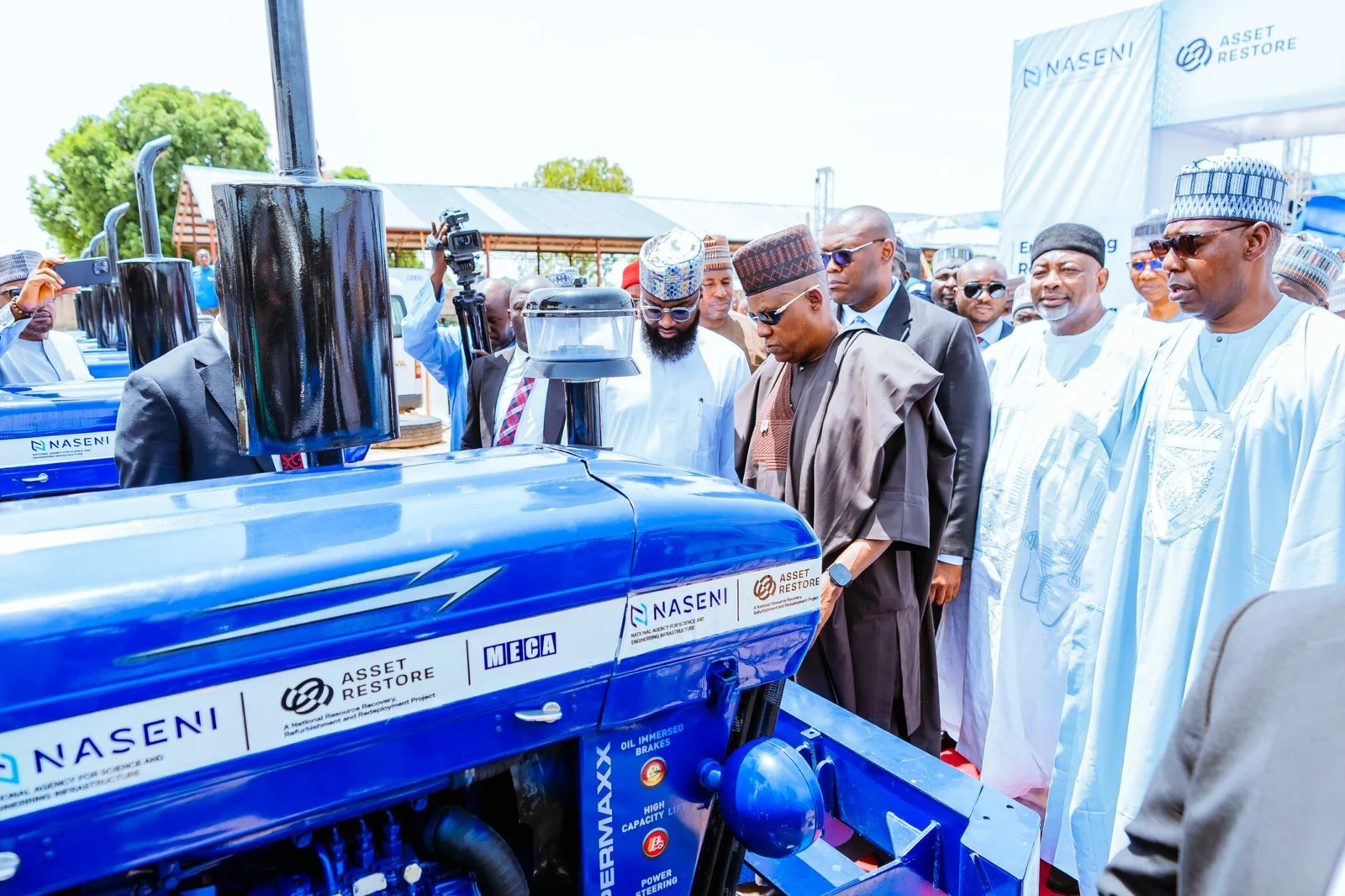
Vice President Kashim Shettima on Sunday flagged off the National Assets Restoration Programme by commissioning 375 refurbished tractors at the Borno State Agricultural Mechanization Agency Farm Centre. The initiative, led by the National Agency for Science and Engineering Infrastructure (NASENI), aims to revive idle and abandoned national assets to boost Nigeria’s agricultural sector and overall economy.
Speaking at the event in Maiduguri, Shettima described the programme as a timely and innovative response to Nigeria’s long-standing problem of neglected public assets. “This initiative is a powerful shift in how we think about value, sustainability, and innovation. It fits within the broader vision of President Bola Ahmed Tinubu’s administration to build a productive, self-reliant, and diversified economy,” he said.
He stressed that the programme is designed to increase productivity across agriculture, industry, and other sectors by investing in infrastructure, skills development, and technology. “We must commend NASENI for stepping forward with this brilliant idea to mitigate a national tragedy. They have shown great capacity in technology transfer and home-grown engineering,” Shettima added.
The tractors commissioned were part of a larger purchase of 1,000 tractors made by Borno’s former governor, now Vice President Kashim Shettima, when he led the state. Governor Babagana Umara Zulum of Borno State, who hosted the event, acknowledged this foundational investment and thanked NASENI for refurbishing broken-down tractors without charging the state government.
“This is the single largest investment not just in Borno but in Nigeria. The National Assets Restoration Programme could not have been possible without this foundation,” Governor Zulum said, praising NASENI’s commitment to restoring state-owned assets.
Executive Vice Chairman of NASENI, Khalil Suleiman Halilu, in his keynote address, said the programme shows that Nigerian problems can have Nigerian solutions. “We are building local capacity, developing talent, and enabling technology transfer at scale. We are turning NASENI into a national enabler, quietly but boldly proving that government can deliver transformation,” he said.
Halilu explained that Nigeria has over 47,000 broken but serviceable agricultural and security assets locked away or left to rust. The estimated replacement cost of these assets exceeds ₦14 trillion. However, the restoration programme offers a solution to recover these assets at only 15 to 25 percent of their replacement cost, saving the country over ₦10 trillion.
“Our national survey revealed the vast value hidden in these broken assets. With the right engineering, people, and partnerships, we can restore full functionality and revive productivity, create jobs, and improve security,” he added.
Halilu thanked President Tinubu and Vice President Shettima for their constant support and encouragement, as well as Governor Zulum for turning Borno into the first node of the national restoration network.
The Minister of Agriculture and Food Security, Senator Abubakar Kyari, also commended the initiative, highlighting its importance for food security. “The National Assets Restoration Programme aligns perfectly with the government’s Renewed Hope Agenda. It will play a critical role in meeting our food security goals,” he said, praising NASENI’s bold vision.
Earlier, Engr. Mohammed Yadudu, NASENI’s Programme Coordinator for Asset Restore, explained that with support from their technical partner, Machine and Equipment Corporation Africa (MECA), the restoration work began in December 2024. The project focuses on reviving government-owned assets that have long been idle but hold great value for agriculture and the economy.
The restoration of tractors and other machinery under this programme marks a significant step toward mechanizing Nigerian agriculture, reducing dependency on imports, and improving productivity. The tractors will be deployed to farmers in Borno and other states to boost agricultural output, create jobs, and support economic growth.
The National Assets Restoration Programme reflects a growing commitment by the Nigerian government to use innovation and technology to address long-standing challenges. By rehabilitating idle assets, Nigeria stands to save billions of naira while enhancing local industries and food production.