
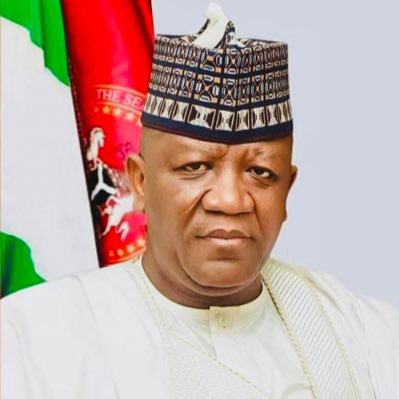
Former Zamfara State Governor and current Senator, Abdulaziz Yari, has criticised Nigerians who call on United States President, Donald Trump, to intervene in the country’s affairs, saying no foreign power can fix Nigeria. He insisted that the task of repairing the nation rests solely on Nigerians, especially the political elite who control the country’s political and economic direction.
Yari made the remarks on Wednesday in Abuja during the launch of the One Nigeria Project, an initiative organized by the National Association of Former Local Government Council Chairmen (NALGON). The program brought together former public office holders, political leaders, and stakeholder groups to discuss unity, governance reforms, and grassroots development.
Speaking at the event, Yari expressed deep concern over the growing trend of citizens appealing to foreign governments and leaders when national issues arise. He said such calls are a sign of misplaced expectations and a refusal to confront Nigeria’s internal problems.
“America calls itself God’s own country, but Nigeria is even more of God’s own country. If Nigerians can put the country first like Americans do, we will overcome our challenges,” he said.
Yari criticized those who believe the U.S. president—or any foreign leader—can solve Nigeria’s political, economic, or security challenges.
“Stop calling on Trump; he has no business in Nigeria. Only Nigerians can fix Nigeria,” he said, urging citizens to focus more on unity and national responsibility rather than foreign intervention.
The senator also took aim at Nigeria’s political elite, accusing them of causing most of the divisions in the country. According to him, the elite class, which he estimates at fewer than two million people, has the power to unite or divide the nation.
He said insecurity, economic problems, and social divisions are usually worsened by the actions or disagreements of the elite, not ordinary citizens.
“If the elite agree to work together in the interest of the nation, insecurity and other national problems will be solved,” he said.
Yari explained that the political class holds the key to building trust, creating fair policies, and addressing long-standing grievances across regions and ethnic groups.
Yari, who said he has been monitoring local government administration since 1986, once again highlighted the importance of strengthening local government structures. He argued that local governments must receive proper funding and constitutional backing to function effectively.
According to him, Nigeria cannot develop fully if local councils remain weak, financially dependent, or badly managed.
He stressed that strong local governments would be better positioned to deliver basic services, support community development, and reduce rural insecurity by addressing problems before they escalate.
“If Nigeria is serious about solving insecurity and strengthening the economy, the government must empower local councils. They are the closest to the people,” he said.
In what appeared to be a subtle jab at political figures with foreign citizenship, Yari also said he is fully loyal to Nigeria and holds only a Nigerian passport.
He suggested that some public commentators and critics speak carelessly because they have alternative countries to fall back on, while millions of ordinary Nigerians have no such options.
“Those with multiple passports forget the weight of their words because they have alternatives. We do not. Our roots are here,” he said.
His comments touched on an ongoing national debate about loyalty, patriotism, and the influence of Nigerians living abroad on countrywide discourse.
Also speaking at the event, former Attorney-General of the Federation, Michael Aondoakaa, supported Yari’s call for stronger local government systems. He argued that councils must be empowered because they are the first line of contact between citizens and government.
According to Aondoakaa, local leaders know their communities better and can easily work with traditional institutions, youth groups, and security agencies to identify threats early.
He said Nigeria’s security problems would reduce significantly if local governments were adequately funded, monitored, and allowed to function independently.
“Local government leaders are closest to the people and understand their communities better than anyone. They must be supported and empowered,” he stated.
Former Benue State Governor, Samuel Ortom, also addressed the gathering and urged Nigerians to support President Bola Ahmed Tinubu’s administration regardless of political or ethnic differences.
Ortom said national stability requires cooperation between past and current leaders, and between communities across different parts of the country.
“We must support the President and avoid sentiments. Nigeria belongs to all of us,” he said.
The former governor also encouraged former local government officials to collaborate with those currently in office to share knowledge, experience, and strategies for effective governance.
Yari’s remarks come at a time when debates about foreign influence and the role of diasporan voices have intensified. Some Nigerians, frustrated by insecurity, economic hardship, and governance challenges, have increasingly looked toward foreign powers—especially the U.S. and U.K.—to pressure the Nigerian government.
In recent years, social media campaigns have tagged foreign presidents, lawmakers, and organizations in attempts to attract attention to Nigerian issues such as police brutality, human rights concerns, and election-related conflicts.
Critics of this trend argue that relying on foreign intervention reflects desperation and a collapse of trust in local institutions. Others believe Nigeria must solve its problems internally through stronger leadership, accountability, and citizen engagement—an argument echoed strongly by Yari.
Yari concluded his remarks by calling for unity and a renewed commitment to national development. He stressed that Nigeria’s diversity should be a strength, not a weakness, and warned that division among political leaders only deepens insecurity and poverty.