
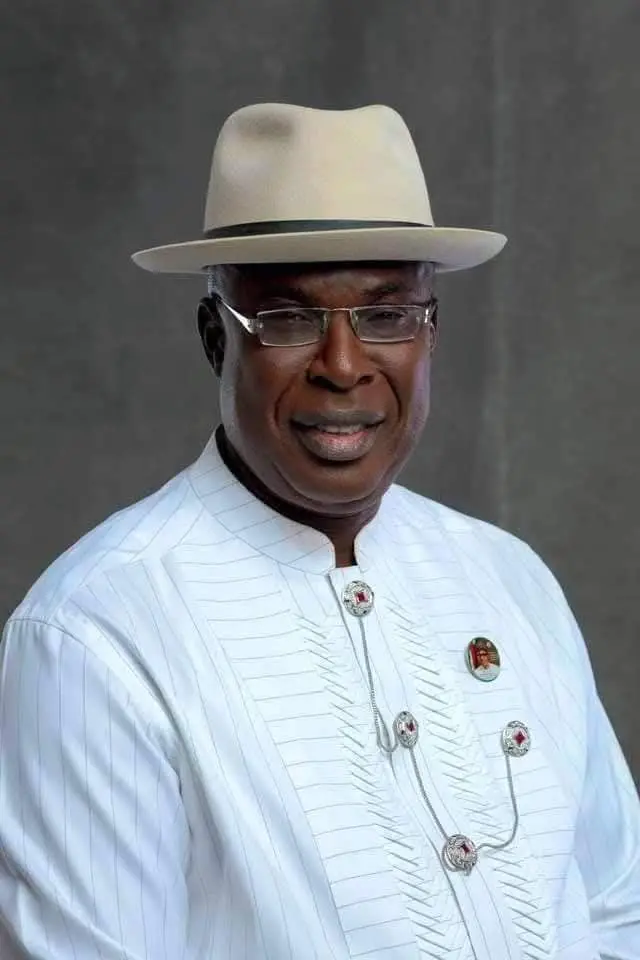
The Maitama residence of former Bayelsa State Governor and ex-Minister of State for Petroleum Resources, Chief Timipre Sylva, has been sealed by the Economic and Financial Crimes Commission (EFCC). The move comes weeks after the anti-graft agency declared him wanted over an alleged $14.8 million fraud case.
The sealing of the property sparked strong reactions on Monday, as Sylva’s Special Assistant, Julius Bokoru, issued a statement condemning the action. He described the EFCC’s move as unlawful, disrespectful, and a violation of due process.
The statement, titled “A grave breach of decency: EFCC’s attempted raid and defacement of Sylva’s family home,” accused the commission of “behaviour unbecoming of any institution that claims to act in the national interest.”
According to Bokoru, EFCC officials arrived at the former governor’s home without issuing any prior notice or invitation and without presenting a warrant or subpoena. He claimed that Sylva was neither informed of the operation nor given an opportunity to respond before the house was sealed.
“The latest action by the commission was undertaken without a single letter, without a subpoena, without a warrant, without notification, and without even the most basic adherence to lawful process,” he said.
Bokoru further accused the EFCC of disregarding respect and procedure, saying: “No courtesy. No procedure. No humanity.”
He described the sealing of the property as “a troubling assault on the very principles that underpin a civilized society,” adding that the agency’s conduct was unacceptable.
The development marks another chapter in the growing legal and political challenges facing Sylva. In November, the EFCC declared the former governor wanted in connection with an alleged $14.8 million fraud. The commission accused him of failing to honour previous invitations, prompting the public declaration.
Sylva served as Governor of Bayelsa State from 2008 to 2012 before being appointed Minister of State for Petroleum Resources in 2019 under President Muhammadu Buhari’s administration. As minister, he oversaw key energy reforms, including discussions around the Petroleum Industry Act (PIA), before resigning in 2023 to pursue another gubernatorial bid in Bayelsa.
Shortly after the EFCC’s declaration, military intelligence operatives stormed Sylva’s Abuja home, arresting his brother and driver. Reports at the time linked the raid to an alleged failed coup attempt, though the details of the case remain unclear. The unusual involvement of military intelligence raised concerns about the overlapping roles of security agencies and the increasing political tension surrounding Sylva’s situation.
Bokoru also stated that the former minister had reached out to the EFCC last week in an effort to fix a mutually convenient date to honour the agency’s invitation. According to him, this gesture showed Sylva’s willingness to cooperate with investigators.
He argued that despite this communication, the EFCC still went ahead to seal the house without ensuring that proper legal steps were followed. The aide suggested that the agency’s actions could be interpreted as an attempt to embarrass the former governor.
The EFCC had yet to issue a formal response to Bokoru’s claims at the time of reporting, and it remains unclear whether the sealing of the property is connected directly to the fraud allegation or to other ongoing investigations.
The incident has reignited debate over how the EFCC carries out investigations, especially in politically sensitive cases. Over the years, critics have accused the commission of using dramatic tactics — including raids, public declarations, and property marking — to create pressure on suspects. Supporters of the EFCC, however, argue that such measures are sometimes necessary to prevent suspects from evading justice.
Sylva’s case is one of several high-profile investigations currently being handled by the EFCC as it seeks to restore public confidence and strengthen its anti-corruption drive.
The situation may also have political implications, particularly given Sylva’s recent attempt to return as governor of Bayelsa State in the 2023 election, which he lost to incumbent Governor Douye Diri. Sylva remains a prominent figure in the All Progressives Congress (APC) and has strong political influence in the Niger Delta.
Some of his supporters have argued that the recent actions against him may be politically motivated, though there is no official evidence to support this claim. Others believe the case reflects a broader push by Nigeria’s anti-corruption agencies to revive stalled investigations from past administrations.
With Sylva now reaching out for a formal interrogation date and the EFCC taking enforcement actions, the coming weeks are likely to determine the direction of the case. If the former minister honours the invitation, it may clarify whether the sealing of his home was procedural or punitive.