
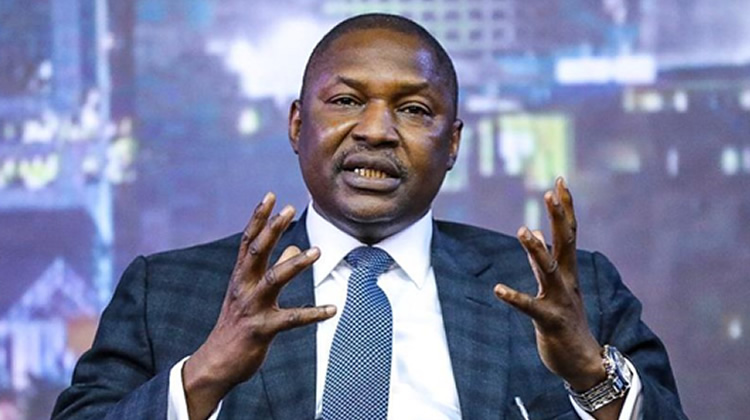
Former Attorney General of the Federation and Minister of Justice, Abubakar Chika Malami (SAN), has strongly denied allegations linking him to the controversial Abacha loot and claims that he operated 46 illegal bank accounts.
The denial followed reports suggesting that the allegations were made by the Economic and Financial Crimes Commission (EFCC). In a statement issued on his behalf by his media aide, Alhaji Bello Doka, Malami described the claims as false, baseless, and misleading.
According to the statement, Malami has no connection whatsoever to funds recovered from the late military ruler, General Sani Abacha, popularly known as the Abacha loot. He also rejected the claim that he operates 46 bank accounts, describing it as “ridiculous” and without any factual basis.
Doka said the former minister maintains only six personal bank accounts, all of which, he said, are fully known to the EFCC. He added that at no point was Malami officially confronted with claims of owning or operating 46 illegal accounts during any interaction with the anti-graft agency.
“The EFCC is aware of the six bank accounts that belong to him,” Doka said. “The allegation that he operates forty-six unlawful bank accounts is ridiculous and without foundation.”
He further stated that during any invitation or engagement with the EFCC, Malami was never presented with documents or evidence to support the claim of 46 bank accounts. According to him, the allegation appears to exist only in media reports and not in any formal investigation process.
Doka challenged the EFCC to publicly provide proof if the accounts truly exist. He said the commission should publish details of at least 23 of the alleged accounts, which represent half of the claim, to allow for transparency and public verification.
“For fairness and transparency, the commission should either publish verifiable details of these accounts or formally withdraw the allegation,” Doka said. “Media statements alone are not enough to prove such serious claims.”
Malami served as Attorney General of the Federation and Minister of Justice from 2015 to 2023 under the administration of former President Muhammadu Buhari. As the country’s chief law officer during that period, he played a central role in legal matters, including anti-corruption cases and international asset recovery efforts.
One of the major issues during his tenure was the recovery of stolen funds linked to the Abacha regime. The Abacha loot refers to billions of dollars allegedly looted from Nigeria during the military rule of General Sani Abacha between 1993 and 1998. Over the years, successive Nigerian governments, working with foreign countries, have recovered parts of these funds.
These recovered monies have often been the subject of public debate, investigations, and political controversy, especially concerning how they were recovered, managed, and spent. Allegations of mismanagement or diversion of recovered funds have frequently attracted public attention and calls for accountability.
Doka stressed that Malami’s role in the Abacha loot recoveries was strictly within the law and carried out in his official capacity as Attorney General. He said there was no basis to link the former minister personally to any stolen funds or financial wrongdoing.
The media aide also emphasized that Malami, as a Senior Advocate of Nigeria and former chief law officer of the federation, is a law-abiding citizen who respects due process. He said the former minister remains open to cooperating with any lawful investigation by relevant authorities.
“Malami has nothing to hide,” Doka said. “He is ready to cooperate with any genuine and lawful inquiry, as he has always done.”
The statement also expressed concern over what it described as trial by media, warning that unverified claims could damage reputations without due process. Doka urged the public to be cautious about accepting allegations without clear evidence.
In recent times, the EFCC has intensified investigations into alleged corruption involving past and present public officials as part of its mandate to fight economic and financial crimes. These investigations often generate public interest, especially when they involve high-profile figures.
However, legal experts have repeatedly stressed that allegations alone do not amount to guilt and that suspects are presumed innocent until proven otherwise by a court of law. They also emphasize the importance of transparency and clear communication from anti-corruption agencies to maintain public trust.
Doka thanked supporters of the former minister for standing by him amid the controversy. He said Malami remains calm, focused, and undistracted, despite what he described as an ongoing media storm.
“He appreciates the goodwill and support from Nigerians who understand his track record and commitment to public service,” Doka said.
So far, the EFCC has not issued a detailed public response directly addressing Malami’s denial or providing specifics about the alleged 46 bank accounts. Observers say a clear statement from the commission could help clear the air and address growing public debate.
The development has added to ongoing discussions about accountability, transparency, and the fight against corruption in Nigeria. Many Nigerians continue to demand that allegations involving public figures be handled openly, fairly, and based on evidence.
As the situation unfolds, attention remains on whether the EFCC will respond to the challenge to provide proof or withdraw the claims. For now, Malami insists that the allegations are false and that his record remains clean.