
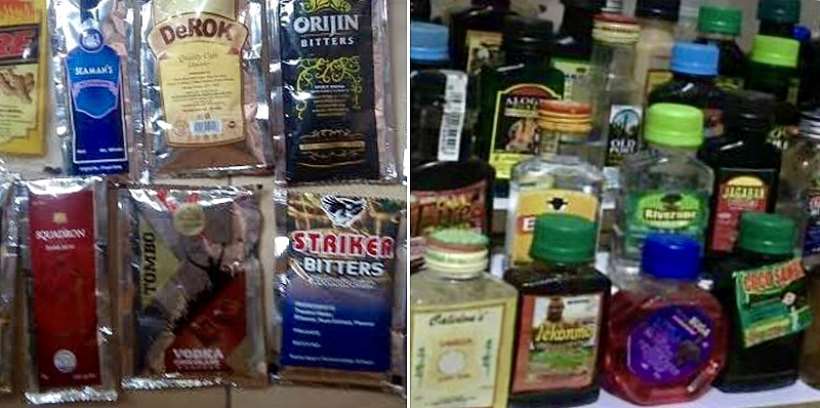
The Federal Government has ordered an immediate suspension of all enforcement actions linked to the proposed ban on sachet alcohol and 200ml PET bottle alcoholic drinks. The suspension will remain in place until consultations are completed and a final policy decision is announced.
The directive came from the Office of the Secretary to the Government of the Federation (OSGF). It followed concerns raised by the House of Representatives Committee on Food and Drugs Administration and Control over the planned enforcement of the ban.
This development brings temporary relief to manufacturers, distributors, and sellers of sachet alcohol, many of whom had expressed fears over possible job losses and business closures if the ban was enforced as earlier planned.
In a statement issued on Monday, Terrence Kuanum, Special Adviser on Public Affairs to the Secretary to the Government of the Federation (SGF), confirmed that the OSGF had received an official letter from the House Committee dated November 13, 2025.
The letter, with reference number NASS/10/HR/CT.53/77, was signed by the Deputy Chairman of the committee, Hon. Uchenna Harris Okonkwo. According to the statement, the lawmakers drew attention to existing resolutions of the National Assembly on the issue and advised the executive arm of government to proceed with caution.
The OSGF explained that the concerns raised by the House of Representatives are now being reviewed. This review, it said, is in line with its responsibility as the Chairman of the Cabinet Secretariat and the central body that coordinates the implementation of government policies.
“Accordingly, all actions, decisions, or enforcement measures relating to the proposed sachet alcohol ban are to be suspended pending the conclusion of consultations and the issuance of a final directive,” the statement said.
The office further assured Nigerians that the government is taking a careful and balanced approach to the matter. It said all relevant issues are being considered before any final decision is made.
According to the OSGF, these issues include resolutions passed by the National Assembly, public health concerns, the economic impact of the ban, and the wider national interest.
The sachet alcohol ban has been a subject of public debate for several years. The National Agency for Food and Drug Administration and Control (NAFDAC) had earlier announced plans to phase out the production and sale of alcohol in sachets and small plastic bottles, especially those below 200ml.
NAFDAC had argued that sachet alcohol is easily accessible, cheap, and often abused, especially by young people. The agency said this easy access contributes to rising cases of alcohol abuse, addiction, and related health problems across the country.
Public health experts have also raised concerns that sachet alcohol is widely consumed without proper regulation in some areas. They say it has contributed to social problems such as drunk driving, domestic violence, and declining productivity, particularly among youths.
However, the proposed ban has faced strong opposition from industry players, labour unions, traders, and some lawmakers. They argue that sachet alcohol provides jobs for thousands of Nigerians across the value chain, from manufacturing to distribution and retail.
According to industry estimates, the sachet alcohol segment employs factory workers, transporters, wholesalers, retailers, and small shop owners, many of whom rely on daily sales for survival. Critics of the ban warn that a sudden enforcement could worsen unemployment at a time when the country is already facing economic pressure.
Some lawmakers have also argued that banning sachet alcohol may push the product into the black market. They fear this could lead to the circulation of unregulated and more dangerous alcoholic drinks, putting consumers at greater risk.
The House of Representatives Committee on Food and Drugs Administration and Control has repeatedly called for wider consultations before any final decision is taken. The committee believes that both public health and economic realities must be considered to avoid unintended consequences.
The letter sent to the OSGF reflects the National Assembly’s position that enforcement should not proceed without alignment between the executive and legislative arms of government. Lawmakers insist that existing resolutions of the House on the matter must be respected.
With the latest directive, NAFDAC is expected to halt any enforcement actions related to the ban for now. This includes raids, seizures, sanctions, or penalties linked to sachet alcohol and affected PET bottle products.
The Federal Government’s decision to pause enforcement suggests a willingness to listen to different stakeholders and avoid rushed policy actions. It also shows the role of the National Assembly in shaping and influencing major policy decisions.
The OSGF said consultations are ongoing and involve a wide range of stakeholders. These include government agencies, lawmakers, health experts, manufacturers, and other affected groups.
The government also assured Nigerians that once a final decision is reached, the public will be formally informed. This will include clear guidelines on the way forward and how any new policy will be implemented.
For now, operators in the alcohol industry can continue their businesses without fear of immediate enforcement, while discussions continue at the highest levels of government.