
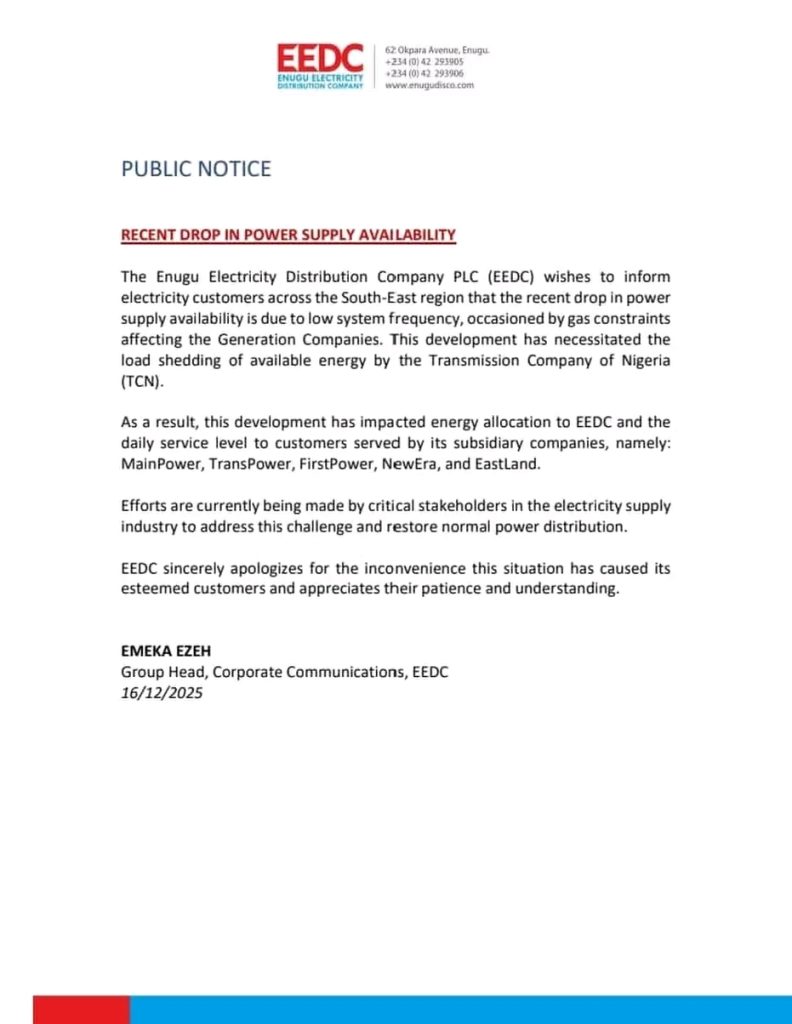
Residents and businesses across the South-East have experienced a noticeable drop in electricity supply in recent days, a development attributed to low system frequency caused by gas shortages affecting power generation companies, the Enugu Electricity Distribution Company (EEDC) has explained.
In a statement released on Tuesday, the Group Head of Corporate Communications at EEDC, Emeka Ezeh, said the Transmission Company of Nigeria (TCN) was compelled to implement load shedding as a result of the reduced power generation.
“The current drop in supply is due to gas constraints that have affected the output of several power generation companies. The low system frequency has left TCN with no option but to ration available electricity across the network,” Ezeh said.
EEDC noted that the energy shortfall has significantly reduced the allocation of power to its distribution network, affecting customers served by its subsidiary companies, including MainPower, TransPower, FirstPower, NewEra, and EastLand. This has led to intermittent electricity supply in both residential and commercial areas.
Many businesses in urban centres such as Enugu, Aba, Onitsha, and Awka reported frequent power outages over the past week, with some shops and small manufacturing companies struggling to maintain operations. Households, meanwhile, have had to rely more on generators, increasing running costs and household expenses.
EEDC explained that load shedding, a measure where available electricity is rationed to balance supply and demand, is being used to manage the situation temporarily. Load shedding ensures that the available power is distributed to different areas in rotation rather than a complete blackout.
“The company is closely working with power generation companies and relevant stakeholders to address the gas supply challenges. Efforts are ongoing to restore normal electricity supply across the South-East as quickly as possible,” the statement added.
Residents of major cities across the South-East have expressed frustration over the recent power shortages. Many noted that the irregular electricity supply has disrupted daily life, with some reporting difficulties in running household appliances and maintaining refrigeration for perishable goods.
Small business owners have also raised concerns. A shop owner in Onitsha, who asked not to be named, said, “Power keeps going off for hours. We depend on electricity for lighting, operating freezers, and running some of our machines. It is affecting our business and increasing costs because we now spend more on fuel for generators.”
Local authorities have urged residents to remain calm and avoid panic buying of generators or fuel, noting that the situation is temporary and that companies are making efforts to stabilise power supply.
Ezeh, speaking on behalf of EEDC, appealed to consumers to exercise patience and understanding during this period. He assured that the company is committed to restoring stable electricity supply and is closely monitoring developments from generation companies and the TCN.
“We regret the inconvenience caused to our customers and want to assure them that all necessary steps are being taken to address the power supply challenges. We appeal to residents and businesses to bear with us as we work to stabilise supply,” he said.
The company also encouraged consumers to report power outages through official channels to enable faster response and service restoration.
Nigeria’s electricity supply system has long faced challenges including insufficient generation, gas supply constraints, transmission bottlenecks, and vandalism of infrastructure. According to the Nigerian Electricity Regulatory Commission (NERC), these issues have historically contributed to low electricity availability, affecting millions of households and businesses across the country.
The South-East, which includes Enugu, Anambra, Imo, Abia, and Ebonyi States, is one of Nigeria’s most industrialised regions. Frequent power outages in this area have significant economic implications, especially for small and medium-sized enterprises that rely on stable electricity for manufacturing, retail, and services.
As EEDC and other stakeholders work to resolve the current gas constraints, consumers across the South-East are advised to plan ahead, reduce energy consumption where possible and report outages to distribution companies for prompt attention.