
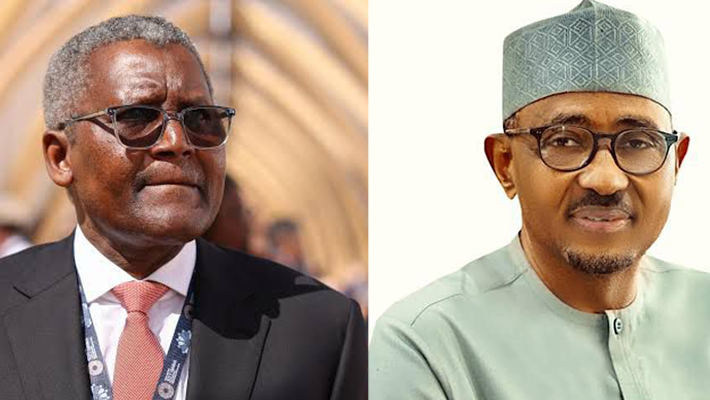
The House of Representatives has summoned Africa’s richest man, Alhaji Aliko Dangote, and the Chief Executive Officer of the Nigerian Midstream and Downstream Petroleum Regulatory Authority (NMDPRA), Alhaji Faruk Ahmed, following serious allegations and counter-allegations of corruption and economic sabotage in Nigeria’s petroleum sector.
The invitation was issued by the Joint Committee on Petroleum Resources (Downstream and Midstream) after an emergency meeting held in Abuja. The meeting was convened amid growing concerns that the public dispute between the two influential figures could threaten the fragile stability recently achieved in the oil and gas industry.
The committees are jointly chaired by Hon. Ikenga Imo Ugochinyere and Hon. Henry Okogie. They said the decision to summon both men was taken unanimously after careful deliberation on the potential impact of the controversy on fuel supply, pricing, and public confidence.
The lawmakers’ action followed allegations made by Dangote on Sunday, in which he accused the NMDPRA and its leadership of corruption and economic sabotage. Although details of the allegations were not fully disclosed in public statements, the comments quickly sparked reactions across the industry and on social media.
Speaking after the emergency meeting, Hon. Ugochinyere said the House was compelled to act swiftly to prevent the situation from escalating further.
“The key issue that necessitated this emergency meeting was the growing tension that has returned to the downstream sector as a result of concerns and allegations raised by Alhaji Aliko Dangote against the NMDPRA,” he said.
According to him, Nigeria cannot afford renewed instability in the petroleum sector, especially at a time when the country is still adjusting to major reforms introduced by the Federal Government.
Nigeria’s downstream oil sector has remained sensitive since the removal of fuel subsidy in 2023. The policy, introduced by President Bola Tinubu’s administration, led to a sharp rise in petrol prices and increased pressure on households and businesses.
In response, the government and industry players have worked to stabilise fuel supply, improve regulation, and encourage local refining to reduce dependence on imported petroleum products. One of the key pillars of this effort is the Dangote Refinery, which is expected to play a major role in meeting Nigeria’s fuel needs.
Lawmakers said the public dispute between Dangote and the petroleum regulator could undermine these efforts if not properly addressed.
“We are in a post-subsidy era where every action and statement matters. Government, regulators, and private investors must work together to ensure stability, fairness, and transparency,” Ugochinyere noted.
The committee urged both Dangote and the NMDPRA leadership to suspend public statements and media exchanges while the National Assembly conducts its investigation.
According to the lawmakers, public accusations without proper examination could confuse Nigerians and worsen tension in the sector.
“We have appealed to all parties involved to exercise restraint. Let the National Assembly do its job without distractions or unnecessary media battles,” Ugochinyere said.
He stressed that the House of Representatives has the constitutional duty to investigate matters affecting the national economy and public interest.
The committee revealed that it has already received several petitions related to the petroleum industry. These petitions, according to the lawmakers, raise important questions that must be addressed openly.
Among the issues under review are the process for issuing fuel import licences, the role of regulators in approving imports, and whether Nigeria’s domestic refineries currently have the capacity to meet daily fuel demand.
“There are serious questions Nigerians are asking. Can our local refineries supply enough fuel? Are import licences being issued fairly? Are regulations being applied equally to all players?” Ugochinyere asked.
He said the House wants clear answers backed by facts, not accusations or counter-accusations.
Alhaji Aliko Dangote is the President of the Dangote Group and owner of the Dangote Refinery, the largest single-train refinery in the world. The refinery is seen as a game changer for Nigeria’s energy sector, with the potential to reduce fuel imports and save foreign exchange.
On the other hand, the NMDPRA is the regulatory body responsible for overseeing Nigeria’s midstream and downstream petroleum operations. It was created under the Petroleum Industry Act (PIA) to ensure transparency, fair competition, and efficient regulation of the sector.
Hon. Ugochinyere said the House is not taking sides and will approach the matter without fear or favour.
“Our duty is to Nigerians. We want to understand the real issues behind these allegations so we can help broker lasting solutions,” he said.
He added that the committee’s decisions were reached after closed-door discussions and reflected the collective position of all members present.
The lawmakers assured Nigerians that the investigation would be transparent and aimed at strengthening, not weakening, the petroleum sector.
Industry stakeholders, labour unions, and civil society groups are closely monitoring developments, as any disruption in the downstream sector could affect fuel prices and availability nationwide.
For now, Nigerians await the appearance of Dangote and the NMDPRA CEO before the House committee, a session expected to shed more light on the allegations and chart a path toward stability and accountability in the oil sector.