
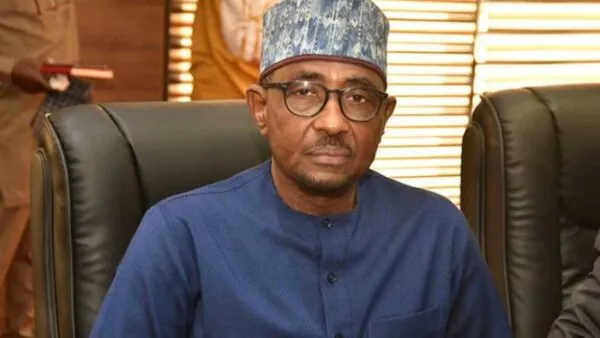
The Former Chief Executive Officer of the Nigerian Midstream and Downstream Petroleum Regulatory Authority (NMDPRA), Engineer Farouk Ahmed, is facing growing scrutiny following allegations that he approved moves to pay over ₦200 billion in outstanding bridging claims to oil marketers.
The allegations were made in a press statement issued by the Dangote Group and sent to Channels Television on Wednesday. The statement said the planned payment has raised serious concerns within the oil and gas industry, especially because of claims that a large portion of the funds cannot be properly verified.
This development comes amid an ongoing corruption petition filed by the President and Chief Executive Officer of Dangote Industries Limited, Aliko Dangote, against Farouk Ahmed at the Independent Corrupt Practices and Other Related Offences Commission (ICPC).
Bridging claims are payments made by the government to oil marketers to cover the cost of transporting petroleum products from depots to different parts of the country. The aim is to ensure that fuel prices remain uniform nationwide, regardless of distance.
Under the system, marketers pay a levy per litre of fuel, which is meant to fund the bridging scheme. In return, they are reimbursed for transport costs. However, the system has long been criticised for lack of transparency and weak oversight.
According to the Dangote Group’s statement, industry analysts say the bridging system has rarely benefited ordinary Nigerians, as fuel prices often differ widely across states despite the payments made to marketers.
The Dangote Group said the plan to settle bridging claims estimated at over ₦200 billion, covering legacy obligations for 2023, 2024, and 2025, has raised red flags among economists and sector experts.
The statement alleged that the NMDPRA could not provide verifiable data to justify a significant portion of the claims. According to industry sources quoted in the statement, there are discrepancies of up to 47 per cent between claims submitted by marketers and the actual levies paid per litre.
“In several instances, marketers submit bridging claims that do not correspond with the levies paid per litre, with discrepancies of up to 47 per cent,” the statement said.
It added that the proposed settlement of about ₦250 billion in claims, despite the absence of reliable data to support nearly half of the amount, suggests possible irregular practices.
The Dangote Group called on the Auditor-General of the Federation to immediately halt the processing of all bridging claims until a full investigation and forensic audit are carried out.
Beyond the issue of bridging claims, Aliko Dangote has also filed a formal petition against Farouk Ahmed at the ICPC, accusing him of abuse of office, corrupt enrichment, and unlawful diversion of public funds.
The petition, dated Tuesday, was submitted through Dangote’s lawyer, Ogwu Onoja (SAN), and received by the office of the ICPC Chairman, Musa Aliyu (SAN).
In the petition, Dangote urged the anti-graft agency to arrest, investigate, and prosecute the NMDPRA chief, alleging that Ahmed lives far beyond his legitimate income as a public servant.
According to the petition, Farouk Ahmed allegedly spent more than $7 million on the education of his four children in Switzerland. The payment, Dangote claimed, was made upfront for six years, without any lawful source of income to justify such spending.
The petition alleged that Farouk Ahmed has spent his entire working life in the Nigerian public sector and could not have earned enough legally to cover the alleged expenses.
“That Engr Farouk Ahmed has grossly abused his office contrary to the provisions of the Code of Conduct for Public Officers,” the petition stated.
It further alleged that he spent “over 7 million dollars of public funds” on the education of his children in different schools in Switzerland.
Dangote reportedly provided details of the four children, the schools they attend, and the amounts allegedly paid, to allow the ICPC to independently verify the claims.
The oil magnate also accused Ahmed of using his position at the NMDPRA to divert public funds for personal gain, actions he said have led to public anger and recent protests by some groups.
The ICPC has confirmed receipt of the petition and announced that investigations have begun. The Commission’s spokesperson, John Okor Odey, acknowledged the petition in a statement.
“The ICPC writes to confirm that it received a formal petition on Tuesday 16th December, 2025, from Alhaji Aliko Dangote through his lawyer,” Odey said.
He added that the petition is against the CEO of the NMDPRA, Farouk Ahmed, and assured the public that it would be thoroughly investigated.
The confirmation has further intensified public attention on the matter, given the importance of the petroleum sector to Nigeria’s economy.
In response, Farouk Ahmed has denied the allegations, describing them as “wild and spurious.” In a disclaimer signed by him, Ahmed said he would not engage in public exchanges with Dangote.
“My attention has been drawn to a purported response I was said to have made on the recent allegations against my person,” he said, adding that the statement did not come from him.
Ahmed said he deliberately chose not to respond publicly because of the sensitive nature of his position as a regulator.
“While I am aware of the wild and spurious allegations made against me and my family, I have opted not to engage in public brickbat,” he stated.
He said he welcomed the decision to take the matter to a formal investigative body, expressing confidence that the process would clear his name.
The allegations come at a time when Nigeria’s oil and gas sector is under intense pressure. The country is dealing with high fuel prices, reduced government revenue, and public frustration following the removal of fuel subsidy.
The NMDPRA plays a key role in regulating fuel distribution, pricing, and payments to marketers. Any allegation of corruption within the agency raises serious concerns about transparency and accountability.
As investigations continue, attention will remain on the ICPC and other oversight bodies. The calls for a forensic audit of bridging claims are also expected to grow louder.