
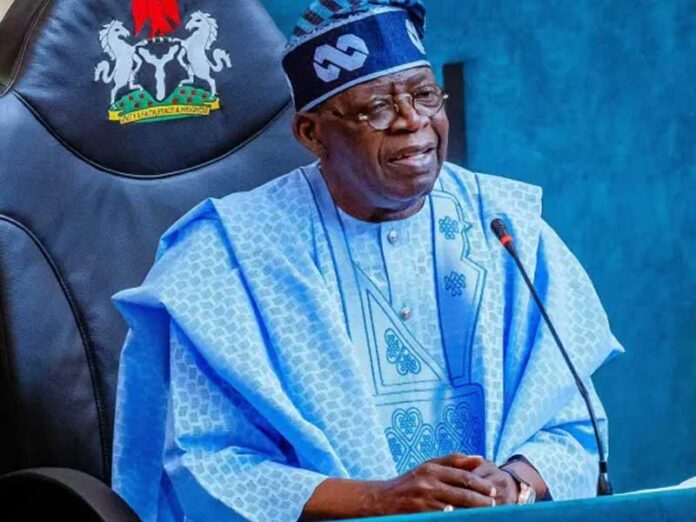
President Bola Ahmed Tinubu on Wednesday presented the 2026 Appropriation Bill to a joint session of the National Assembly, outlining a ₦58.18 trillion budget aimed at economic stability, stronger growth and better living conditions for Nigerians.
The budget, titled “Budget of Consolidation, Renewed Resilience and Shared Prosperity,” comes at a time when the country is still adjusting to major economic reforms introduced since Tinubu took office in May 2023. These reforms include the removal of fuel subsidy, changes in the foreign exchange system and efforts to improve government revenue.
Speaking before lawmakers, the President said the 2026 budget was designed to build on recent economic gains, reduce pressure on households and businesses, and ensure that growth benefits ordinary Nigerians.
Tinubu said the budget was prepared against the background of improving economic conditions, both globally and within Nigeria. According to him, recent data show that the economy is beginning to stabilise after a difficult transition period.
He disclosed that Nigeria’s economy grew by 3.98 per cent in the third quarter of 2025, up from 3.86 per cent in the same period of 2024. Inflation, which had risen sharply earlier in the year, has now slowed down for eight straight months. Headline inflation fell from 24.23 per cent in March 2025 to 14.45 per cent in November 2025.
The President attributed the drop in inflation to better food and energy supply, tighter monetary policies and improved market confidence. He expressed hope that inflation would continue to fall in 2026 if there are no major shocks.
Tinubu also said oil production had improved due to better security and reforms in the oil and gas sector. Non-oil revenue has also increased, not through higher taxes, but through improved tax collection and administration.
According to him, investor confidence is returning, as shown by rising capital inflows and renewed private sector interest. Nigeria’s foreign reserves have also grown to about $47 billion as of November 2025, the highest level in seven years, providing a stronger buffer against external shocks.
While presenting the new budget, Tinubu admitted that the implementation of the 2025 budget faced challenges. As of the third quarter of 2025, government revenue stood at ₦18.6 trillion, about 61 per cent of the target, while expenditure reached ₦24.66 trillion, representing 60 per cent of projected spending.
He explained that part of the challenge was due to the extension of the 2024 capital budget into 2025, which required government to focus on completing ongoing projects. As a result, only ₦3.10 trillion, or about 17.7 per cent of the 2025 capital budget, had been released by the third quarter.
The President assured lawmakers that 2026 would see stricter budget discipline. He said key officials, including the Ministers of Finance and Budget, had been directed to ensure that the budget is implemented according to approved plans and timelines.
He also warned government-owned enterprises to meet their revenue targets, noting that digital systems would be deployed to block leakages and ensure transparency in revenue collection.
The President outlined the main figures of the 2026 federal budget. Expected total revenue is put at ₦34.33 trillion, while total expenditure is projected at ₦58.18 trillion. This includes ₦15.52 trillion for debt servicing.
Recurrent non-debt spending is estimated at ₦15.25 trillion, while capital expenditure stands at ₦26.08 trillion. The budget deficit is ₦23.85 trillion, representing 4.28 per cent of Gross Domestic Product (GDP).
Tinubu said the budget assumptions were based on a crude oil price of $64.85 per barrel, daily oil production of 1.84 million barrels, and an exchange rate of ₦1,400 to the dollar.
He stressed that government remains committed to reducing waste, managing debt responsibly and ensuring that borrowed funds are used for projects that bring real benefits to citizens.
A major focus of the 2026 budget is security. The President proposed ₦5.41 trillion for defence and security, noting that peace and stability are necessary for economic growth.
He said the funds would be used to modernise the armed forces, strengthen intelligence-led policing, secure borders and support community peacebuilding efforts. Tinubu also announced a tougher stance on armed groups, declaring that any group operating outside state authority would be treated as terrorists.
Infrastructure development is also a priority, with ₦3.56 trillion allocated to roads, power, transport and other key projects. Education will receive ₦3.52 trillion, while health is allocated ₦2.48 trillion.
In education, Tinubu highlighted the impact of the Nigerian Education Loan Fund, which has supported over 418,000 students across 229 tertiary institutions. In healthcare, he said spending represents about six per cent of the total budget, excluding liabilities.
He also revealed that Nigeria has secured over $500 million in health grants from the United States government to support targeted health programmes.
The President said agriculture would play a key role in the government’s plan to create jobs and reduce poverty. The budget prioritises input financing, mechanisation, irrigation, storage and processing to boost food production.
According to him, improving agricultural value chains will help reduce post-harvest losses, increase farmers’ incomes and strengthen food security.
Tinubu stressed that the success of the budget would depend on proper implementation. He promised better revenue mobilisation, smarter spending and stronger accountability.
He said Nigerians would be able to see how public funds are used, as government strengthens monitoring and reporting systems.
In his closing remarks, the President said the 2026 budget belongs to all Nigerians and reflects the sacrifices made during the reform period. He called for cooperation between the Executive and the Legislature to deliver the goals of the Renewed Hope Agenda.