
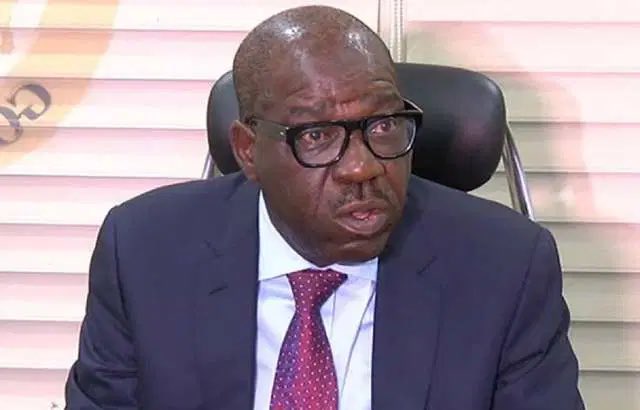
Former Edo State Governor, Mr Godwin Obaseki, has warned Nigerian politicians against using public power for personal gain, saying leaders who act selfishly will face divine punishment.
Obaseki made the remarks in a video message shared on his official X (formerly Twitter) page, where he spoke openly about leadership, governance, and his time as governor of Edo State. His comments come amid ongoing public debates about leadership quality, accountability, and the use of power in Nigeria’s political system.
The former governor said politics should not be seen as a means to acquire wealth or personal influence but as a responsibility to improve the lives of citizens and serve a higher moral purpose.
According to Obaseki, political power is a divine trust that must be used to serve the people and honour God. He warned that leaders who use power only to benefit themselves, their families, and close allies are failing in their duty.
“If you are in politics to get power, and you get the power and it’s only for you and your friends and the people close to you, then God will punish you,” he said.
He added that anyone who believes God has given them power must use it to help others and improve society.
“Because if God has given you power, and you cannot use that power directly for Him, glorify Him, then I don’t see how you will do it,” Obaseki said.
His statement reflects a growing concern among Nigerians about corruption, inequality, and the gap between political leaders and ordinary citizens.
Obaseki, who served as governor of Edo State from 2016 to 2024, said he has no regrets about how he governed the state. He insisted that all the decisions he took while in office were carefully planned and focused on the welfare of the people.
Asked what he would do differently if given another chance, the former governor said he would follow the same path, but with greater speed.
“What would I do differently if I had another opportunity? Nothing. I will do it in the same way. In fact, I will do it even more. I will do that quicker and faster,” he said.
He explained that while some reforms took time to show results, he believed they were necessary for long-term development.
One of the key areas Obaseki highlighted was education. During his administration, the Edo State Government introduced reforms aimed at improving learning outcomes, teacher training, and school infrastructure.
He said he wished some of these reforms had started earlier so their full impact would be clearer by the time he left office.
Obaseki also spoke about his decision to support a successor, saying it was part of a deliberate plan to ensure continuity of policies and reforms.
“This is why we fought to bring someone I know will continue. Everything I did was planned. All the actions I took were for the benefit of the people. Not for me,” he said.
In Nigerian politics, transitions between administrations often lead to the abandonment of existing projects and policies, especially when political parties change. Obaseki said his support for continuity was aimed at protecting public investments and ensuring that reforms were not wasted.
The former governor expressed concern over attempts to dismantle programmes introduced by his administration. He warned that such actions would hurt ordinary citizens, not former leaders.
“When I see people trying to destroy what we did, I say you add to what you met, not destroy it,” he said.
He used healthcare as an example, explaining that closing hospitals or removing health insurance schemes would directly affect the poor and vulnerable.
“You’re not hurting me. You remove health insurance or close hospitals down, am I the one that will get treatment from there?” he asked.
“It might even be your brother or sister tomorrow who will need treatment from that hospital you have refused to open.”
Obaseki also spoke emotionally about poverty and hunger in the country, questioning how leaders can remain comfortable while citizens struggle to survive.
“How can somebody gain power today, and sleep well and be happy, seeing that so many people are not able to eat and suffer? What is the purpose?” he asked.
He said leaders must always remember why they sought power and who they are meant to serve.
According to him, ignoring the suffering of the people shows a lack of understanding of the purpose of leadership.
Obaseki’s comments come at a time when Nigerians are facing economic challenges, including high inflation, rising food prices, and unemployment. Many citizens have expressed frustration over governance and the perceived gap between leaders and the people.
His remarks have sparked discussions on social media, with some praising him for speaking boldly about moral leadership, while others questioned the overall impact of his administration.
While Obaseki did not mention any specific individuals or political parties, his message was clear: leadership should be about service, compassion, and responsibility.
He stressed that power should be used to improve lives, reduce suffering, and build systems that outlast individual leaders.