
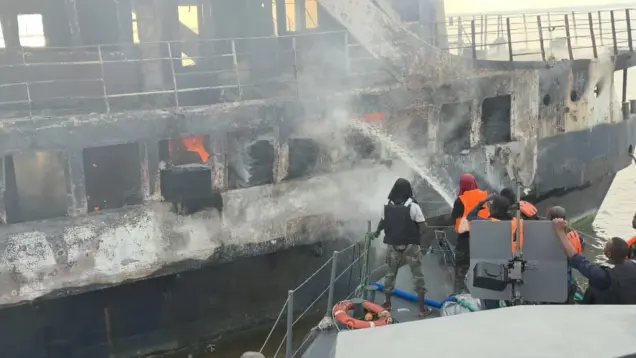
A sea-going vessel travelling from Gabon to Nigeria was engulfed in fire on Tuesday morning inside the Calabar Channel, causing panic among its crew members and leading to an emergency rescue operation by the Nigerian Navy. The vessel, identified as MV Chimba Express, was reportedly conveying scrap materials and other logistics when the incident occurred.
The fire broke out while the vessel was still en route from Gabon to Calabar, Cross River State. Reports said the crew noticed thick smoke and rising flames onboard, forcing them to send a distress call for help.
The Nigerian Navy Ship (NNS) OSE, which was on routine patrol in the area, responded quickly to the distress call and carried out a rescue operation that saved 20 crew members from the burning vessel.
According to information released by the Nigerian Navy, the rescued crew members included 14 Nigerians and six Cameroonians. They were all brought to safety and given first aid by naval personnel.
A statement issued on Tuesday by the Base Operations Officer of Nigerian Navy Ship VICTORY, Lieutenant Commander Kelechi Ahunanya, gave details of the incident and the rescue efforts.
He explained that NNS OSE received the distress call at about 1:00pm while on routine patrol duties within the Calabar Channel. The patrol team immediately moved to the location of the distressed vessel.
“Upon arrival at the scene, thick smoke was observed billowing from the vessel, prompting immediate rescue operations by naval personnel,” the statement said.
According to the Navy, some of the crew members had already abandoned the vessel out of fear, while others were trapped on deck as the fire spread.
“Crew members who had abandoned the vessel, as well as those stranded on deck, were rescued using life buoys,” the statement added.
The Navy confirmed that all 20 crew members were successfully rescued alive and administered first aid. None of the rescued seafarers was reported to have sustained serious injuries at the time of the rescue.
However, the statement raised concerns about the fate of the vessel’s Chief Engineer. According to the Navy, the Chief Engineer reportedly jumped into the water due to fear of a possible explosion caused by the fire.
Lieutenant Commander Ahunanya said the Chief Engineer is feared dead, but added that search and rescue operations were still ongoing to locate him.
“The Chief Engineer of the vessel, who reportedly jumped into the water for fear of an explosion, is feared to have died. Search and rescue operations are ongoing,” the statement said.
The Navy also disclosed that the rescue operation was supported by personnel from Forward Operating Base Ibaka, Naval Security Station 030 Houseboat, and local fishermen in the area. Their combined efforts helped in saving the lives of the crew members.
The Calabar Channel is an important waterway in southern Nigeria, linking the Calabar Port to the Atlantic Ocean. It is frequently used by commercial vessels transporting goods to and from Nigeria and neighbouring countries, including Cameroon, Equatorial Guinea and Gabon.
Maritime incidents such as fires, collisions and engine failures are not uncommon in the region, especially due to aging vessels, poor maintenance, and the transportation of hazardous or flammable materials.
In this case, MV Chimba Express was reportedly carrying scrap materials and logistics. While the exact cause of the fire has not yet been confirmed, maritime experts say fires on vessels can be caused by engine faults, electrical problems, or the nature of the cargo being carried.
The Nigerian Navy has not yet announced whether an investigation will be launched into the cause of the fire. However, such incidents are usually followed by safety checks and inquiries to prevent future occurrences.
Residents of coastal communities around Calabar expressed relief that most of the crew members were rescued alive. Some fishermen who assisted in the operation described the fire as intense and said the smoke could be seen from a distance.
One fisherman, who spoke anonymously, said the presence of the Navy helped prevent a major disaster. “If the Navy did not arrive on time, many people would have died. The fire was very serious,” he said.
The Nigerian Navy has continued to play a key role in maritime safety and security within Nigeria’s territorial waters. Through routine patrols and quick response to distress calls, the Navy has helped save lives and protect maritime activities.
In recent years, the Navy has increased its presence in the Gulf of Guinea, an area known for heavy maritime traffic as well as challenges such as piracy, illegal fishing and smuggling.
The quick response by NNS OSE highlights the importance of regular patrols and effective communication systems at sea. It also shows the value of cooperation between security agencies and local communities during emergencies.
Maritime authorities have advised vessel operators to ensure proper maintenance of their ships and comply with safety regulations, especially when carrying cargo that may increase fire risk. Crew members are also encouraged to undergo regular safety training to handle emergencies at sea.