
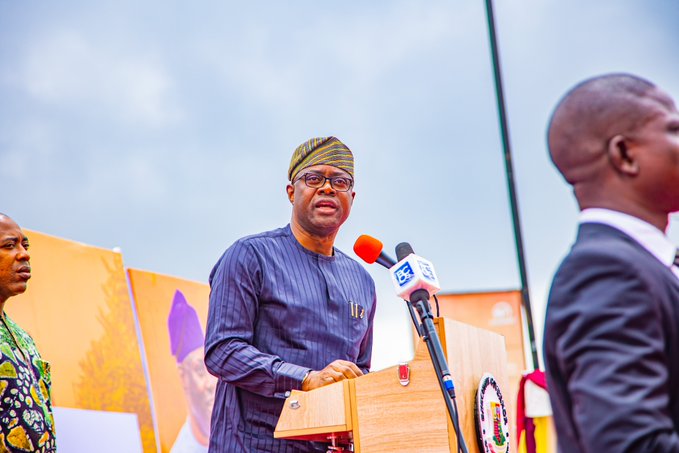
Oyo State Governor, Seyi Makinde, has admitted that he regrets supporting President Bola Tinubu during the 2023 presidential election, stating that the decision did not yield the results he had anticipated. The governor’s revelation marks a significant political development, especially given his previous role in the controversial “G5” group of Peoples Democratic Party (PDP) governors who openly opposed their party’s presidential candidate at the time.
Makinde made the disclosure on Tuesday while speaking with journalists at the Government House in Ibadan, the state capital. According to him, the decision to back Tinubu, who was the presidential candidate of the ruling All Progressives Congress (APC) in 2023, was made with the hope that the president would act in the national interest and work to address Nigeria’s challenges.
“I said it earlier, I’m human. I supported the current president, even though in another party at that time, because I thought we’ll do what is right for the country,” Makinde said. “I believed the president would reset the country and bring together competent individuals from across Nigeria to tackle national issues. But unfortunately, that is not what we’re seeing. I regret that action. Yes, I do.”
Makinde was among five PDP governors, popularly known as the G5, who openly worked against their party’s candidate, Atiku Abubakar, during the 2023 polls. The group was led by then Rivers State Governor, Nyesom Wike, and opposed Atiku’s candidacy on the grounds of zoning principles. They argued that the PDP should have presented a southern presidential candidate following former President Muhammadu Buhari’s eight-year tenure as a northerner.
The G5 governors’ defection and support for Tinubu during the election had significant political repercussions, sparking debates within the PDP and across the country about loyalty, party discipline, and political strategy. Makinde’s admission of regret now adds another layer to the discussion, signaling that some of those decisions did not produce the outcomes intended by the governors.
Makinde also clarified his stance ahead of the 2027 presidential elections. He declared that President Tinubu would not receive his support when he seeks re-election, citing concerns over the survival of democracy and the future of the PDP.
“My support for the current president in 2023 was based on the hope that he would work for the country, but that is not happening,” Makinde said. “He will not get my support in 2027. I will continue to protect the PDP and democratic principles in Nigeria.”
The governor further explained the source of his political disagreement with Minister of the Federal Capital Territory, Nyesom Wike, a former ally in the G5 group. Makinde said the rift arose after Wike allegedly told Tinubu in a meeting that Makinde would “hold PDP” for the president ahead of the 2027 elections—a statement Makinde claimed was made without consultation with other party stakeholders.
“I was in a meeting with the President, Wike, and a few others, and Wike said to the President that I will hold PDP for you against 2027,” Makinde recounted. “So, we got up, and I asked Wike, did we agree to this?”
Makinde highlighted that while Wike is free to support Tinubu’s re-election bid, other members of the PDP also have the right to protect the party and resist moves that could undermine democratic pluralism. “We must ensure that no individual or faction can weaken the PDP. Democracy requires that we uphold the party’s principles and allow diverse voices to be heard,” he added.
Makinde has been known for his pragmatic approach to governance and politics. Since becoming governor of Oyo State, he has positioned himself as a leader focused on development and effective administration. His willingness to speak candidly about past political decisions reflects his commitment to transparency and accountability, according to political commentators.
The governor’s comments also serve as a reminder of the significance of zoning arrangements in Nigerian politics. The G5’s opposition to Atiku Abubakar in 2023 was largely framed around the principle of regional rotation of power, which remains a central issue in presidential politics. Makinde’s reflection on his decision to support Tinubu shows the continued tension between personal judgment and party expectations in a complex democratic environment.
Party stakeholders within the PDP have not yet publicly responded to Makinde’s statement. However, analysts predict that it could trigger internal debates regarding strategies for the 2027 elections and the management of intra-party disagreements.
For the general public, Makinde’s revelation offers insight into the calculations that political leaders make when navigating national elections. It also underscores the importance of accountability, as voters observe the consequences of political choices and alliances.