
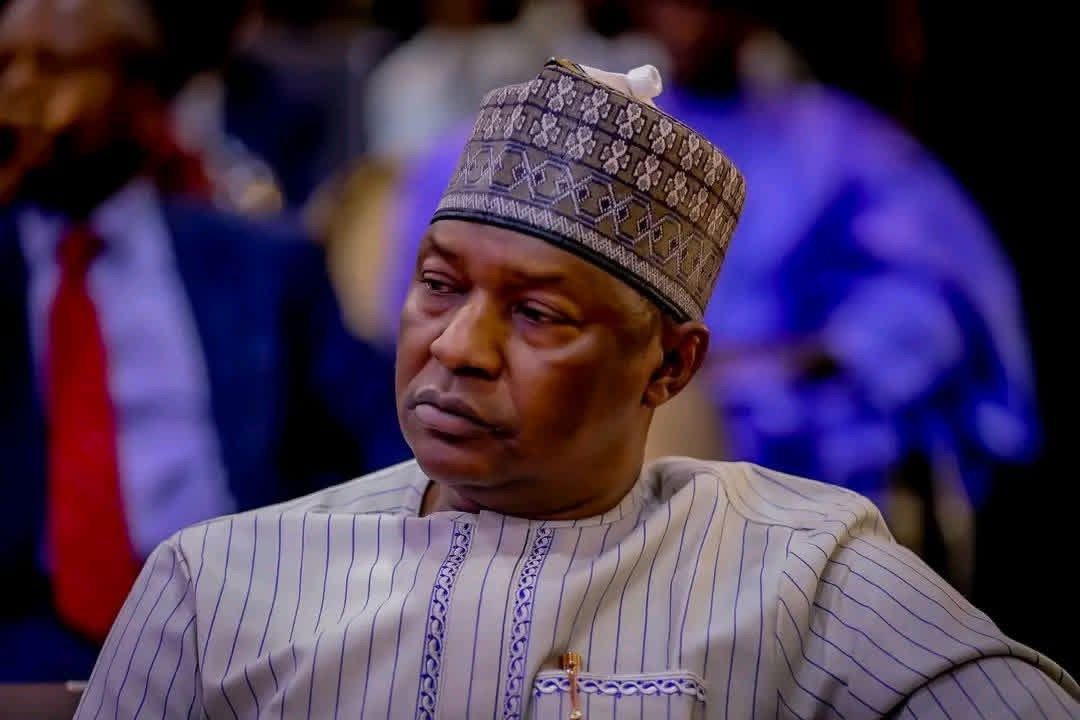
The Federal Government has filed fresh money laundering charges against a former Attorney-General of the Federation and Minister of Justice, Abubakar Malami (SAN), and his son, Abubakar Abdulaziz Malami, over alleged financial dealings involving more than N1 billion.
The new charges were filed before the Federal High Court in Abuja and are contained in a 16-count charge marked FHC/ABJ/CR/700/2025. The Federal Republic of Nigeria is listed as the complainant, while Hajia Bashir Asabe is named as a co-defendant alongside Malami and his son.
According to court documents, the defendants are accused of handling, transferring, and concealing funds suspected to be proceeds of unlawful activities. The government alleges that the transactions violated provisions of the Money Laundering (Prevention and Prohibition) Act, 2022.
Investigators reportedly traced a total sum of N1,014,848,500 to a Sterling Bank account linked to the alleged transactions. Prosecutors claim the money moved through different accounts and business entities in a way designed to hide its true source.
One of the companies mentioned in the charge is Metropolitan Auto Tech Limited. According to the prosecution, the firm was allegedly used as a front to conceal the origin and movement of the funds. The government claims the company played a key role in disguising the transactions as legitimate business activities.
Court filings allege that between 2015 and 2025, the defendants acquired several properties in Abuja, Kano, and Kebbi states using illicit funds. These properties are said to include luxury homes in high-end areas of Abuja such as Maitama, Asokoro, Gwarimpa, and Jabi.
Some of the property purchases allegedly took place while Malami was serving as Nigeria’s Attorney-General and Minister of Justice. Prosecutors argue that this raises serious ethical and legal concerns, given Malami’s position as the nation’s chief law officer at the time.
One of the counts in the charge states that between July 2022 and June 2025, the defendants knowingly used Metropolitan Auto Tech Limited to conceal the unlawful origin of over N1.014 billion. The prosecution says this act contravenes the Money Laundering Act, which criminalises the concealment or disguise of proceeds of crime.
The charge sheet further outlines the alleged use of multiple bank accounts, hotel businesses, and real estate firms to retain, transfer, or disguise large sums of money. These include payments for hotels, shopping plazas, duplexes, and large plots of land across different states.
According to the prosecution, the defendants “reasonably ought to have known” that the funds were derived from illegal activities. Under Nigerian law, this standard applies when circumstances suggest that a person should have been aware that funds were not from legitimate sources.
The government’s case is being closely watched because of Malami’s past role in government. He served as Attorney-General of the Federation from 2015 to 2023 under former President Muhammadu Buhari, making him one of the longest-serving justice ministers in Nigeria’s history.
During his time in office, Malami was a powerful figure who oversaw major legal cases, anti-corruption prosecutions, and government litigation. However, his tenure was also marked by repeated allegations of corruption and abuse of office, which he consistently denied.
Malami often defended himself by saying his actions were lawful and in line with his duties as Attorney-General. He maintained that accusations against him were politically motivated and lacked evidence. Despite public criticism, he remained in office until the end of the Buhari administration in 2023.
The fresh charges come amid renewed efforts by the current administration to tackle corruption and recover stolen public funds. President Bola Tinubu’s government has repeatedly pledged to strengthen anti-corruption agencies and ensure accountability, regardless of political status or past influence.
The Economic and Financial Crimes Commission (EFCC) has been leading investigations into several high-profile figures from previous administrations. Analysts say the charges against Malami signal the government’s intention to pursue complex financial crimes involving politically exposed persons.
In a related case, the Federal High Court in Abuja had earlier granted Malami interim bail in a separate matter involving the EFCC. In that case, the court ordered him to surrender his international passport as part of his bail conditions.
The court also directed Malami to provide two sureties and meet other existing bail requirements. These conditions were meant to ensure his availability for trial and prevent him from leaving the country without permission.
The related case has been adjourned until January 5, 2026, for further proceedings. It remains unclear how the new charges will affect the ongoing matter, but legal experts say the cases could run alongside each other if they involve separate allegations.
So far, neither Malami nor his legal team has made a public statement in response to the fresh charges. His supporters have in the past described the allegations against him as part of a political witch-hunt, while critics argue that the law should take its course.
For many Nigerians, the case raises broader questions about corruption, accountability, and trust in public office. With rising economic hardship and calls for better governance, there is growing public interest in seeing high-profile corruption cases properly investigated and resolved.
As the court process unfolds, attention will remain focused on how the judiciary handles the case and whether the prosecution can secure convictions. The outcome may have far-reaching implications for Nigeria’s fight against corruption and the credibility of its justice system.