
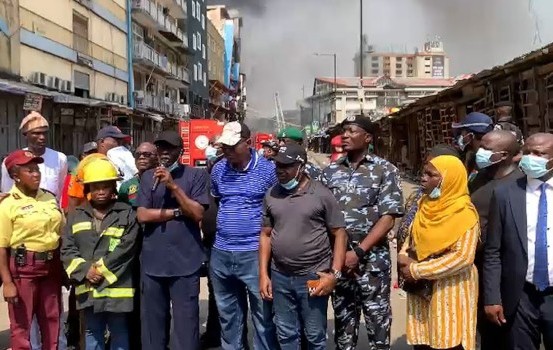
The Lagos State Government has ordered the demolition of the 25-storey Great Nigeria Insurance (GNI) building on Lagos Island after a major fire outbreak that affected several properties in the area. Governor Babajide Sanwo-Olu gave the directive on Thursday when he visited the scene of the incident at Martins Street, close to the popular Balogun Market.
The fire, which started late on Wednesday, spread quickly from the GNI building to nearby structures, affecting more than 10 buildings in total. The affected area is one of the busiest commercial zones in Lagos, known for its crowded markets, old buildings, and heavy daily human traffic.
Speaking to journalists during the inspection, Governor Sanwo-Olu said the GNI building would be pulled down once firefighters completely put out the fire and the area is confirmed safe. He explained that the building had become unsafe due to the extent of damage caused by the inferno.
According to the governor, a special committee has been set up to oversee the demolition process. The committee will be headed by the Commissioner for Special Duties and Intergovernmental Relations, Mr Gbenga Oyerinde. Sanwo-Olu said the committee would ensure that the demolition is done carefully and safely in the coming days.
“The building has been badly affected by the fire, and it will be dangerous to leave it standing,” the governor said. “Once the fire is fully controlled, we will move in to demolish the structure to prevent further danger to lives and property.”
Sanwo-Olu confirmed that no deaths were recorded in the incident, which he described as a major relief given the location and scale of the fire. However, he disclosed that about seven people sustained injuries and have been taken to the hospital for treatment.
He added that all those who were seriously injured are currently receiving medical attention, while emergency agencies are still on ground to manage the situation and prevent the fire from spreading again.
The governor also advised residents, traders, and business owners around Lagos Island to be more safety conscious, especially during the dry season. He noted that fire outbreaks are more common at this time of the year due to high temperatures, poor electrical wiring, and the storage of flammable materials in crowded areas.
“This is not the first fire incident we are experiencing on Lagos Island,” Sanwo-Olu said. “People must take safety seriously. We appeal to everyone to be careful with electrical appliances, generators, and fuel, particularly in old buildings.”
He urged members of the public to stay away from the affected area to allow emergency workers to do their job properly. According to him, cordoning off the area is necessary to prevent accidents and ensure public safety.
The governor assured affected traders that the state government would support them during this difficult period. Although he did not give details of the support, he said the government would work with relevant agencies to assess the level of damage and provide necessary assistance.
“All first responders will remain on ground to ensure the fire does not start again,” he said. “We will also look into how to support traders whose shops and goods have been affected.”
When journalists visited the scene on Thursday, many traders were seen clearing out their shops in nearby buildings. Some were removing goods, while others stood watching helplessly as smoke continued to rise from parts of the affected buildings.
All shops on Martins Street were shut, and major adjoining roads were closed to traffic. Security operatives cordoned off the area, while business activities around the scene were put on hold to prevent further escalation of the situation.
The fire caused panic among traders and residents, many of whom rely on daily sales to survive. Balogun Market is one of the largest markets in Lagos and plays a major role in the city’s economy. A disruption in activities there often affects thousands of traders, suppliers, and customers.
Emergency response teams were deployed immediately after the fire broke out. Agencies on ground include the Lagos State Fire and Rescue Service, Lagos State Emergency Management Agency (LASEMA), the Nigeria Police Force, the Federal Road Safety Corps (FRSC), the Federal Fire Service, and the Lagos State Traffic Management Authority (LASTMA).
Officials from these agencies worked together to control the fire, manage traffic, and ensure public order. Firefighters battled the flames for several hours due to the height of the GNI building and the presence of combustible materials inside and around the structure.
The GNI building, located in a densely populated commercial area, is an old high-rise structure that has housed offices and shops over the years. Like many buildings on Lagos Island, it was constructed decades ago, at a time when safety standards were different from what is obtainable today.
Lagos Island is known for its aging infrastructure, narrow streets, and high level of commercial activity. These factors often make it difficult for emergency responders to access fire scenes quickly and control outbreaks before they spread.
Over the years, the Lagos State Government has repeatedly warned building owners and occupants to follow safety rules, carry out regular checks on electrical systems, and avoid illegal alterations to buildings. Despite these warnings, fire incidents continue to occur, especially in market areas.
Experts have often pointed to poor maintenance, overloaded power sources, and lack of fire safety equipment as major causes of fires in markets and old commercial buildings across the state.
As investigations into the cause of the GNI building fire continue, residents and traders hope that lessons will be learned to prevent similar incidents in the future. Many have also called on the government to speed up urban renewal projects on Lagos Island to replace unsafe structures and improve access for emergency services.
For now, the focus remains on fully putting out the fire, ensuring the safety of the area, and helping affected traders recover from their losses. The planned demolition of the GNI building marks the next step in preventing further risks and restoring order to one of Lagos’ busiest commercial districts.