
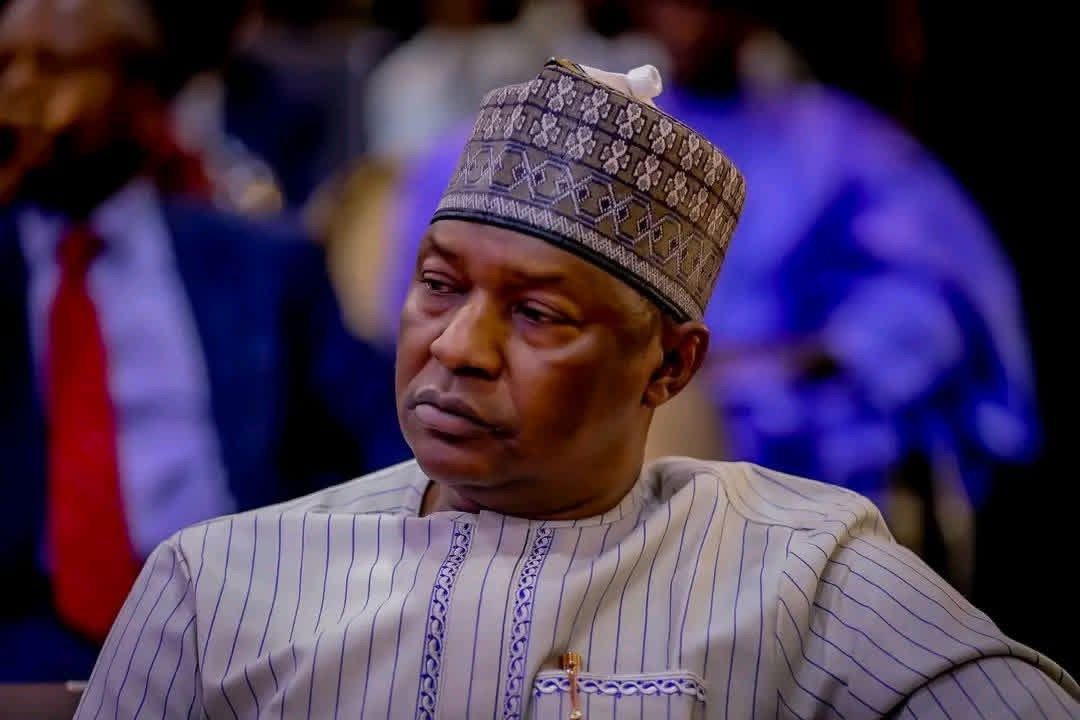
Former Attorney General of the Federation (AGF) and Minister of Justice, Abubakar Malami, SAN, is set to begin a major legal battle today, December 2, as a Federal High Court in Abuja hears arguments on whether he and two other defendants should be granted bail in a N9 billion alleged corruption case.
Malami is standing trial alongside his son, Abubakar Abdulaziz Malami, and a female co-defendant, Hajia Bashir Asabe. Asabe is a staff member of Ramadiya Property Limited and is currently being held at the Kuje Correctional Centre in Abuja following an order of remand by the court.
The three defendants are facing a 16-count charge bordering on money laundering, brought against them by the Economic and Financial Crimes Commission (EFCC) on behalf of the Federal Government. They were arraigned before Justice Emeka Nwite of the Federal High Court, Abuja, where they all pleaded not guilty to the charges.
At the last court sitting, Justice Nwite fixed today’s date for the hearing of their bail applications after rejecting an oral request made by the defence team. The defendants are expected to be brought from custody to court to continue the bail proceedings.
During the previous hearing, counsel to the defendants, Joseph Daudu, SAN, made an oral application asking the court to grant bail to his clients. He argued that the offences listed in the charge were bailable under Nigerian law and did not require a written application.
Daudu told the court that money laundering is not a capital offence and that the law only demands a written bail application in cases involving capital crimes, such as murder. He stressed that the charges against Malami and the other defendants were not complex and that they should enjoy the constitutional presumption of innocence.
“The defendants are presumed innocent until proven guilty. The offences are bailable, and this court has the power to grant bail,” Daudu said while urging the judge to release the defendants pending the determination of the case.
However, the EFCC strongly opposed the oral bail request. Counsel to the anti-graft agency, Ekele Iheanacho, SAN, argued that the Administration of Criminal Justice Act (ACJA) clearly outlines conditions that must be considered before granting bail.
According to Iheanacho, Section 162 of the ACJA requires the court to assess several factors, including the likelihood of the defendants appearing for trial, the nature of the charges, and the possibility of interfering with witnesses. He explained that these factors must be presented through affidavit evidence, which can only be done in a written application.
“These facts must come before the court through affidavits. Both the prosecution and the defence must place their facts before the court to enable it to exercise its discretion properly,” Iheanacho said.
Justice Nwite agreed with the EFCC’s position and ruled that the oral bail application was improper. He directed the defence to file a formal written bail application and fixed today for both parties to argue their positions.
The EFCC alleges that the defendants were involved in money laundering activities amounting to N9 billion. While the full details of the transactions are expected to be laid out during the trial, the anti-graft agency claims the offences were committed through illegal financial dealings linked to property and other assets.
Money laundering is a serious offence under Nigerian law. It involves concealing the source of illegally obtained funds to make them appear legitimate. Convictions for such offences can attract heavy fines, forfeiture of assets, and long prison sentences.
The EFCC has, in recent years, increased its focus on high-profile corruption cases, especially those involving former public officials. The agency says this is part of its mandate to fight corruption and recover public funds.
Abubakar Malami served as Nigeria’s Attorney General of the Federation and Minister of Justice from 2015 to 2023 under former President Muhammadu Buhari. As AGF, he was the country’s chief law officer and a key figure in the administration’s anti-corruption drive.
During his time in office, Malami was involved in several major legal and political decisions, including high-profile prosecutions, international asset recovery efforts, and legal advice to the federal government. His tenure also attracted controversy, with critics accusing him of abuse of office, allegations he repeatedly denied while in office.
His current trial marks a significant moment, as it is uncommon for a former AGF to be charged with corruption-related offences. The case has therefore drawn public attention and sparked debate about accountability and the rule of law in Nigeria.
Today’s proceedings will focus strictly on the bail applications. The defence is expected to present written arguments explaining why the defendants should be released from custody, while the EFCC will respond with reasons why bail should be denied or granted under strict conditions.
If the court grants bail, it may impose conditions such as the surrender of international passports, provision of sureties, or restrictions on movement. If bail is denied, the defendants will remain in custody while the trial continues.
The case has been adjourned for further hearing after the bail issue is settled. As the trial progresses, more details are expected to emerge about the alleged N9 billion transactions and the roles each defendant is accused of playing.