
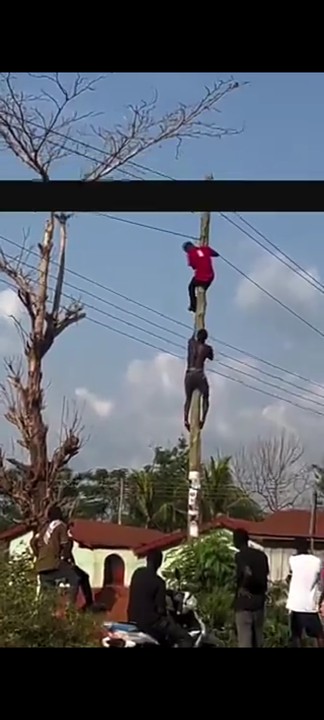
A trending video from Ghana showing a suspected thief attempting to escape by climbing an electric utility pole has sparked widespread reactions across social media in West Africa, including Nigeria. The incident, captured on camera by bystanders, has drawn attention not only because of the unusual escape attempt but also because of the violent response that followed.
In the video, which has been widely shared online, a man believed to have been caught stealing is seen climbing a tall electric pole in an effort to avoid being held by members of the community. Witnesses can be heard shouting as the man struggles to move higher up the pole, apparently hoping to escape arrest or punishment.
However, his plan did not succeed. Another community member, acting quickly, climbed the pole barefoot and pulled the suspect down by his leg. The two men struggled briefly on the pole before the suspect was forced back to the ground. Once he was brought down, the situation became chaotic as a crowd gathered around him.
Reports and video clips show that the suspect was then surrounded by several people. The crowd reacted angrily, and the man was beaten before order could be restored. The scene included loud shouts from onlookers, among them men, women, and children. Due to the violent nature of the footage, many social media users warned others to view with caution.
The video has triggered mixed reactions online. Some viewers expressed shock at the method the suspect used to try to escape, calling it risky and dangerous, especially given the presence of high-voltage power lines. Others focused more on the response of the crowd, condemning the use of violence and calling for respect for the rule of law.
Incidents like this are not new in parts of Africa, where cases of vigilante justice still occur, especially in areas where people feel the police are slow to respond or ineffective. In some communities, suspected thieves are punished on the spot by mobs rather than being handed over to the authorities. While such actions are often driven by anger and frustration, they raise serious concerns about human rights and public safety.
In Ghana, as in Nigeria, the law clearly states that suspects should be arrested and handed over to the police for investigation and trial. Mob justice is illegal and can lead to serious injury or death. Authorities in both countries have repeatedly warned citizens against taking the law into their own hands.
The use of an electric pole as an escape route also highlights another major danger: the risk of electrocution. Utility poles carry live wires that can cause severe injury or death if touched. Experts say climbing such structures without proper equipment or training is extremely risky, not only for the person climbing but also for those nearby.
The viral nature of the video has also raised questions about the role of social media in spreading violent content. While videos like this can bring attention to social problems, they can also normalise violence or encourage copycat behaviour. Some users called on platforms to do more to limit the spread of such content, especially when children can easily access it.
For Nigeria, the video serves as a reminder of similar incidents that have occurred in the past. Several cases of mob justice have been reported across the country, often ending in tragedy. Civil society groups and human rights organisations have continued to campaign for better policing, faster justice, and more public education on the dangers of vigilante actions.
As the Ghana video continues to circulate, many commentators are urging calm and reflection. While crime remains a serious concern in many communities, experts stress that violence against suspects only creates more problems and does not solve the root causes of crime.
The incident has once again opened a broader conversation about safety, justice, and responsibility in society. It highlights the need for citizens to choose lawful actions, even in moments of anger, and for governments to ensure that justice systems work effectively for everyone.