
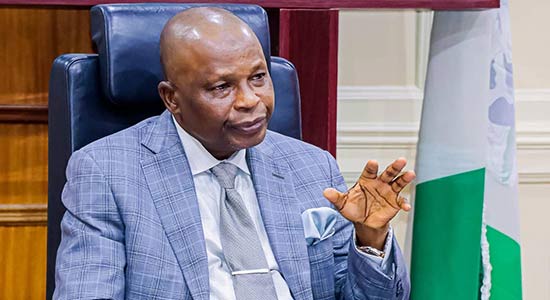
The Attorney General of the Federation and Minister of Justice, Prince Lateef Olasunkanmi Fagbemi (SAN), has formally terminated the criminal defamation case filed against Senator Natasha Akpoti-Uduaghan, bringing an end to a legal battle that attracted wide public attention across the country.
The decision by the Federal Government to discontinue the case was conveyed through a notice filed at the Federal High Court in Abuja, where the Kogi Central Senator had been standing trial. The move is expected to lead to the dismissal of all charges against the senator when the court resumes from its Christmas vacation.
The notice of discontinuance was signed by Mohammed Babadoko Abubakar, the Director of Public Prosecution of the Federation (DPPF), acting on behalf of the Attorney General of the Federation. The document was titled “Notice of Discontinuance of Proceedings in Charge Number FHC/ABJ/CR.195/2025.”
According to the document, the decision was taken under Sections 108 (1), (2), and (5) of the Administration of Criminal Justice Act (ACJA), 2015. These provisions empower the Attorney General to discontinue criminal proceedings at any stage before judgment.
The notice clearly stated: “Take notice that the Office of the Attorney General of the Federation intends to discontinue proceedings in this matter.”
With this development, Justice Umar Garba of the Federal High Court, Abuja, who is handling the case, is expected to formally strike out or dismiss the charge against Senator Akpoti-Uduaghan at the next adjourned date.
Senator Natasha Akpoti-Uduaghan was arraigned before the court on June 3, 2025, over allegations of defamation. The case followed statements she allegedly made during a television interview, where she claimed that Senate President Godswill Akpabio and former Kogi State Governor, Yahaya Bello, were involved in a plot to assassinate her.
At the time of her arraignment, the senator was under suspension from the Senate following disagreements and controversies linked to her comments and conduct. The charges were filed after complaints were reportedly made by those mentioned in her claims.
The Federal Government accused Senator Akpoti-Uduaghan of making statements that could harm the reputation of others, an offence punishable under Section 391 of the Penal Code Law, Cap 89, Laws of the Federation, 1990. The prosecution argued that the senator’s public statements were defamatory and capable of causing public unrest.
During her arraignment, Senator Akpoti-Uduaghan pleaded not guilty to all the charges. Justice Garba admitted her to bail on self-recognition, meaning she was not required to provide a surety or pay any bail sum.
The case immediately became a subject of national debate, with legal experts, civil society groups, and political observers expressing differing views. While some argued that the law should take its course, others questioned the use of criminal defamation laws against a serving senator, especially over comments made in the course of public discourse.
Human rights groups have long criticized criminal defamation laws in Nigeria, describing them as outdated and capable of suppressing free speech. They argue that disputes over reputation should be handled as civil matters rather than criminal cases.
The decision by the Attorney General to discontinue the case has therefore been welcomed by some as a step in the right direction. Legal analysts say the move reinforces the powers of the Attorney General under the law and also reflects the principle that criminal prosecution should be guided by public interest and justice.
However, others believe the withdrawal of the case raises questions about consistency in the application of the law, especially in politically sensitive matters. They argue that while the Attorney General has the constitutional power to discontinue cases, such decisions should always be clearly explained to maintain public trust.
The Office of the Attorney General has not yet issued a detailed public statement explaining the reasons for discontinuing the charges. Under Nigerian law, the Attorney General is not required to provide reasons when exercising the power of nolle prosequi, which allows the state to stop prosecution.
Section 108 of the Administration of Criminal Justice Act allows the Attorney General to discontinue proceedings either by informing the court orally or by filing a notice in writing, as was done in this case.
Senator Akpoti-Uduaghan, who represents Kogi Central Senatorial District, has been a prominent and sometimes controversial figure in Nigerian politics. She is known for her outspoken nature and has often spoken on issues of governance, accountability, and alleged abuse of power.
Her allegation of an assassination plot earlier in the year sparked serious reactions across the political space. Senate President Godswill Akpabio and former Governor Yahaya Bello both denied the claims and described them as false and damaging.
The matter also deepened political tension within the Senate and contributed to debates about discipline, freedom of expression, and the treatment of dissenting voices in the legislature.
With the criminal case now terminated, attention is expected to shift to possible civil actions, if any, by those who feel defamed. Unlike criminal defamation, civil defamation allows individuals to seek damages through the courts without involving the state as prosecutor.
As the Federal High Court prepares to formally close the case, observers say the development could set a tone for how similar cases are handled in the future. It also comes at a time when calls are growing for the reform or repeal of criminal defamation laws in Nigeria.
For Senator Natasha Akpoti-Uduaghan, the decision marks a major relief and removes a legal burden that has followed her for months. Whether the episode will have lasting political consequences remains to be seen.
When the court resumes, Justice Umar Garba is expected to act on the notice filed by the Attorney General and bring the matter to an official close, ending one of the most talked-about legal disputes involving a serving Nigerian senator in recent times.