
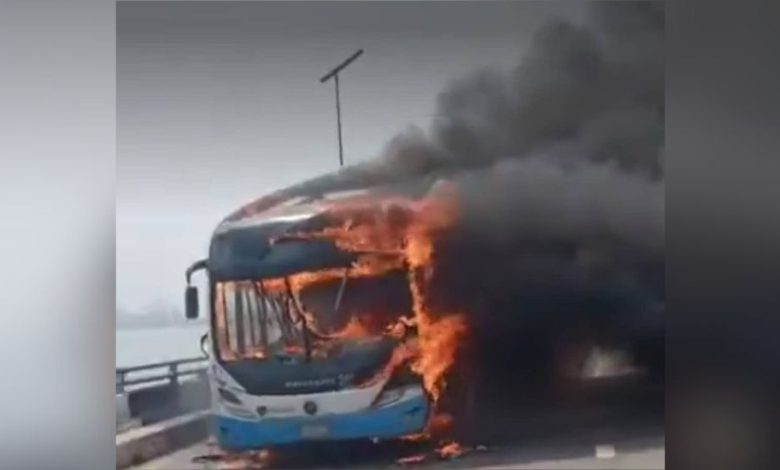
Panic gripped motorists on Tuesday afternoon after a Bus Rapid Transit (BRT) vehicle caught fire on the Third Mainland Bridge, Lagos, causing massive traffic congestion and anxiety among road users. The incident occurred at about 1:00 p.m., near the Adekunle section of the bridge, heading towards Iyana Oworo, one of the busiest traffic routes in Nigeria’s commercial hub.
According to the Lagos State Traffic Management Authority (LASTMA), the high-capacity BRT bus suddenly went up in flames, prompting motorists to slow down, stop, or seek alternative routes. The agency confirmed the incident in a statement posted on its official X handle, highlighting the disruption it caused on one of Lagos’ busiest bridges.
“The high-capacity bus is currently on fire on the Third Mainland Bridge by Adekunle, inward Iyana Oworo, and this is impacting traffic flow,” LASTMA said. “Our personnel are on ground managing traffic while efforts are ongoing to extinguish the fire.”
Social media footage of the incident showed the bus completely engulfed in flames, sending thick black smoke into the air. Motorists were seen trying to navigate cautiously, while others abandoned their vehicles temporarily, seeking safety from the blaze.
The Lagos State Fire and Rescue Service quickly responded to the emergency, working to bring the fire under control. Traffic officers were also deployed to redirect vehicles and prevent further gridlock. Fortunately, there were no reports of injuries or loss of life, but the incident caused a long traffic jam stretching from Adekunle towards Iyana Oworo, affecting thousands of commuters heading to work, school, and other destinations.
The Bus Rapid Transit system in Lagos is a high-capacity public transport scheme designed to reduce congestion on the city’s busy roads. Launched in 2008, the BRT system has grown to become one of the main public transport options for thousands of Lagos residents daily. It operates on dedicated lanes along major highways, including the Third Mainland Bridge, which connects Lagos Island to the mainland.
The Third Mainland Bridge is one of Lagos’ most important infrastructures. Spanning about 11.8 kilometers, it is a critical route connecting Lagos Island to the mainland and serving as a major artery for both commuters and commercial traffic. Any disruption on the bridge often leads to significant traffic jams and delays, as experienced during this incident.
BRT buses, like the one involved in the fire, typically carry hundreds of passengers per trip. Thankfully, on this occasion, the bus was reportedly empty or had very few passengers at the time of the fire, which prevented casualties.
Motorists on the bridge described scenes of panic and confusion. “I was stuck in traffic when I noticed thick smoke ahead,” said Mr. Adewale, a driver caught in the congestion. “People were honking, some were getting off their cars, and others were trying to take pictures. It was very frightening.”
Another eyewitness, Mrs. Funke Ojo, explained, “I thought the bus might explode because the flames were very intense. I quickly reversed my car and moved to a safer distance. We are thankful that no one was hurt.”
Such incidents, although rare, often cause fear among commuters and disrupt the flow of traffic on critical roads. Emergency response teams, such as the Lagos State Fire and Rescue Service and LASTMA, play a vital role in minimizing damage and ensuring public safety.
The Lagos State Government has been proactive in addressing emergencies like this one. LASTMA and the Lagos State Fire and Rescue Service have been improving their capacity to respond to road incidents, fires, and accidents across the state.
In this case, LASTMA officers immediately deployed personnel to manage traffic, while fire service officials worked to extinguish the blaze. Vehicles were rerouted to alternative routes to ease congestion. Residents and commuters are urged to follow traffic officers’ instructions during emergencies to ensure safety and smooth traffic flow.
As of the time this report was filed, the cause of the fire had not been determined. Investigations are expected to involve both the Lagos State Fire and Rescue Service and the BRT management team to establish the reason for the outbreak. Possible causes could include electrical faults, engine overheating, or mechanical failure, but no official confirmation has been made.
The incident disrupted traffic for hours, affecting both private and commercial vehicles. Commuters faced delays, with some abandoning their cars to seek alternative means of transport. The disruption also highlighted the challenges Lagos faces with traffic management, especially during emergencies on key routes like the Third Mainland Bridge.