
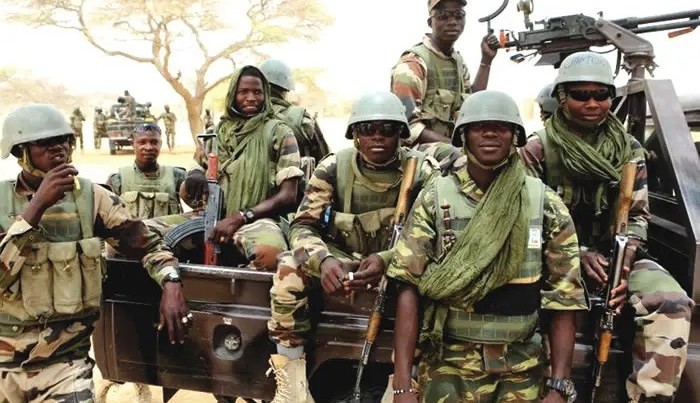
Troops of Operation Hadin Kai have neutralised eight terrorists during a clearance operation in parts of Borno State, as efforts continue to rid the North-East of insurgent groups.
Military sources confirmed that the operation took place in Kayamla and Sojiri villages, both located in Borno State, an area that has witnessed repeated attacks by armed groups over the years.
According to the sources, the operation was part of an ongoing military offensive codenamed Desert Sanity V. The mission involved coordinated patrols and clearance exercises aimed at rooting out insurgents believed to be hiding in remote communities and surrounding bushes.
The troops targeted fighters of Jama’atu Ahlis Sunna Lidda’awati wal-Jihad (JAS) and the Islamic State West Africa Province (ISWAP), two rival factions that emerged from the Boko Haram insurgency. Intelligence reports had indicated that members of the groups were hibernating in the Kayamla and Sojiri areas.
Military sources said the troops, working closely with members of the Civilian Joint Task Force (CJTF), encountered the terrorists during the operation. A gun battle followed, leading to the neutralisation of eight insurgents.
“During the encounter, eight terrorists were neutralised, while others fled the area,” one of the sources said.
The fleeing insurgents were said to have abandoned weapons and other items while escaping. Items recovered from the scene included several AK-47 rifles and ammunition.
Importantly, the military confirmed that no soldiers were injured during the operation and no operational equipment was damaged. This was described as a boost to troop morale and a sign of improved coordination and intelligence gathering.
The patrol team has continued operations in nearby enclaves to prevent the terrorists from regrouping or launching retaliatory attacks. Soldiers are also maintaining a strong presence in the area to reassure residents and encourage displaced persons to return home when it is safe to do so.
Operation Hadin Kai is the Nigerian military’s main counter-insurgency operation in the North-East, covering Borno, Yobe, and parts of Adamawa states. The operation replaced the earlier Operation Lafiya Dole and focuses on degrading the fighting capacity of insurgents while restoring peace to affected communities.
The current phase of the offensive, Desert Sanity V, is part of a wider strategy to clear remaining terrorist hideouts, cut supply routes, and deny the groups access to food, weapons, and new recruits.
For over a decade, Borno State has been the epicentre of Nigeria’s insurgency crisis. The conflict, which began in 2009, has claimed thousands of lives and forced millions of people to flee their homes. Entire communities have been destroyed, and livelihoods such as farming and fishing have been severely disrupted.
Although the Nigerian military has recorded several successes in recent years, insurgent attacks have continued in some remote areas. These attacks often target villages, military positions, and key roads, making sustained operations like Desert Sanity V necessary.
The involvement of the Civilian Joint Task Force has remained crucial to the success of such operations. The CJTF is made up of local volunteers who support the military by providing intelligence, guiding troops through difficult terrain, and helping to identify suspected insurgents.
Residents of affected communities have often praised the role of the CJTF, saying their knowledge of the local environment has helped improve security.
Military authorities have repeatedly assured Nigerians that efforts to end terrorism in the North-East remain ongoing. They have also urged residents to report suspicious movements and avoid providing support to armed groups.
In recent months, the military has stepped up operations across Borno State, targeting forests, islands, and rural settlements believed to be used as hideouts by terrorists. These operations have led to the recovery of weapons, destruction of camps, and the surrender of some fighters.
The latest operation in Kayamla and Sojiri villages is seen as part of this broader push to weaken the remaining strength of JAS and ISWAP factions. Sustained pressure will be needed to prevent the groups from regrouping or expanding into new areas.
As troops continue their patrols in the surrounding areas, residents and local leaders hope the renewed military presence will bring lasting peace and allow normal life to return.