
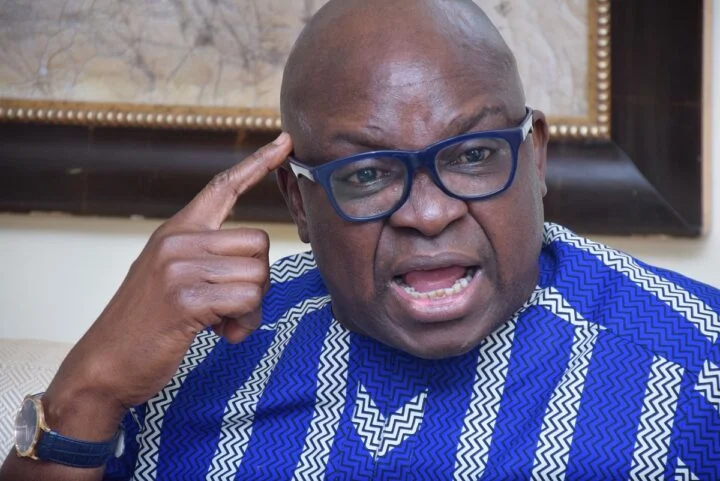
Former Governor of Ekiti State, Mr Ayo Fayose, has joined the growing debate over the political crisis rocking Rivers State, saying Governor Siminalayi Fubara should not be fighting his predecessor and political benefactor, Nyesom Wike, the Minister of the Federal Capital Territory (FCT).
Fayose made the remarks during an interview on Arise Television aired on Tuesday. In the interview, the outspoken former governor said Fubara was “nobody” in the political space just a few years ago and should show respect to Wike, who played a key role in his rise to power.
The comments come amid a prolonged power struggle between Governor Fubara and Wike, who governed Rivers State for eight years before handing over to Fubara in May 2023. Since then, the relationship between the two men has broken down, leading to deep divisions within the Rivers State government and the Peoples Democratic Party (PDP) in the state.
Fayose, a two-time governor of Ekiti State and a former PDP chieftain, said it was wrong for Fubara to challenge Wike over control of the political structure of Rivers State. According to him, there is a clear difference between holding public office and controlling political leadership.
“There’s what we call a nomenclature,” Fayose said. “When I was governor, when I’m coming, the traditional rulers, the leaders of thought, people that matter in the state, they get up and say, ‘Fayose is coming. The governor is coming.’ Nothing is called to order until the governor is seated. That is the office.”
He explained that while the office of governor deserves respect, political leadership is another matter entirely. Fayose questioned the basis on which Fubara now claims political authority in the state.
“There’s a difference between the office and 001,” he said, referring to the common title used by powerful political leaders in Nigerian states. “What brought about the 001? Who gave you the platform to be calling yourself 001? Who gave me the platform?”
Fayose argued that political success does not happen by chance and that those who help others rise should not be ignored once power is achieved. He said Fubara’s current struggle with Wike sends a bad message.
“It is a sad narrative for Governor Fubara to be struggling,” Fayose said. “It will be a sad story for my governor to be fighting fire for fire on the street. No. Rather, he should manage the situation.”
The former Ekiti governor used a local proverb to stress his point, saying those who give life are more important than those who give wealth. According to him, without political backing and support, Fubara would not have become governor.
“You don’t know Fubara three years ago,” Fayose said. “You never heard of a Fubara three years ago. Nobody will recommend… who is Governor Fubara?”
Fayose added that while he respects Fubara as the sitting governor of Rivers State, respect for office does not mean challenging political realities. He said even if Wike openly claims leadership of the state’s political structure, it is not for Fubara to contest it.
“Even if Wike said he’s the leader, it is not to the mouth of Governor Fubara to be contesting that. We all know the truth,” he said.
The crisis in Rivers State has been one of the biggest political stories in Nigeria since late 2023. Governor Fubara and Wike, once close allies, fell out over control of the state’s political machinery and the House of Assembly. The disagreement led to a split in the state assembly, with lawmakers dividing along loyalty lines.
At one point, the crisis turned violent when the Rivers State House of Assembly complex was damaged by fire. Lawmakers loyal to Wike later moved to impeach Fubara, while the governor accused his predecessor of trying to control him from Abuja. The situation drew the attention of President Bola Tinubu and other national leaders, who intervened to calm tensions.
Although a peace deal was announced after meetings at the Presidential Villa, cracks have remained. Political activities in the state continue to reflect deep mistrust between both camps, with supporters trading accusations in the media.
Wike, who is now Minister of the FCT under the All Progressives Congress (APC)-led federal government, remains a powerful figure in Rivers politics despite not being in the PDP-controlled state government. His influence has continued to shape events in the state, leading to questions about loyalty, party discipline, and the role of political godfathers in Nigerian democracy.
Fayose’s comments have sparked mixed reactions across the country. While some agree with his view that Fubara should respect Wike as his political benefactor, others believe a sitting governor should not be controlled by a former leader.
Supporters of Governor Fubara argue that he was elected by the people of Rivers State and should be allowed to govern without interference. They say loyalty should not mean total submission, especially when it affects governance and development.
On the other hand, Wike’s supporters insist that political loyalty and structure matter and accuse Fubara of biting the hand that fed him. They argue that respect for political hierarchy is necessary to maintain order within parties.
As the debate continues, Rivers residents remain concerned about how the crisis may affect governance. Many fear that prolonged political tension could distract the government from addressing key issues such as infrastructure, security, and youth unemployment.