
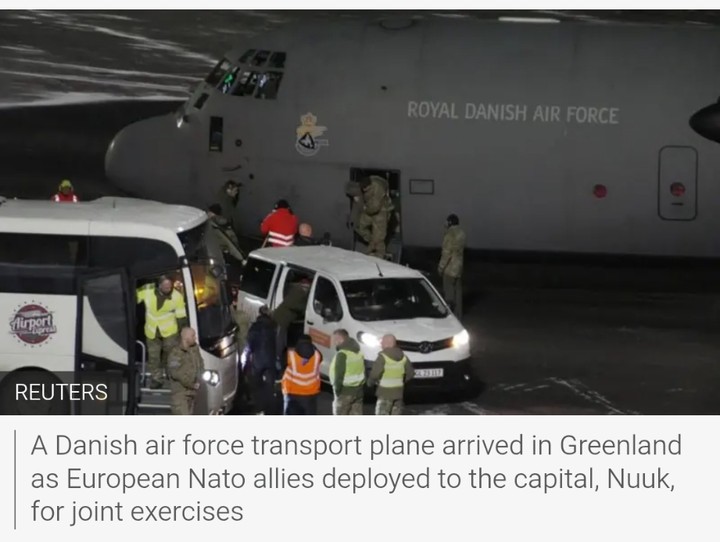
European military personnel have arrived in Greenland, marking a new development in rising tensions over the Arctic island after former United States President Donald Trump repeated his view that the US needs control of the territory.
Officials confirmed that a small group of French soldiers landed in Nuuk, the capital of Greenland, as part of a wider European deployment described as a “reconnaissance mission”. Other countries involved in the operation include Germany, Sweden, Norway, Finland, the Netherlands and the United Kingdom. Each country is sending only a limited number of personnel for now.
Greenland is a large island located in the Arctic region and is rich in natural resources. It is a semi-autonomous territory that belongs to the Kingdom of Denmark. While Greenland manages many of its internal affairs, Denmark still controls its foreign policy and defence.
The arrival of European troops comes at a time of renewed attention on Greenland following comments by Donald Trump. Trump, who has long shown interest in the island, has argued that Greenland is important for US security and economic interests. During his presidency, he once suggested buying the island, a proposal that was firmly rejected by Denmark and Greenland.
French President Emmanuel Macron confirmed that the first group of French troops would soon be strengthened with more support. He said France plans to send land, air and sea assets to the region. This means additional soldiers, aircraft and naval vessels may follow in the coming weeks.
A senior French diplomat, Olivier Poivre d’Arvor, said the deployment is meant to send a clear political message. According to him, the mission is the first of its kind and is intended to show that the North Atlantic Treaty Organisation (NATO) is present and active in Greenland. NATO is a military alliance that includes the US, Canada and many European countries.
Poivre d’Arvor explained that the initial French group consists of only 15 military personnel. Despite the small number, he stressed that the move is symbolically important. He added that the presence of European forces shows unity among allies and their shared interest in the Arctic region.
The deployment happened just hours after Denmark’s foreign minister and Greenland’s foreign affairs representative travelled to Washington, DC. They were scheduled to meet US Vice-President JD Vance to discuss issues related to Greenland and wider Arctic security.
Greenland has become increasingly important in global politics because of its location and natural wealth. The island sits between North America and Europe and lies along key Arctic sea routes. As climate change causes ice to melt, these routes are becoming more accessible for shipping and military movement.
In addition, Greenland is believed to have large deposits of minerals such as rare earth elements, which are important for modern technology, including mobile phones, electric vehicles and military equipment. Control over these resources has raised interest from major powers like the United States, China and Russia.
For European countries, the Arctic is no longer a distant region. Melting ice, increased shipping and growing military activity have made the area a focus of security planning. Countries such as Norway, Sweden and Finland are already Arctic or near-Arctic states, while others like France and the UK see the region as vital to NATO’s future.
Denmark has repeatedly said that Greenland is not for sale and that any decision about the island’s future rests with the people of Greenland. Greenland’s leaders have also made it clear that while they welcome cooperation, they do not want to be caught in a power struggle between larger countries.
The current European mission is being described as limited and defensive. Officials say it is mainly for observation, training and cooperation among allies. There has been no indication that the troops are preparing for combat or any form of confrontation.
For Nigeria and other African countries, the situation highlights how global competition over resources and strategic locations is expanding into new regions. It also shows how climate change can reshape international politics by opening up areas that were once difficult to access.
As events continue to unfold, attention will remain on Greenland and how relations between the United States, Europe and Arctic nations develop. For now, European leaders insist the deployment is about cooperation and stability, not conflict, even as global interest in the Arctic continues to grow.