
Popular Nigerian influencer and TikToker, Peller, has become the center of social media discussions after the resurfacing of his West African Senior School Certificate Examination (WAEC) result, just days after he celebrated gaining admission to study Law at a Nigerian university.
The influencer had recently taken to his Instagram page to share the news of his university admission. In his post, he confidently declared that he would soon no longer be considered illiterate, writing: “I won’t be called an illiterate again. Very soon, it will be Lawyer Peller.” The announcement was met with a mix of excitement, support, and scepticism from fans and critics alike.
Although Peller did not publicly name the institution where he gained admission, online reports suggest that he was admitted to Caleb University, Lagos, a private institution known for offering various undergraduate programmes, including Law. Caleb University has a reputation for academic excellence and has attracted students from across the country since its establishment.
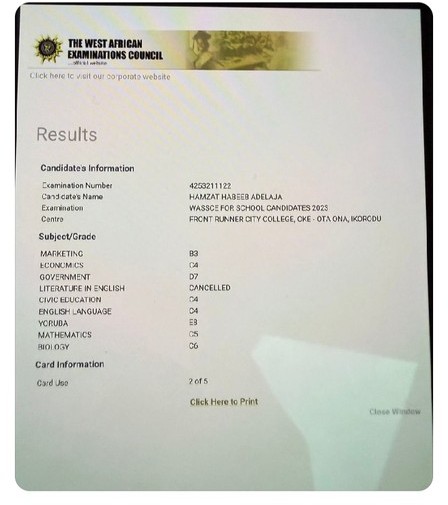
Following his announcement, some social media users began questioning how the influencer could secure admission without a clear proof of WAEC results. In response, Peller shared an image of his WAEC certificate, apparently to silence critics and demonstrate that he met the minimum academic requirements for admission.
However, the shared certificate quickly sparked further debate. Observers noted that some of the grades listed were unusual. According to screenshots circulating online, Peller reportedly recorded an E grade in Yoruba, a core language subject, while his Literature in English, a compulsory subject required for Law programmes, was marked as cancelled. These revelations raised eyebrows and prompted questions about the legitimacy of his admission and the processes used by the university to verify academic credentials.
On social media, reactions were divided. Some of Peller’s followers defended him, arguing that private universities have flexibility in their admission processes and that the influencer could have met other criteria, such as alternative qualifications or special consideration. Supporters also praised his courage for publicly sharing his WAEC result, calling it a step toward transparency.
On the other hand, critics expressed concern and called for clarification from the university. Many users questioned how a Law programme, which typically requires high proficiency in core subjects like English and Literature, could admit a student with cancelled or poor grades in essential subjects. Some critics went further to demand an official statement from Caleb University to explain how the admission was processed.
The controversy highlights a broader debate about admissions into Nigerian universities. Over the years, some private institutions have faced scrutiny for their admission processes, with critics arguing that flexibility in entrance requirements can sometimes compromise academic standards. Meanwhile, universities maintain that they have the authority to consider additional factors beyond WAEC grades, such as aptitude tests, interviews, or other certifications.
The incident also highlights the growing influence of social media personalities in Nigeria. Influencers like Peller command large followings on platforms such as TikTok, Instagram, and YouTube. Their personal milestones, from career achievements to educational successes, often become public talking points, drawing intense scrutiny and debate online. For many young Nigerians, Peller represents a figure of aspiration—a person who transitioned from social media fame to pursuing higher education—but the resurfaced WAEC result has shifted public focus toward questions of academic credibility.
As of the time of filing this report, neither Peller nor Caleb University has issued an official statement to address the questions raised by the resurfaced WAEC result. The university’s silence has contributed to the ongoing speculation and online discussions, with many Nigerians calling for transparency to maintain public trust in higher education.
Some social media commentators have suggested that the controversy could serve as a teachable moment, highlighting the importance of academic transparency, while others warn against the dangers of online shaming and the rush to judge without complete facts. For Peller, the incident has amplified his visibility even further, making him a trending topic across platforms like Twitter, Instagram, and TikTok, but also placing him under intense scrutiny.
Despite the criticism, some supporters argue that Peller’s public declaration of his ambition to become a lawyer is commendable. They contend that personal growth, perseverance, and determination are equally important in education, and that online debates should not overshadow his efforts to pursue higher learning.
The case continues to develop as social media users track Peller’s posts and await any response from Caleb University. The broader debate touches on issues of academic integrity, admission standards, and the influence of social media on public perception of education in Nigeria.