
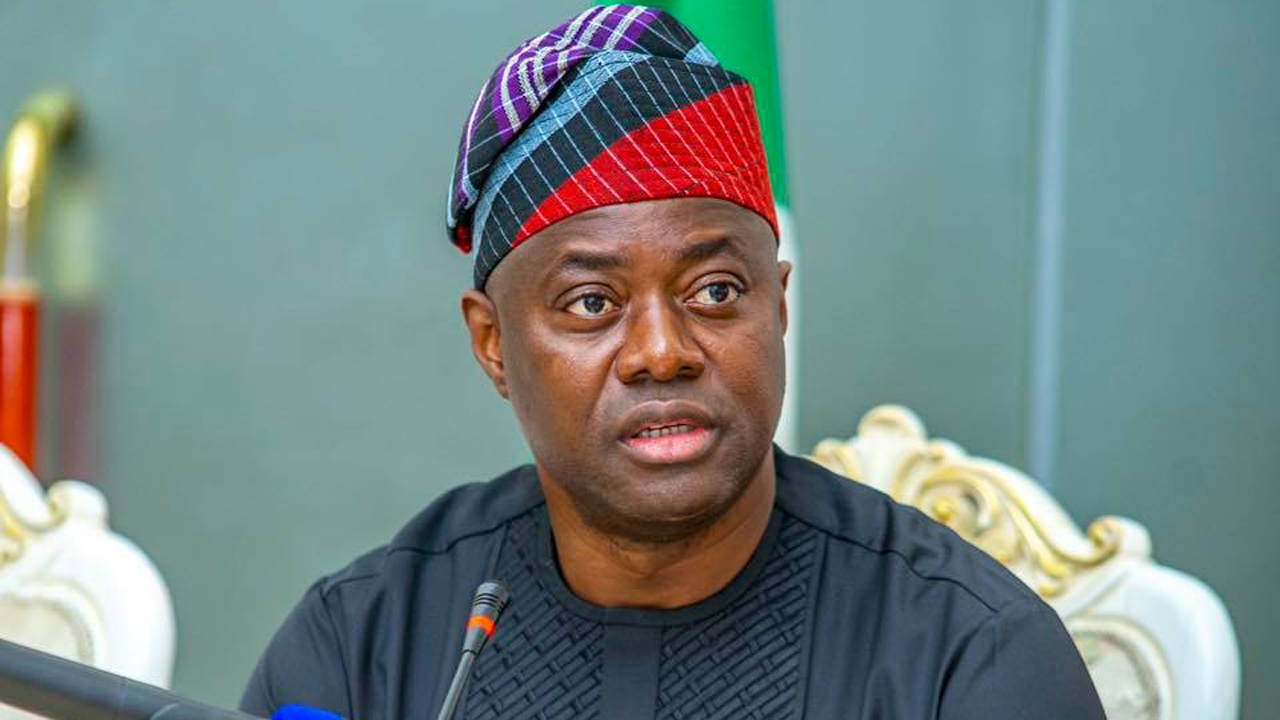
Oyo State Governor, Seyi Makinde, has said that it has become increasingly difficult to speak truth to power under the administration of President Bola Tinubu. The governor made the remarks on Saturday, January 24, 2026, during the 60th birthday celebration of Samson Ajetomobi, president of The Men of Issachar Vision Incorporated (MIV) and overseer of Redemption Faith Churches, held in Ibadan, the Oyo State capital.
The event was attended by several dignitaries, including the immediate past Vice President, Yemi Osinbajo, whose leadership style Governor Makinde compared favourably with the current administration.
Governor Makinde, while speaking at the event, reflected on his early days in office as the governor of Oyo State and how he benefited from Osinbajo’s consultative approach.
“Sir, I personally miss you in that position,” Makinde said directly to Osinbajo. “A lot of people may not know why things are not really the same. It’s not a political talk because I’m not on that podium.”
Makinde recounted a critical moment during the COVID-19 pandemic in February 2020, barely seven months after he assumed office. At the time, the nation faced the prospect of a full lockdown, and states were being advised to restrict movements to curb the spread of the virus.
“I remember I was barely seven months into the position of the governor of Oyo State, and that was my very first public service job. And we had a crisis in the country; this was February 2020,” Makinde recalled.
He explained that during a National Economic Council (NEC) meeting, Osinbajo, who was then the Vice President and acting chairman of the council, alongside a few colleagues, suggested that states consider lockdown measures.
“There was Covid, and we came in for the national economic council meeting. It was a hot meeting; the chairman of the council (Osinbajo) came in and a few of my colleagues. I wasn’t sure whether they held a meeting before that meeting, but they came in and said we should all go back and lock down our state,” he said.
Makinde added, “So, for Oyo State people, why I did not lock down during Covid was because of his decision.” The governor used the moment to highlight Osinbajo’s consultative style, which allowed him and other state governors to deliberate and make informed decisions.
In contrast, Governor Makinde criticised the Tinubu administration for what he described as a lack of transparency and consultation, particularly regarding tax reform bills. He claimed that governors were not properly consulted and that even the details of bills passed by the National Assembly and signed into law remained unclear to state executives.
“You cannot speak truth to power in this dispensation,” Makinde said. “We had the same situation in this dispensation; it was the tax bill, and we said, ‘Look, bring the tax bill; bring it back; let us all have an opportunity to look dispassionately at it.’ They said the tax bill will go ahead. It is an affront for even the governors to be saying what the Presidency has done to send the tax bill to the National Assembly. The tax bill, we don’t know what was passed at the National Assembly, we don’t also know what was signed up.”
The governor’s remarks reflect growing concerns among some state leaders about the perceived centralisation of power and decision-making under the Tinubu administration. Critics argue that policies, especially those with wide economic implications like tax reforms, should involve more consultations with state governments to ensure smooth implementation and prevent potential conflicts.
Governor Makinde also drew attention to the importance of consultative leadership in crisis management. He stressed that during the COVID-19 pandemic, the ability of state leaders to exercise discretion, guided by federal advice rather than rigid directives, helped mitigate negative impacts on citizens while maintaining public health protocols.
The birthday event, organised by MIV and hosted by Samson Ajetomobi, attracted several religious leaders, government officials, and notable personalities from across Oyo State. It was a platform not only to celebrate Ajetomobi’s 60th birthday but also to emphasise the values of leadership, faith, and community service.
Makinde’s remarks praising Osinbajo’s style of leadership resonated with attendees, highlighting a contrast between the consultative approach of the past administration and the current approach under President Tinubu. While Osinbajo often involved stakeholders and allowed room for discussion before final decisions were made, the governor suggested that the present government tends to push policies with minimal consultation.
The governor’s criticism of the tax reform process underscores a key tension between federal initiatives and state-level implementation. Tax policies affect state revenues, investment climate, and public perception, making proper communication and stakeholder engagement crucial. By highlighting this issue, Makinde signals the importance of inclusive governance and transparent policy-making to avoid disputes between state and federal authorities.
Beyond politics, Governor Makinde used the occasion to encourage collaboration between government, religious institutions, and civil society. He noted that leaders must balance authority with consultation to achieve sustainable governance and maintain public trust.
The presence of Osinbajo at the event, coupled with Makinde’s public praise, reflects the enduring respect many politicians and citizens have for the former Vice President’s leadership style. It also sends a subtle message about the kind of governance many stakeholders hope to see—one that values dialogue, inclusion, and transparency.
As of now, the Tinubu administration has not publicly responded to Governor Makinde’s remarks. However, the statements are likely to fuel ongoing discussions about leadership approaches, policy consultation, and the role of state executives in shaping national decisions.
The event in Ibadan was therefore more than a birthday celebration; it became a platform for reflecting on leadership, governance, and the importance of speaking truth to power. Governor Makinde’s speech highlighted the challenges that some state leaders face in communicating effectively with the federal government, particularly under administrations that favour a less consultative approach.