
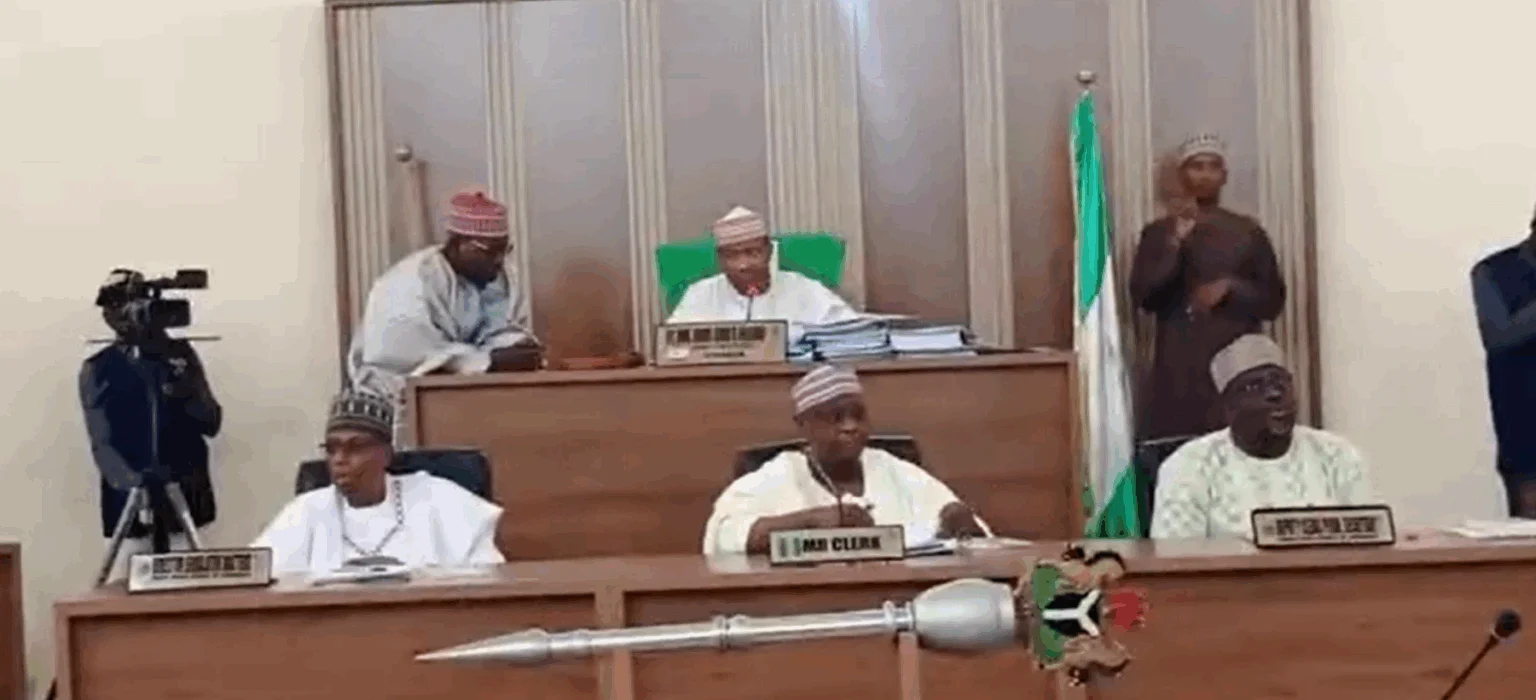
Twenty-two members of the Kano State House of Assembly have defected from the New Nigeria Peoples Party (NNPP) to the All Progressives Congress (APC), deepening the political shake-up in the state following Governor Abba Kabir Yusuf’s exit from the NNPP.
The lawmakers announced their defection on Monday during a plenary session of the House. The move came shortly after Governor Yusuf formally resigned from the NNPP and rejoined the APC, a development that has continued to trigger major political realignments across Kano State.
Governor Yusuf’s decision followed his recent visit to President Bola Ahmed Tinubu at the State House in Abuja, after which he submitted his resignation letter to the NNPP. In the letter addressed to the chairman of the Diso–Chiranchi Ward in Gwale Local Government Area, the governor cited deepening internal crises and prolonged leadership disputes within the party as reasons for his exit.
The governor did not defect alone. His return to the APC was accompanied by a large number of elected officials, including 22 members of the Kano State House of Assembly, eight members of the House of Representatives, and all 44 local government chairmen in the state. The mass defection has significantly weakened the NNPP’s political structure in Kano, which had been its strongest base nationwide.
During Monday’s plenary session, the atmosphere in the Assembly chamber reflected the gravity of the moment. The Speaker of the House, Jibril Falgore, presided over the session and formally acknowledged the defection of the lawmakers. A video of the proceedings, later shared on social media, showed each lawmaker being called upon to announce their decision publicly.
Speaker Falgore himself was among those who left the NNPP for the APC. Representing Rogo constituency, Falgore’s defection, alongside that of the Deputy Speaker, Muhammad Bello Butu Butu of Tofa/Rimin Gado, marked a major turning point in the leadership of the House.
Other principal officers who defected include the Majority Leader, Lawan Hussain from Dala; the Deputy Majority Leader, Garba Shehu Fammar from Kibiya; and the Chief Whip, Muddasir Ibrahim Zawachiki from Kumbotso. Their exit means that nearly the entire leadership structure of the Assembly has now aligned with the APC.
Announcing his defection on the floor of the House, one of the lawmakers, Rabiu Shuaibu, who represents Dawakin Kudu, made a clear declaration. “I, Shuaibu Rabiu, representing Dawakin Kudu, resign my membership of the NNPP to the APC with immediate effect from today,” he said.
Another member, Tukur Mohammed from Fagge constituency, also confirmed his decision in similar terms. “Mr Speaker, I am here to confirm I am resigning my membership of the NNPP and joining the APC,” he said.
Other lawmakers who defected include Zakariyya Abdullahi Nuhu (Gabasawa), Lawal Tini (Ajingi), Musa Tahir Haruna (Albasu), Ali Lawan Alhassan (Bagwai/Shanono), Ali Muhammad Tiga (Bebeji), and Hafiz Gambo (Bunkure).
The list also features Murtala Muhammad Kadage (Garko), Abdulmajid Isah Umar (Gwale), Ahmad Ibrahim (Karaye), Alhassan Zakari (Kura/Garun Malam), Suleiman Mukhtar Ishaq (Madobi), Abdulhamid Abdul (Minjibir), Muhammad Ibrahim (Rano), Kabiru Sule Dahiru (Tarauni), and Ali Abdullahi Manager (Wudil).
Governor Yusuf, who was elected under the NNPP platform, was widely seen as a product of the Kwankwasiyya political movement. However, ongoing internal disagreements within the party leadership reportedly strained relationships and created divisions that affected governance and party cohesion.
In his resignation letter, Yusuf said the internal crises had made it difficult for the party to function effectively. He noted that his decision was taken in the interest of stability, governance, and the welfare of the people of Kano State.
Kano State is one of Nigeria’s most politically influential states due to its large population and voting strength. Developments in the state often have wider implications for national politics, especially ahead of general elections.
With the 2027 elections still two years away, many see the recent defections as early positioning by political actors seeking stability and stronger platforms. The APC leadership has welcomed the defectors, describing the move as a return home for many who were former members of the party.
So far, the NNPP has not issued an official response to the latest wave of defections in the Kano State House of Assembly. However, party loyalists have expressed concern that the developments could further weaken the party’s influence in the state.
For the Kano State House of Assembly, the defections mean a major shift in party dominance within the chamber. With the Speaker, Deputy Speaker, and other principal officers now in the APC, the party is firmly in control of legislative activities in the state.