
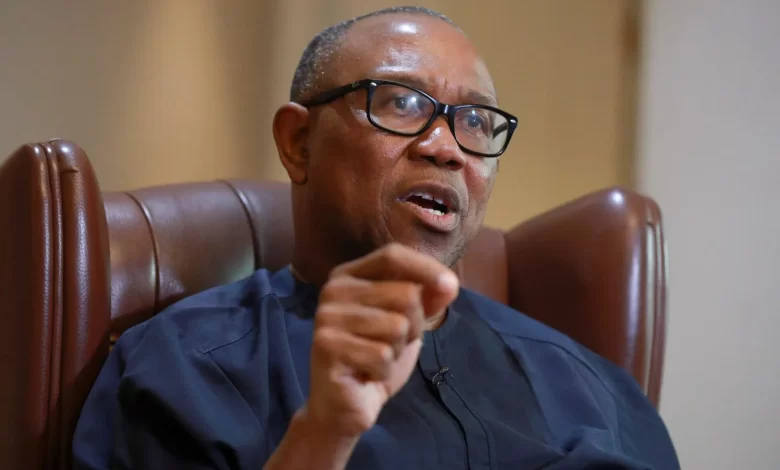
Former presidential candidate of the Labour Party (LP) in the 2023 general elections, Mr Peter Obi, has criticised President Bola Tinubu over what he described as excessive time spent outside Nigeria in January.
Obi said the President spent only about eight days in the country during the month, while Nigeria continued to face serious challenges including insecurity, food shortages, power failure and labour unrest.
The former Anambra State governor made the remarks in a post on his official X (formerly Twitter) handle on Sunday.
According to Obi, January is usually a critical month for governance, as it sets the tone for the rest of the year. He said leaders in other countries often use the period to focus on domestic issues, review policies and address urgent national problems.
However, he accused President Tinubu of placing foreign engagements above the pressing needs of Nigerians.
“This first month serves as a critical measure of the challenges that lie ahead, and it is painfully evident that the situation in the country continues to worsen,” Obi wrote.
He said insecurity had increased across the country, with reports of killings, kidnappings and abductions in many states.
“In just January, we saw reports of several killings, hundreds of kidnappings and abductions that include children, pregnant women, and nursing mothers, with the abductors demanding millions,” he said.
Obi added that the worsening security situation has made it difficult for farmers to return to their farms, especially in rural areas.
According to him, this has contributed to food shortages, rising prices and deeper poverty among rural communities.
“Farmers remain unable to return to their farms, plagued by ongoing insecurity which exacerbates food shortages and rural poverty,” he stated.
Nigeria has in recent years struggled with widespread insecurity, including banditry in the North-West, kidnappings in the North-Central, insurgency in the North-East and other violent crimes in different parts of the country.
Many communities have been displaced, while farming activities have been disrupted, affecting food production nationwide.
Obi also expressed concern over the state of education in the country, saying many children are out of school due to insecurity and teachers’ strikes.
“Education stands as a cornerstone of national development, yet countless children remain out of school, and those in school cannot attend because of insecurity or teachers’ strikes,” he said.
He described the situation in the Federal Capital Territory (FCT), Abuja, as particularly troubling.
According to him, it is unacceptable that schools remain closed in the seat of government while huge sums of money are spent on other projects.
“This is particularly tragic in Abuja, the seat of government, where schools remain shuttered,” Obi said.
“This is the same Abuja where billions were squandered on renovating a conference centre for the president and bus terminals.”
He questioned whether the nation’s leaders truly understand the importance of education to national development.
Obi also condemned Nigeria’s poor electricity supply, noting that the country experienced two national grid collapses in January alone.
“Our nation, with the worst access to electricity and abysmal supply, witnessed two grid collapses in just January,” he said.
Nigeria’s power sector has long been a major concern, with frequent outages affecting homes, businesses and industries.
In his post, Obi questioned the necessity of President Tinubu’s frequent foreign trips, especially at a time when the country is facing multiple crises.
He said the President spent a total of 23 days abroad in January across two foreign trips.
According to Obi, Tinubu began the year outside the country and returned to Nigeria on January 17, only to leave again on January 26 for Türkiye, where he was still reported to be as of January 31.
“While leaders in other nations prioritise domestic governance in January, Nigeria’s president prioritises international engagements over pressing national issues,” Obi said.
“What urgent matters continuously warrant his absence from the nation?” he asked.
He further claimed that when the President returns briefly to Nigeria, it is often to attend political events.
“When he does return, it often appears to be merely to welcome defectors into the APC before he jets off again,” Obi alleged.
President Tinubu has defended his foreign trips in the past, saying they are necessary to attract investment, strengthen diplomatic ties and promote Nigeria’s interests abroad.
Government officials have also argued that the President remains actively involved in governance even while outside the country.
However, critics say the frequent travels send the wrong signal at a time when many Nigerians are struggling with high living costs, unemployment and insecurity.
Obi also criticized the ruling All Progressives Congress (APC), accusing it of focusing more on politics than governance.
He said the political class appears more concerned with rallies, party activities and the next election cycle than with solving the problems facing ordinary Nigerians.
“The collective impact of these events paints a grim portrait of a nation grappling simultaneously with insecurity, economic distress, failing infrastructure, and profound social upheaval,” he said.
“Instead of confronting these urgent challenges head-on in pursuit of solutions, much of the political class remains engrossed in power calculations and the next election cycle.”
He added that the APC, in particular, seems more interested in welcoming defectors and holding rallies than visiting failing institutions or addressing citizens’ daily struggles.
Since the 2023 elections, political activities such as defections and party realignments have continued across the country, drawing criticism from sections of the public.
Many Nigerians have expressed frustration that political leaders appear disconnected from the hardship faced by ordinary citizens.
Obi, who came third in the 2023 presidential election, has remained a strong voice in national debates, often using social media to comment on governance, the economy and social issues.
His comments have continued to attract wide reactions, with supporters agreeing with his concerns and others defending the President’s actions.
As Nigeria moves further into the year, many citizens are watching closely to see how the government will address insecurity, economic pressure, education challenges and power supply.
For critics like Obi, leadership presence and focus at home are key to restoring public confidence and tackling the nation’s problems.
The Presidency has not yet officially responded to Obi’s latest comments as of the time of filing this report.