
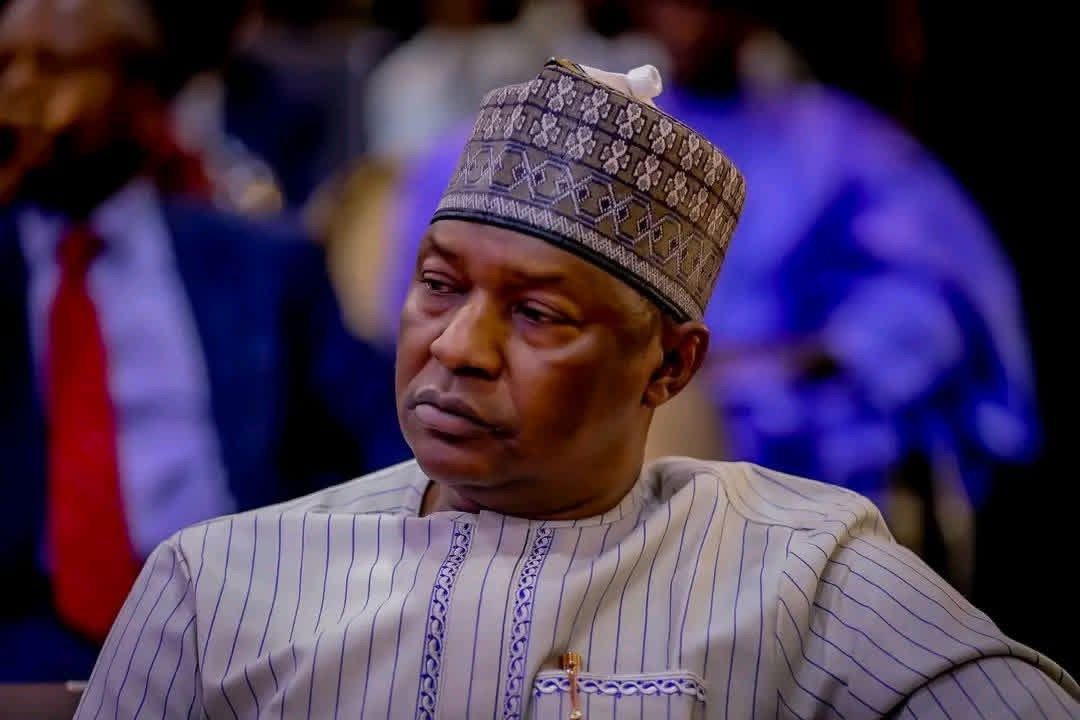
A former Attorney-General of the Federation (AGF) and Minister of Justice, Abubakar Malami (SAN), has told a Federal High Court in Abuja that he earned hundreds of millions of naira from salaries, allowances, gifts and other lawful sources during his time in public service.
Malami made this known while challenging the interim forfeiture of some of his properties by the Economic and Financial Crimes Commission (EFCC). He argued that the seized properties were acquired legally and not through proceeds of crime.
On January 6, 2026, Justice Emeka Nwite of the Federal High Court ordered the interim forfeiture of 57 properties believed to be proceeds of unlawful activities. The properties were allegedly linked to Malami and two of his sons, Abdulaziz Malami and Abiru Rahman Malami.
The order followed an ex parte application filed by the EFCC, in which the anti-graft agency claimed that the properties were reasonably suspected to have been acquired through illegal means. The court also directed the EFCC to publish the forfeiture order in a national newspaper, inviting interested parties to show cause within 14 days why the assets should not be finally forfeited to the Federal Government.
However, Malami has now approached the court with a motion on notice, asking that the interim forfeiture order be set aside, at least as it affects some of the properties.
In the application, marked FHC/ABJ/CS/20/2026 and filed on January 27, Malami accused the EFCC of misleading the court by hiding important facts and presenting information in a way that created a false impression.
Through his legal team led by senior advocate Joseph Daudu, Malami argued that the forfeiture proceedings violate his constitutional rights, including his right to property, presumption of innocence and right to family life.
He also warned that allowing the case to continue could lead to conflicting court decisions and unnecessary duplication of legal processes.
Malami specifically challenged the forfeiture of three properties listed as numbers 9, 18 and 48 in the EFCC’s application. These include Plot 157, Lamido Crescent, Nasarawa Government Reserved Area (GRA), Kano, which he said was purchased on July 31, 2019.
Another property is a bedroom duplex with boys’ quarters located at No. 12, Yalinga Street, off Adetokunbo Ademola Crescent, Wuse II, Abuja. According to Malami, the house was acquired in October 2018 for ₦150 million.
The third property is the ADC Kadi Malami Foundation Building, which he said was bought for ₦56 million and is held in trust for the estate of his late father, Kadi Malami.
Malami is asking the court to set aside the interim forfeiture order as it affects these three properties and restrain the EFCC from interfering with his ownership and control of them.
In a detailed 14-point argument, his lawyer said the EFCC failed to provide any clear evidence linking the properties to money laundering or any specific criminal offence.
Daudu told the court that Malami properly declared the assets in his asset declaration forms submitted to the Code of Conduct Bureau (CCB) in 2019 and 2023, as required by law.
“These assets, their value and their root of title have been clearly stated and demonstrated in the asset declaration forms spanning from 2019 to 2023,” Daudu said.
He explained that Malami’s wealth came from multiple legal sources, which were also fully declared to the CCB.
According to the court documents, Malami said he earned ₦374,630,900 from salaries, estacodes, severance allowances and other official earnings while serving as Attorney-General and Minister of Justice.
He also listed income from sitting allowances earned as a member of several boards and committees, including the Federal Judicial Service Commission, Federal Capital Territory Judicial Service Commission, Legal Practitioners’ Privileges Committee, and a presidential committee.
Malami further stated that he made ₦574,073,000 from the sale of assets, while his business activities recorded a turnover of ₦10.017 billion over time. He also disclosed that he loaned ₦2.522 billion to businesses.
One of the most controversial claims in the document was that Malami received ₦958 million as traditional gifts from personal friends.
In addition, Daudu said Malami earned ₦509,880,000 from the launch and public presentation of his book titled “Contemporary Issues on Nigerian Law and Practice, Thorny Terrains in Traversing the Nigerian Justice Sector: My Travails and Triumphs.”
“These streams of income and the profits from businesses over the years show that the properties were acquired through lawful means,” Daudu argued.
He insisted that the EFCC obtained the interim forfeiture order through “suppression of material facts and misrepresentation,” adding that there was no prima facie evidence to justify the seizure of the properties.
The matter, however, could not proceed when it came up in court because it was not listed on the cause list. The case was initially handled during the court’s vacation, and the presiding judge later returned the file to the Chief Judge for reassignment after concluding vacation matters.
Several lawyers were also present in court, having filed applications on behalf of different parties seeking to stop the final forfeiture of the assets.
Malami’s legal troubles go beyond the forfeiture case. He is currently facing a money laundering charge filed by the EFCC. He is also reportedly being detained by the Department of State Services (DSS) over a separate allegation related to terrorism financing, although details of that case remain limited.
Malami served as Nigeria’s Attorney-General and Minister of Justice from 2015 to 2023 under former President Muhammadu Buhari. During his tenure, he was one of the most powerful figures in government and was involved in several high-profile legal and political matters.
The issue of his declared income has drawn public attention, especially when compared with official salary figures for ministers. According to the Revenue Mobilisation Allocation and Fiscal Commission (RMAFC), the annual salary of a minister is about ₦7.8 million, based on a monthly basic salary of ₦650,000, plus allowances such as accommodation, furniture and vehicles.