
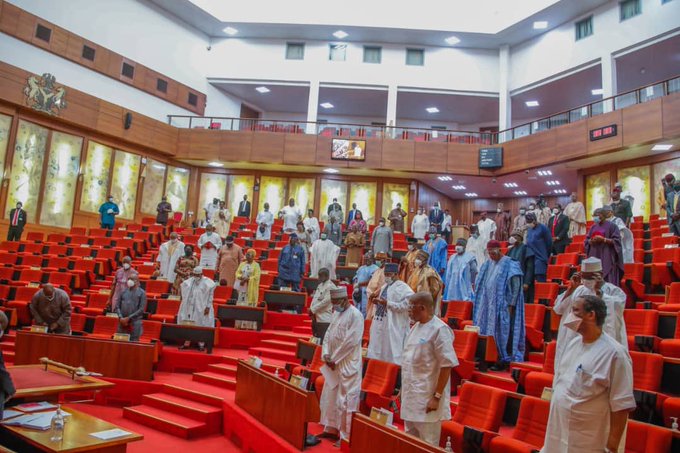
The Senate has set up a 12-member conference committee to harmonise differences between its version of the Electoral Act (Amendment) Bill and the version earlier passed by the House of Representatives.
The decision was announced by the Senate President, Godswill Akpabio, during an emergency plenary session held on Tuesday at the National Assembly in Abuja.
According to Akpabio, the committee was expanded from the initially proposed nine members to 12 after consultations with Senate leadership, in order to ensure wider representation and faster resolution of contentious issues.
“After consultation with the leadership, we have moved the number from nine to 12. I will now read out the names of the conference committee members from the Senate,” Akpabio said during the session.
The committee is chaired by former Plateau State Governor, Senator Simon Bako Lalong. Other members are Senator Mohammed Tahir Monguno, Senator Adamu Aliero, Senator Orji Uzor Kalu, Senator Abba Moro, Senator Asuquo Ekpenyong, Senator Aminu Iya Abbas, Senator Tokunbo Abiru, Senator Niyi Adegbonmire (SAN), Senator Jibrin Isah, Senator Ipalibo Banigo, and Senator Onyekachi Nwebonyi.
The role of the conference committee is to meet with a similar committee from the House of Representatives and resolve areas of disagreement in the Electoral Act Amendment Bill before it is sent to the President for assent.
Akpabio urged the committee to treat its assignment as urgent, noting that electoral reforms are critical to Nigeria’s democratic process.
“When you meet, you should recognise that this is a matter of urgency,” he said. “I believe that if you are able to conclude within the next few days or one week, the President should be able to sign the amended Electoral Bill into law within the month of February.”
He added that once the harmonisation process is completed, the final version of the bill would be transmitted promptly to President Bola Ahmed Tinubu for assent.
The Senate President then struck the gavel to formally constitute the committee.
Tuesday’s emergency plenary session was marked by moments of tension and interruptions, as lawmakers disagreed sharply over provisions in the bill, especially those relating to the electronic transmission of election results.
Several senators spoke at the same time, while others attempted to interrupt proceedings, making it difficult at some points to maintain order in the Red Chambers.
The disagreements became more pronounced after a motion was raised by Senator Tahir Monguno, who suggested that the Senate should reverse its earlier approval of Clause 60(3) of the Electoral Act (Repeal and Enactment) Bill, 2026.
Clause 60(3) of the bill deals with how election results should be transmitted from polling units to the Independent National Electoral Commission (INEC).
Last week, the Senate amended the clause by removing the requirement for real-time electronic transmission of results. Instead, it retained the provision in the 2022 Electoral Act, which gives INEC the power to decide the mode and timing of result transmission.
This decision sparked widespread criticism from opposition parties, civil society organisations, and members of the public, who argued that removing “real-time” transmission weakens transparency and opens the door to manipulation.
In response to the controversy, Akpabio aligned himself with a proposal recognising electronic transmission as the primary method of sending results, while allowing manual submission of results using Form EC8A only in cases where technical failure occurs.
The proposal led to heated debate among senators. Senator Enyinnaya Abaribe called for individual voting on the matter so that each senator’s position would be clearly recorded.
However, after further discussions, Abaribe later withdrew his request, allowing deliberations to continue without a formal division.
Despite the disagreements, Senate leaders maintained that there was broad support for electronic transmission among lawmakers.
The emergency plenary session was convened following strong public backlash over the Senate’s amendments to the Electoral Act, particularly on electronic transmission of election results.
In recent days, protests have taken place in Abuja and other parts of the country. One of the major demonstrations was the Occupy National Assembly protest, where civil society groups, opposition parties, and concerned citizens gathered to demand mandatory real-time electronic transmission of results.
Prominent political figures, including former Anambra State Governor Peter Obi and former Minister of Transportation Rotimi Amaechi, also joined calls for stronger electoral transparency.
Protesters argued that Nigeria’s past elections have been plagued by result manipulation, delays, and lack of trust, and that real-time electronic transmission is necessary to restore confidence in the process.
In response to the criticism, Senate President Akpabio clarified that the Senate had not rejected electronic transmission of results.
According to him, the decision to remove the words “real time” was meant to avoid legal and operational problems that could arise from network failures in remote areas.
He explained that insisting on real-time transmission without considering poor network coverage could lead to court cases that might invalidate elections.
Akpabio said the Senate wanted to give INEC the flexibility to manage elections effectively, especially in areas where technology may fail.
While critics insist that the amendment weakens transparency, several senators have argued that the disagreement is more about wording than substance.
They say a majority of senators support electronic transmission in principle and that manual collation is only intended as a backup, not a replacement.
According to them, the Senate’s goal is to strike a balance between transparency and practical realities on the ground.
The newly formed conference committee is expected to work with its House of Representatives counterpart to agree on a final version of Clause 60(3) and other disputed sections of the bill.
Once both chambers agree on a unified text, the bill will be passed again and sent to President Tinubu for assent.
The outcome of the committee’s work is expected to shape the future of elections in Nigeria. Many Nigerians are watching closely, hoping that the final law will strengthen transparency, reduce disputes and improve trust in the electoral system.