
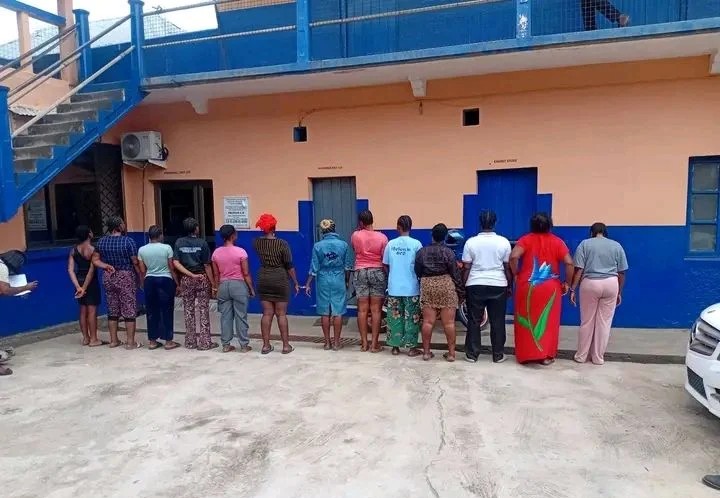
Police in Ghana’s Eastern Region have arrested 13 suspected commercial sex workers, including 12 Nigerians and one Ghanaian, during a special operation in Koforidua. Two other suspects, a landlord and a bouncer, were also picked up in connection with the case.
The arrests were carried out by officers of the New Juaben South Municipal Police Command on Monday, February 10, 2026. The operation followed a complaint by a 30-year-old Nigerian woman, Stella Godwill, who alleged that she was trafficked from Nigeria to Ghana for prostitution.
According to the Municipal Police Commander, Superintendent Ransford Nsiah, the complainant told police she had been brought into Ghana by a woman identified as Christabel Simon Monday. She alleged that she was forced into commercial sex work and given a daily earnings target of 400 Ghana cedis.
The woman claimed that on the day of the incident, she was only able to make 250 cedis. She alleged that her handler, whom she described as a “queen mother,” and the woman’s boyfriend, Simon Kwarteng, assaulted her for failing to meet the daily target.
Police said they acted quickly after receiving the complaint on February 6. Officers began investigations and traced the main suspect to Dabiasem, a suburb of New Juaben. Christabel Monday was arrested there.
Further investigations led officers to a suspected brothel in the same area, where 12 more suspects were arrested. Police said condoms and other items were recovered during the operation.
Superintendent Nsiah said the arrests are part of ongoing efforts to address prostitution and human trafficking in the region. He added that the suspects will be put before the court after investigations are completed.
Police said the case began when Stella Godwill reported that she had been assaulted because she failed to meet a daily income target set by her alleged trafficker.
“Last Sunday, we received a complaint from another Nigerian lady that she had been assaulted by her mistress, whom we normally call a ‘queen mother.’ The assault happened because she could not meet the daily target of GH¢400 set by the queen mother,” Superintendent Nsiah said.
The police commander explained that after the report was filed, officers launched a targeted operation to rescue other possible victims and dismantle the network behind the operation.
During the raid, officers also arrested a man accused of converting his property into a brothel. According to police, the landlord allegedly charged the women GH¢25 per day to stay in the building.
“We also arrested another man who had constructed a house and turned it into a brothel where the women are staying. He collects GH¢25 per day from them. So far, about 15 persons, aged between 15 and 32 years, are in police custody and will be put before the court immediately,” Superintendent Nsiah said.
Police later confirmed that about 15 suspects, aged between 15 and 31, are currently in custody. Authorities said one of the suspects is a minor and has been separated from the others for protection. Arrangements are being made with the Department of Social Welfare to ensure proper care and support.
Assistant Superintendent of Police Augustine Kusi Asante, the Municipal Crime Officer, warned landlords against allowing their properties to be used for illegal activities. He noted that Section 277 of Ghana’s Criminal Offences Act, 1960, makes it a crime to operate a brothel. The law prescribes penalties including fines or imprisonment.
Police said the suspects are believed to have violated Sections 273, 274, and 277 of the Act, which deal with prostitution, human trafficking, and brothel operations.
The involvement of a minor in the case has raised serious concern among authorities. Police stressed the need for stronger cooperation between the public and law enforcement agencies to protect vulnerable young people.
The latest arrests have once again brought attention to the problem of human trafficking between Nigeria and Ghana. Both countries share close ties, and many West Africans move across borders in search of better economic opportunities.
However, security agencies in both nations have repeatedly warned about trafficking networks that lure young women with promises of jobs in hospitality, sales, or domestic work. In many cases, victims are later forced into prostitution under harsh conditions.
In recent years, Ghanaian authorities have uncovered several similar syndicates operating in parts of Accra, Kumasi, and the Eastern Region. Many of the victims were reportedly recruited from Nigeria and transported across the border without proper documentation.
Nigeria has also faced challenges with human trafficking. The National Agency for the Prohibition of Trafficking in Persons (NAPTIP) has rescued and rehabilitated many victims over the years. The agency has continued to warn young Nigerians about offers that seem too good to be true, especially those involving travel abroad.
The Economic Community of West African States (ECOWAS) allows free movement of citizens within member countries, including Nigeria and Ghana. While this policy supports trade and unity in the region, it has also been exploited by criminal networks involved in trafficking.
Ghanaian police say investigations into the Koforidua case are ongoing. They are working to determine whether the suspects are part of a larger trafficking network operating in the Eastern Region.
Authorities have urged members of the public to provide useful information that can help dismantle such networks. They stressed that trafficking and exploitation not only harm victims but also damage the image of the countries involved.
Community leaders in Koforidua have also expressed concern about the development. Some residents say the presence of brothels in residential areas affects security and public morals.
As the suspects prepare to face court proceedings, attention will likely focus on the role of those who recruit, transport, and profit from the exploitation of vulnerable women and girls.