
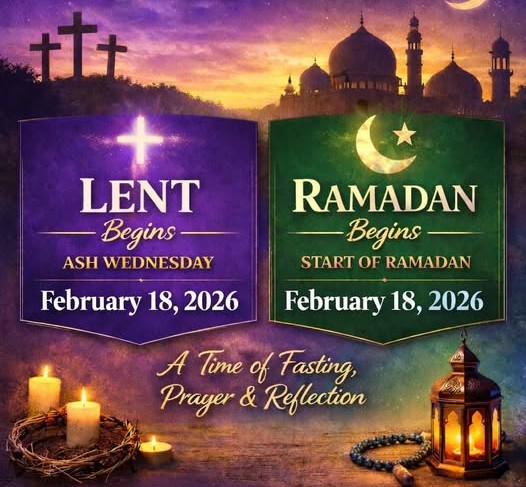
Millions of Muslims and Christians across the world have begun the sacred seasons of Ramadan and Lent today, marking periods of prayer, fasting, and spiritual renewal in both faiths.
The two religious observances, though different in practice and tradition, share common themes of self-discipline, charity, repentance, and closer devotion to God. In Nigeria, a country with a large population of both Muslims and Christians, the start of Ramadan and Lent holds deep religious and social importance.
Saudi Arabia Supreme Court on Tuesday announced the sighting of the crescent moon, which marks the beginning of Ramadan 1447 in the Islamic calendar.
With the sighting of the Hilal, the holy month of Ramadan began at sunset on Tuesday, with special Taraweeh prayers observed after the Isha prayer. Muslims in Saudi Arabia, Nigeria, Qatar, the United Arab Emirates and several other countries began fasting at dawn on Wednesday.
Ramadan is the ninth month of the Islamic lunar calendar. It is regarded as one of the holiest months in Islam because Muslims believe it was during this month that the Qur’an was first revealed to Prophet Muhammad.
During Ramadan, Muslims fast daily from dawn until sunset. They abstain from food, drink, and other physical needs during daylight hours. The fast is broken each evening with a meal known as iftar. The pre-dawn meal is called suhoor.
Beyond abstaining from food and drink, Muslims are encouraged to increase prayers, give charity, read the Qur’an, and avoid bad habits such as gossip, anger, and dishonesty. The month ends with the celebration of Eid al-Fitr.
In Nigeria, the President-General of the Nigerian Supreme Council for Islamic Affairs and Sultan of Sokoto, Sa’ad Abubakar, officially declared Wednesday, February 18, 2026, as the first day of Ramadan 1447.
According to a statement signed by the Chairman of the Advisory Committee on Religious Affairs, Prof. Sambo Wali Junaid, the crescent moon was sighted in many parts of the country on Tuesday, the 29th day of Sha’aban.
The Sultan said the council received reports of moon sighting from Islamic leaders across Nigeria, confirming that Muslims should begin fasting on Wednesday in line with Islamic teachings.
He called on Muslims across the country to use the holy month to pray for Nigeria’s leaders and for peace and security. Nigeria has in recent years faced security challenges, including banditry, kidnapping, and communal clashes. Religious leaders often use Ramadan as a period to encourage prayers for unity and stability in the country.
While many countries began fasting on Wednesday, others announced a different date. Japan, Oman, Singapore and Turkey said Ramadan 2026 would begin on Thursday, February 19. The difference is due to variations in moon sighting methods and time zones.
At the same time, Christians around the world have begun the season of Lent, which starts with Ash Wednesday. Lent is a 40-day period of prayer, fasting and repentance leading up to Easter Sunday, when Christians celebrate the resurrection of Jesus Christ.
The 40 days of Lent reflect the 40 days Jesus is believed to have fasted in the wilderness, according to the Bible. During this period, many Christians give up certain pleasures or habits as a sign of sacrifice and spiritual focus.
In his 2026 Lenten Message released ahead of Ash Wednesday, Pope Leo XIV urged Christians to practise a different kind of fasting — abstaining from hurtful and offensive words.
The message, published on the website of Vatican, described refraining from harmful speech as a “very practical and frequently unappreciated form of abstinence.”
“I would like to invite you to a very practical and frequently unappreciated form of abstinence: that of refraining from words that offend and hurt our neighbour,” the Pope said.
He explained that Lent is not only about giving up food but also about changing the heart. According to him, every journey of repentance begins when a person allows the word of God to touch the heart, leading to a renewed commitment to follow Christ.
The Pope stressed the importance of listening — both to God and to other people. He said that in a world filled with many voices, Christians must learn to listen carefully, especially to those who are suffering.
“In the midst of the many voices present in our personal lives and in society, Sacred Scripture helps us to recognise and respond to the cry of those who are anguished and suffering,” he said.
He urged Christians to show kindness and respect in their families, workplaces, churches, on social media, and even in political discussions.
According to him, if believers learn to control their language and avoid harsh words, society would see more peace and understanding.
In Nigeria, where Islam and Christianity are the two major religions, it is not unusual for Ramadan and Lent to overlap. When this happens, many Nigerians see it as a special period of reflection for the entire nation.
Religious leaders often call for interfaith harmony, urging both Muslims and Christians to respect each other’s practices. In many communities, neighbours share food during iftar in Ramadan and also support one another during Christian observances.
Fasting in both religions is not only about hunger. It is meant to build self-control, compassion for the poor, and a deeper awareness of God. Both faiths also place strong emphasis on charity during this period. Muslims are encouraged to give zakat and sadaqah, while Christians are urged to give alms to the needy.
As the seasons of Ramadan and Lent begin, many Nigerians are expressing hope that the period will bring peace, healing and unity to the country.
For the next one month, Muslims will gather in mosques for nightly Taraweeh prayers and observe daily fasting, while Christians will attend church services, receive ashes on Ash Wednesday, and prepare spiritually for Easter.
Though their paths differ, the message at the heart of both seasons is similar — to seek forgiveness, practice self-discipline, and work towards a more peaceful and caring society.
As millions bow in prayer from Abuja to Rome, from Sokoto to Saudi Arabia, the world once again enters a sacred time of reflection, sacrifice and hope.