
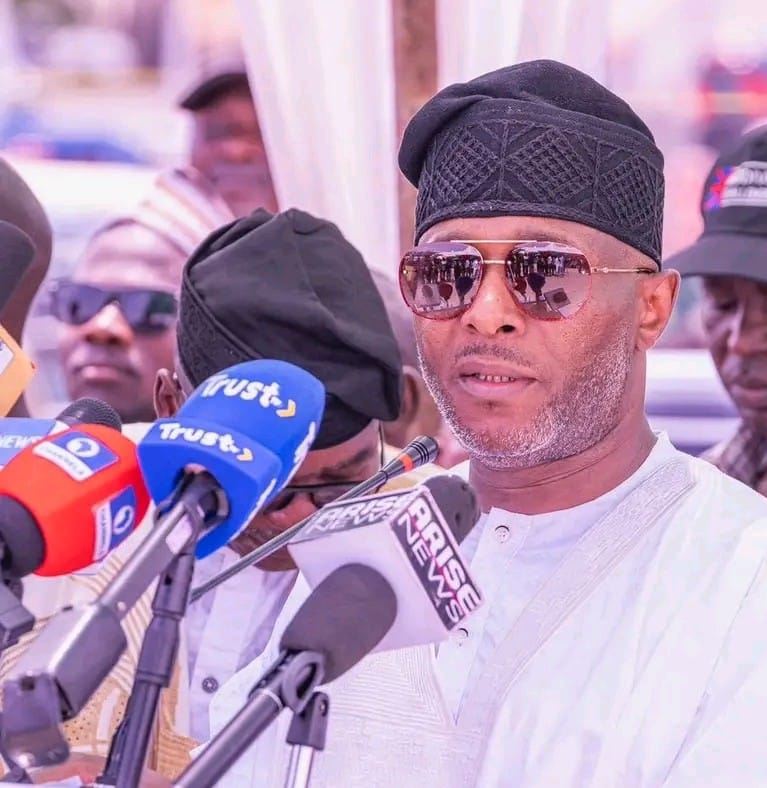
Adamu Atiku Abubakar, the first son of former Vice President Atiku Abubakar, has resigned from his position as Commissioner for Works and Energy Development in Adamawa State.
His resignation was contained in a letter dated March 2, 2026, and addressed to the Governor of Adamawa State, Ahmadu Umaru Fintiri.
In the letter, Adamu said his decision followed “deep personal reflection and careful consideration.” He stated that his resignation takes effect from March 2, 2026.
“I write to formally tender my resignation from the office of Honourable Commissioner for Works and Energy Development, Adamawa State, effective from today, 2nd March, 2026,” the letter read.
He described his time in office as a privilege and thanked Governor Fintiri for giving him the opportunity to serve.
“It has been a rare honour and privilege to serve under your visionary leadership and to contribute, in my modest capacity, to the infrastructural growth and development of our dear state,” he stated.
Adamu also expressed appreciation to the people of Adamawa State for their support during his time in office. He thanked them for their understanding and prayers while he carried out his duties.
He ended the letter with prayers for the governor, asking Allah to guide and strengthen him in the service of the state.
Adamu’s resignation comes just days after a major political development in Adamawa State. On February 27, 2026, Governor Fintiri and 22 commissioners formally announced their defection from the Peoples Democratic Party (PDP) to the All Progressives Congress (APC).
However, Adamu was noticeably absent from the list of commissioners who accompanied the governor during the announcement.
Before his resignation, there had been reports that he chose not to defect to the APC with the governor and other members of the state executive council. His absence from the defection event raised questions about his political position.
The defection of Governor Fintiri and his cabinet members has reshaped the political landscape in Adamawa. The state has long been considered a stronghold of the PDP. The movement of top officials to the APC is seen as a major shift ahead of future elections.
Adamawa State has played an important role in Nigeria’s political history. It is the home state of Atiku Abubakar, who served as Vice President of Nigeria from 1999 to 2007 and has been a key figure in national politics for many years.
Adamu Atiku Abubakar’s appointment as commissioner was seen by some as a move that brought both political and administrative experience into the state cabinet. As Commissioner for Works and Energy Development, he was responsible for supervising infrastructure projects, including roads and energy initiatives.
The Ministry of Works and Energy Development is a key ministry in any state government. It oversees road construction, public buildings, and sometimes rural electrification projects. These areas are important for economic growth and daily life.
During his time in office, the Adamawa State Government focused on improving infrastructure, especially road networks in both urban and rural communities. Though Adamu described his contribution as modest, government officials had previously highlighted ongoing projects aimed at improving connectivity across the state.
His resignation now leaves a vacancy in one of the state’s strategic ministries. It is expected that Governor Fintiri will appoint a replacement in the coming days.
As of the time of filing this report, the Adamawa State Government has not released an official statement beyond acknowledging receipt of the resignation letter.
Some residents of Yola, the state capital, expressed surprise at the resignation but said they hope it will not slow down ongoing infrastructure projects.
“I just hope road projects and electricity plans will continue without delay,” said a civil servant who spoke on condition of anonymity.
Others believe the resignation highlights the changing political environment in the state. Party defections have become common in Nigeria, especially when elections approach. Politicians often switch parties for strategic reasons, including alliances and future ambitions.
In recent years, defections between the PDP and APC have shaped political control in several states. Such moves often lead to new alignments within state assemblies and local government councils.
For now, Adamu Atiku Abubakar has stepped away from his role in government. In his letter, he did not state his next political move or future plans.
.